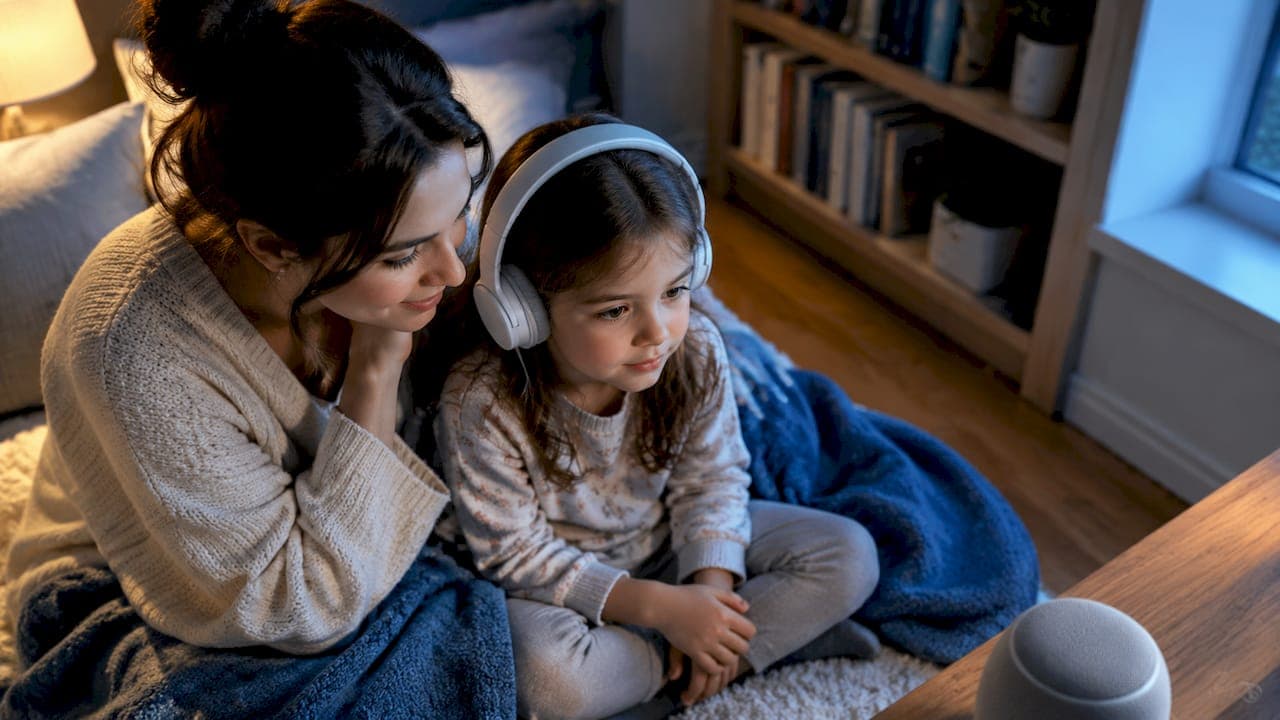
Yes, gentle superheroes exist, and the best ones for sensitive kids are helpers who solve problems with kindness, creativity, or teamwork instead of fists. If your child flinches at explosions or takes on-screen conflict to heart, go straight to the curated list below for books, cartoons, and audio picks built for ages 3 to 8.
TL;DR:
- Most gentle superheroes for sensitive kids focus on helping, problem-solving, or emotional support rather than fighting or violence.
- Books like Superheroes Don't Get Scared and Arnold the Super-ish Hero teach bravery through kindness, fear management, and internal strength.
- Cartoons such as Spidey and His Amazing Friends and Batwheels prioritize teamwork and low-stakes adventures, avoiding real danger or intense combat.
- Media with predictable pacing and resolution through help or dialogue help reduce anxiety and encourage emotional regulation in cautious children.
- Personalized audio stories that feature a child's name and traits can reinforce positive modeling and are highly effective for bedtime, with costs starting at $99 per month.
Table of Contents
- What Makes a Superhero Gentle Enough for Sensitive Kids?
- Why Gentle Heroes Actually Help Anxious Kids
- How to Choose and Introduce Gentle Superhero Stories
- Books, Cartoons, or Audio: Which Format Fits Your Child?
- Quick List: Gentle Superheroes to Try This Week
- Why This Matters More Than It Looks Like It Does
- A Screen-Free Way to Let Your Child Be the Hero
- Sources
- FAQ
What Makes a Superhero Gentle Enough for Sensitive Kids?
A gentle superhero, in practical terms, is one whose main power is helping rather than fighting. The best options for anxious or sensory-sensitive children swap villain battles for problem-solving, teamwork, or emotional courage. That distinction matters more than character popularity. A hero who talks a scared friend through a hard moment teaches something different than one who punches a monster through a wall, and sensitive kids notice the difference immediately.
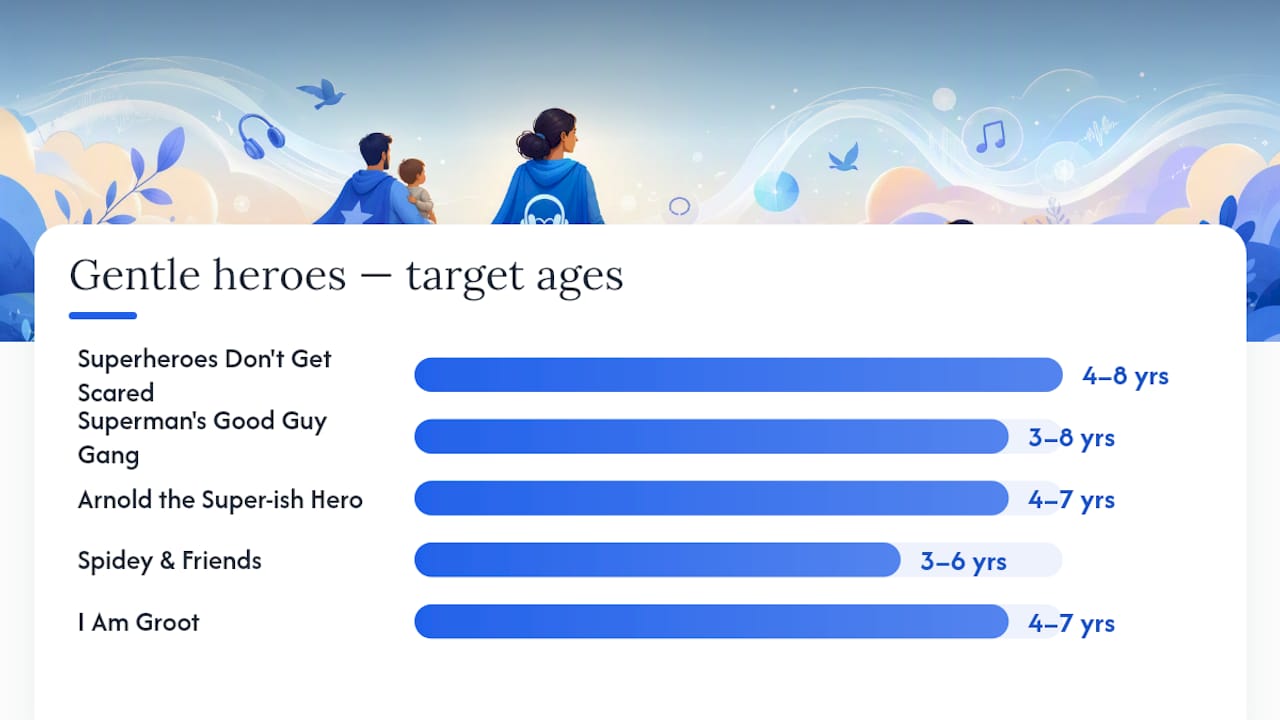
Here is a working roster of picture books, preschool cartoons, and character types that fit that mold, organized by format so you can find what matches your child's attention span and fears.
Books that reframe bravery as an inside job:
- Superheroes Don't Get Scared by Kate Thompson. This picture book normalizes fear itself, showing that even the mightiest heroes feel scared and that bravery means acting anyway. It works well for ages 4 to 8 and shows up in most bookstores and library systems.
- Superman's Good Guy Gang by Rob Justus. A lighter, sillier take where the "power" is being a decent person, marketed for kids around ages 3 to 8 who need bravery, sharing, and fear management modeled without a single punch thrown.
- Arnold the Super-ish Hero, published by Kids Can Press. Arnold is not fast or strong. He is helpful, and the book treats that as a real superpower. It fits best-for ages 4 to 7 and works especially well for kids who feel like they do not measure up to louder, flashier friends. The Kids Can Press product page describes it as a kindness-forward underdog story, good for a quiet character-education moment at bedtime.
- Hank the Brave. Hank freezes when he is scared rather than lashing out, which mirrors how many sensitive kids actually respond to fear. The publisher's own framing targets ages 4 to 7 and treats quiet, relational courage as just as valid as loud heroics.
- Look for Supertato-style picture books too. These lean into cartoonish, low-stakes conflict (a runaway pea, a mischievous vegetable villain) where nothing is ever truly threatening, which suits ages 3 to 5 especially well.
Cartoons built for small viewers, not big drama:
- Spidey and His Amazing Friends. This preschool adaptation strips out real danger and keeps the focus on teamwork between kid-versions of familiar Marvel characters. Media roundups consistently flag it as appropriate for very young viewers, roughly ages 3 to 6, and it streams on Disney+.
- Batwheels. The heroes here are sentient vehicles, not fighters, which removes physical conflict almost entirely while keeping the Batman aesthetic kids recognize. It suits ages 3 to 6 and streams on Max and Cartoon Network platforms.
- I Am Groot. These shorts are quiet, funny, and almost entirely dialogue-light, following baby Groot through small, low-stakes adventures. They work for ages 4 to 7 and stream on Disney+.
Notice what is missing from this list: no live-action Avengers battles, no Batman fight sequences, no villain origin stories with real menace. Those versions of these characters exist, and they are fine for older kids, but they are the wrong entry point for a child who covers their eyes during previews.
Why Gentle Heroes Actually Help Anxious Kids
Peer-reviewed child development research backs up what a lot of parents already sense intuitively. Literature on children's media notes that seeing non-aggressive or empathetic role models helps kids accept their own quiet or shy tendencies rather than feeling pressure to perform bravado they do not feel. A child who is naturally cautious does not need a hero who solves every problem through force. They need one who solves problems the way they might actually solve them.
The research signal: child development literature consistently ties non-aggressive hero modeling to stronger emotional regulation, not just gentler play, because kids rehearse the coping strategies they watch.
Pacing matters just as much as content. A story with predictable structure, where the scary part resolves quickly and the consequences make sense, lowers anxiety in a way that unpredictable, high-stimulation action sequences cannot. Sensitive kids are often reacting less to the danger on screen and more to the uncertainty of what happens next. A book you can flip back through, or a cartoon episode with a formula they already know, gives them a sense of control that a loud, fast-cut fight scene never will.
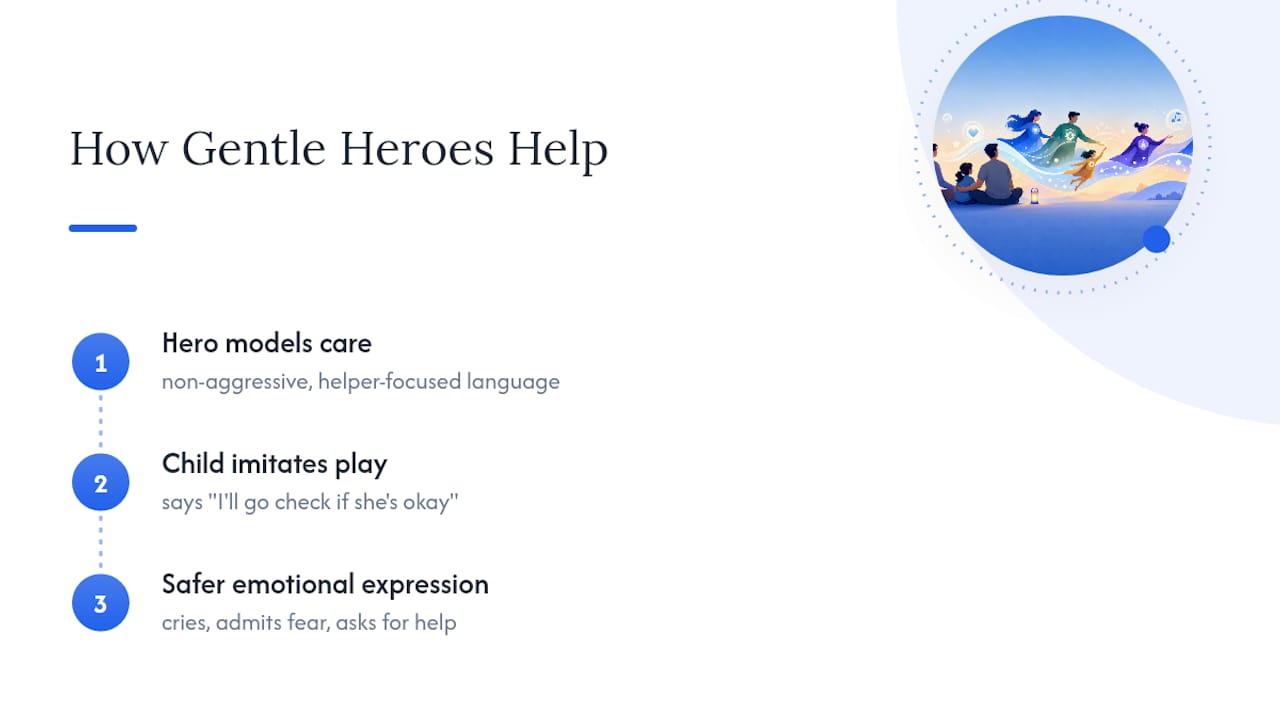
You will see the payoff in ordinary moments, not just during story time. Kids who spend a few weeks with helper-focused heroes tend to bring that language into their own play: "I'll go check if she's okay" instead of "I'll save her from the monster." Sharing improves. Emotional expression gets safer because the hero they are imitating cries, admits fear, or asks for help without losing status. That is the whole mechanism in miniature: kids copy what they watch, so give them something worth copying.
How to Choose and Introduce Gentle Superhero Stories
Picking the right title takes about thirty seconds once you know what to check for. Use this quick filter before you commit to a new book or show:
- Check the tone in the first two pages or first scene. Loud, dark, or tense openings usually predict a loud, dark, or tense middle.
- Confirm the conflict resolves through help, not force. Villains who get talked down, redirected, or simply forgiven are a good sign; villains who get punched into submission are not.
- Look for pacing you control. Books win here because you set the speed. Streaming shows are close behind if episodes run under 12 minutes.
- Match the age band honestly. A story rated for 7 year olds can overwhelm a sensitive 5 year old even if the reading level fits.
When your child's play starts drifting toward aggressive superhero battles, redirection scripts work better than a flat "no." Try these:
- Instead of "stop fighting," say: "Show me how your hero helps the bad guy feel better instead."
- If a toy becomes a weapon, ask: "What does your hero notice that nobody else sees?"
- When a game escalates, redirect with: "Your hero's real power is patience. Let's use that one."
Pro Tip: Keep one "gentle hero" book or episode in permanent bedtime rotation, even after your child moves on to new favorites. Familiar, low-stakes stories work as a reliable wind-down tool exactly because there is no surprise left in them.
If your child currently watches something more intense, transition gradually rather than cutting it off cold. Pair the swap with something they already trust, like a familiar bedtime routine, so the change reads as an addition rather than a punishment.
Books, Cartoons, or Audio: Which Format Fits Your Child?
Each format offers a different kind of control, and the right pick depends less on age and more on how your child processes stimulation.
- Books give you the most control over pacing since you decide how fast to turn the page, and you can skip a page entirely if a scene feels too intense. Titles like Superheroes Don't Get Scared and Arnold the Super-ish Hero work well here. Best for ages 3 to 8, found at bookstores and public libraries.
- Preschool cartoons add social modeling that books cannot, since kids watch characters react to each other in real time. Spidey and His Amazing Friends and Batwheels fit ages 3 to 6 best, both streaming on Disney+ and Max respectively.
- Audio and podcasts remove visual overstimulation entirely, which matters for kids who get overwhelmed by fast cuts or bright screens even when the content itself is gentle. Personalized formats where the child becomes the hero of their own story take this further, letting a child hear their own name modeled as brave and kind rather than watching someone else be brave for them. This format suits ages 4 to 9 and works especially well at bedtime, when a screen would otherwise disrupt sleep. Our guide to superhero podcasts for 5 to 7 year olds breaks down more picks by age.
Quick List: Gentle Superheroes to Try This Week
- Superheroes Don't Get Scared (book, ages 4 to 8): normalizes fear itself, so bravery never requires pretending not to be scared. Find it at any major bookstore or library.
- Arnold the Super-ish Hero (book, ages 4 to 7): kindness as the actual superpower, no combat involved. Available through Kids Can Press and most retailers.
- Hank the Brave (book, ages 4 to 7): for kids who freeze rather than fight, modeling quiet courage.
- Spidey and His Amazing Friends (cartoon, ages 3 to 6): teamwork over combat, streams on Disney+.
- Batwheels (cartoon, ages 3 to 6): sentient vehicles instead of fighters, nearly conflict-free. Streams on Max.
- I Am Groot (short-form cartoon, ages 4 to 7): quiet, low-dialogue mini-adventures. Streams on Disney+.
- Personalized superhero audio stories (podcast, ages 4 to 9): screen-free, paced by the listener, and centered on the child's own name and traits rather than a fictional character's. Our audio learning guide covers what to look for in a bedtime listening routine.
Keep two or three of these in rotation rather than one. Sensitive kids often latch onto whichever story arrives at the right emotional moment, and having options on hand beats scrambling for a substitute when a meltdown is already underway.
Why This Matters More Than It Looks Like It Does
Parents often treat "gentle superhero" as a nice-to-have, a softer alternative for kids who just are not ready for the real thing yet. That framing gets it backwards. The kids who need helper-focused heroes most are usually the ones paying the closest attention to what they watch, which means the lessons land harder, not softer.
The pattern that stands out across families using these stories is not that anxious kids avoid superhero content altogether. They gravitate toward it, just like every other kid their age. What changes is what they do with it. A child who absorbs a story where the hero's power is patience will rehearse patience. A child whose hero problem-solves through empathy will try empathy first before escalating. Personalized formats push this further, because a child hearing their own name modeled as brave processes that differently than watching someone else be brave. It stops being aspiration and starts being rehearsal. For families exploring that route, our piece on tailored superhero adventures for kids ages 4 to 9 walks through how that personalization actually works in practice.
— JG
A Screen-Free Way to Let Your Child Be the Hero
G45-hero-cast turns the "helper superhero" model into something built entirely around your own child, not a licensed character they are borrowing for an hour. Every week, we produce a personalized audio adventure where your child stars as the hero, using their real name, age, and interests, delivered straight to a private podcast feed with no screen involved.
For a sensitive kid, that personalization changes the emotional stakes. They are not watching someone else be brave. They are hearing themselves be brave, at a pace they control, without a single flashing screen to overstimulate them before bed. It fits naturally into the same bedtime routine that works with books like Superheroes Don't Get Scared, just with your child as the main character instead of a stranger. Grandparents can join in too, since the Grandparent Gift plan runs $999 per year and delivers the same weekly episodes to a child's private feed.
If you want to try it with your own family, the Bedtime Standard plan runs $99 per month and gets your child their first personalized episode this week.
Sources
- PubMed Central (PMC) article on child development perspectives
- Superheroes Don't Get Scared — Penguin Random House
- 10 Best Marvel & DC Cartoons For Young Kids — ScreenRant
- Superman's Good Guy Gang — Target product listing
FAQ
Who is the friendliest superhero for a sensitive child?
Arnold from Arnold the Super-ish Hero and the cast of Superman's Good Guy Gang both frame kindness as the actual power, making them among the gentlest entry points for kids who dislike conflict.
Which superhero do young kids gravitate toward most?
Preschoolers consistently respond to Spidey and His Amazing Friends because the stakes stay low and the focus stays on teamwork, which studios have specifically engineered for very young viewers.
What are some good kid-friendly superhero comics or books?
Superheroes Don't Get Scared, Superman's Good Guy Gang, and Arnold the Super-ish Hero all replace physical conflict with courage, kindness, and problem-solving, making them solid picks for ages 3 to 8.
What superhero has heightened senses, and is that intense for a sensitive kid?
Spider-Man's heightened senses are part of his classic comic mythology, but the preschool adaptation Spidey and His Amazing Friends dials that trait down into simple, non-threatening moments rather than overwhelming sensory sequences.
How much does G45-hero-cast cost?
The Bedtime Standard plan is $99 per month, and the Grandparent Gift plan is $999 per year, both available directly on the G45-hero-cast site.