
The right podcast format depends almost entirely on age. Soothing story shows with short episodes work well for preschoolers; serialized science adventures with longer episodes suit older elementary kids; and tweens are ready for investigative narrative formats that assume they can hold a storyline across episodes. Here is the quick breakdown before the full guide:
TL;DR by age bucket:
- Preschool (ages 2–4): Gentle story-driven or music-based shows with short episodes. Best for bedtime or quiet play.
- Early elementary (ages 5–7): Short science, humor, or personalized adventure formats with brief episodes. Great for car rides and co-listening.
- Older elementary (ages 8–9): Inquiry-based or serialized fiction with moderate-length episodes. Works well for independent listening or homework wind-down.
- Tweens (ages 10–12): Investigative, game-show, or narrative serial formats with longer episodes. Ideal for commutes or solo listening.
Table of Contents
- Age-appropriate podcasts: what works at each stage
- How to pick a show: a quick checklist for parents
- Where to find kid-friendly podcasts and how to manage listening
- How to get more from podcasts: co-listening and conversation
- Safety: how to screen episodes and keep listening age-appropriate
- Why audio works for children, and a recommended option for ages 4–9
- Key Takeaways
- Why thoughtful audio beats passive background noise
- Superhero Sounds: weekly personalized podcasts for ages 4–9
- Useful sources for parents
Age-appropriate podcasts: what works at each stage
Attention span and comprehension grow fast between ages 2 and 12, and the format that captivates a kindergartner will bore a fifth-grader inside two minutes.
Preschool (ages 2–4)
Preschoolers need repetition, warmth, and a calm pace. Music-based shows and short bedtime stories work best here. Episodes should stay brief. Co-listening is not optional at this stage; it is how the content actually lands. A parent or caregiver sitting alongside the child, pausing to name characters or repeat a funny line, turns a passive audio moment into genuine connection.

Early elementary (ages 5–7)
Kids in this range are ready for a little mystery and humor. Science curiosity shows, short adventure stories, and personalized audio formats all hold attention well. Educational podcasts for elementary students typically run brief episodes for curious-learner-focused formats, which aligns well with the attention windows of younger elementary children. Car rides are the sweet spot for this age group; the captive setting helps them stay with a story from start to finish.

Older elementary (ages 8–9)
By age 8 or 9, kids can follow a serialized story across multiple episodes and enjoy shows that challenge them with real vocabulary and cause-and-effect reasoning. Episode lengths of moderate duration feel natural. A science-focused kids' show like The Curious Kidcast lists an age range and keeps episodes relatively short, which gives you a useful benchmark when evaluating similar shows. Independent listening becomes realistic here, though a short debrief question after the episode keeps comprehension sharp.
Tweens (ages 10–12)
Tweens respond to formats that treat them as smart. Investigative storytelling, game-show structures, and longer serialized fiction all work. Some family-friendly adventure serials note that episodes should be listened to in order, which is worth checking before you hand a tween a show mid-season. Episodes of longer duration are appropriate for this group.
Episode length and format at a glance:
| Age group | Recommended episode length | Best formats |
|---|---|---|
| Preschool (2–4) | Short episodes | Bedtime stories, music-based, gentle narrative |
| Early elementary (5–7) | Brief episodes | Science curiosity, humor, personalized adventure |
| Older elementary (8–9) | Moderate-length episodes | Serialized fiction, inquiry-based, STEM |
| Tweens (10–12) | Longer episodes | Investigative narrative, game shows, serial drama |
Research note: Tinkercast's educational podcast roundup confirms that shorter episodes suit curious-learner shows and somewhat longer episodes fit more complex educational narratives — a range that maps directly onto the early-to-older elementary transition above.
How to pick a show: a quick checklist for parents
Three steps before you press play on anything new:
- Sample one episode yourself. Five minutes is enough to gauge pacing, host tone, and whether the content matches your child's age.
- Read the episode description. A vague title like "Episode 47" with no summary is a red flag. Good children's shows tell you exactly what the episode covers.
- Check the stated age range and runtime. Publisher pages often list both. If neither is visible, treat the show as unvetted.
Criteria to evaluate:
- Pacing and voice tone. Calm, clear delivery with natural pauses signals a show designed for children. Rapid-fire, hyper-stimulating pacing is a sign the format prioritizes novelty over comprehension.
- Topic complexity. Does the content assume prior knowledge without signposting? A show that drops in jargon without explanation will frustrate a 6-year-old and disengage a 9-year-old.
- Language and themes. Listen for casual profanity, fear-based humor, or themes (violence, adult relationships) that don't belong in a children's show.
- Ads and sponsorships. Note whether the show runs mid-roll ads, host-read sponsorships, or is fully ad-free. This matters more for younger listeners who cannot distinguish advertising from content.
- Supplemental materials. Activity sheets, episode guides, or transcripts are a strong signal that the creators thought carefully about their audience.
Red flags to watch for:
- Fast, repetitive pacing with no narrative arc
- Ads for adult products (insurance, alcohol, financial services) appearing in a "kids" show
- No stated age range anywhere on the show page
- Episodes that reference earlier content without any recap
Where to find kid-friendly podcasts and how to manage listening
Common Sense Media's podcast lists let you filter by age group (preschool, little kids, big kids, tweens), which cuts discovery time significantly. Apple Podcasts' Kids & Family category organizes shows by age and series type, making it a reliable starting point on any Apple device.
Platform and management options:
| Discovery route | Best for | Notes |
|---|---|---|
| Common Sense Media podcast lists | Vetted picks by age and theme | Free; filters by age group |
| Apple Podcasts Kids & Family | Apple device users | Age sub-navigation built in |
| Publisher/show websites | Checking age range and episode length | Most reliable source for runtime data |
| Private subscription feeds | Personalized or premium content | Delivered by email; no open platform needed |
For day-to-day management, create a dedicated playlist on whatever app your household uses and download episodes for offline play before road trips or flights. On iOS, Screen Time lets you restrict podcast apps by age rating. On Android, Google Family Link offers similar controls. Private podcast feeds, like those used by subscription-based personalized shows, deliver episodes directly to a parent's email and bypass open platform discovery entirely, which removes the risk of a child stumbling onto an unvetted show.
Check every show's ad policy before subscribing. A show that is free on a public platform almost always runs ads; a paid or subscription-based feed is more likely to be ad-free. If a show runs host-read sponsorships, you can explain to older kids (8+) what a sponsorship is, which is a useful media literacy moment in itself.
How to get more from podcasts: co-listening and conversation
Passive background listening is the lowest-return way to use a good children's podcast. Active co-listening, where a parent or caregiver engages alongside the child, consistently raises both retention and the child's enjoyment. A few quick ways to make it count:
- Draw the scene. After an episode, ask your child to sketch a character or setting they imagined. No artistic skill required.
- Act out the ending. For story-based shows, pause before the resolution and ask what they think happens next, then play it out.
- Map cause and effect. Ask simple questions about character choices and outcomes to support comprehension.
- Vocabulary 'lightbulb' words. Pick one new word from the episode and use it in conversation.
- Episode scavenger hunt. Before playing, give your child one thing to listen for (a specific character name, a sound effect). It turns listening into a game.
Many shows also offer free printable activity sheets. Pairing one sheet with a single episode extends a 10–15 minute listen into a longer learning moment without adding screen time.
Pro Tip: Set a recurring Sunday listening slot. A predictable routine, same time, same spot, builds anticipation and makes the episode feel like an event rather than background noise. Follow it with one question: "What was the most surprising thing?" That single prompt does more for comprehension than a full debrief.
Safety: how to screen episodes and keep listening age-appropriate
A five-minute pre-screen catches most problems. Read the episode description first, then sample two to three minutes from the middle of the episode (not just the intro, which is often the most polished part). Listen for host tone, language register, and any ad breaks. Check whether the show page lists explicit ad disclosures or sponsored segments.
For younger children, private podcast feeds offer a meaningful safety advantage over open platforms. When a show is delivered to a parent's email and played through a dedicated app or feed reader, the child never browses a public library where unvetted content sits one tap away. Subscription-based personalized shows operate this way by design.
"The best children's podcasts respect the listener's intelligence — they favor inquiry-based formats and vocabulary-building segments over fast, repetitive, hyper-stimulating pacing." This principle, widely shared among children's audio creators, is also the most practical screening criterion a parent can apply in under five minutes.
When a show runs sponsorship reads, the host will typically say something like "this episode is brought to you by..." For children under 7, skip past those segments or choose ad-free alternatives. For older kids, a brief explanation ("that part is an advertisement, like a commercial") builds media literacy without making a big deal of it.
Why audio works for children, and a recommended option for ages 4–9
Audio lets children build mental images without the sensory load of a screen. There is no visual to track, no animation competing for attention; the story lives entirely in the child's imagination. Creators of well-regarded children's audio consistently note that thoughtful pacing and respectful content encourage longer attention and deeper comprehension than visually busy formats.
The episode-length evidence supports this. Tinkercast's research-informed roundup places the effective range at 10–30 minutes depending on complexity, which aligns with what educators observe about sustained attention in the 5–9 age range. Shorter is not always better; a well-paced 20-minute episode holds a 7-year-old longer than a choppy 8-minute one.
A recurring host or character across episodes also matters more than most parents expect. Familiarity with a voice lowers anxiety for younger listeners and helps them engage with topics that would otherwise feel too complex. This is one reason personalized audio, where the child's own name and traits appear in the story, tends to produce noticeably stronger engagement than generic formats.
For families with children ages 4–9 who want a ready-made, age-appropriate listening routine, Superhero Sounds by G45-hero-cast is worth a close look. Weekly personalized episodes, private feed delivery, no open-platform browsing, and a format built around the child as the hero check every criterion in the selection guide above.
Who Superhero Sounds fits best:
- Families wanting a weekly shared listening ritual with no curation effort
- Parents of children ages 4–9 who respond well to hearing their own name in a story
- Grandparents or relatives looking for a gift that delivers something new every week
- Households prioritizing ad-free, private-feed delivery over public platform browsing
For a deeper look at audio learning for kids and how personalized storytelling supports development, the G45-hero-cast blog covers the research in detail.
Key Takeaways
Matching episode length and format to your child's age is the single most reliable way to keep podcast listening engaging rather than frustrating.
| Point | Details |
|---|---|
| Match format to age | Preschoolers need 10–15 minute story shows; tweens can handle 15–30 minute serialized formats. |
| Preview before playing | Sample a middle segment and read the episode description before introducing any new show. |
| Co-listen with younger kids | Active co-listening raises retention; one follow-up question after an episode is enough. |
| Favor private or ad-free feeds | For children under 7, private subscription feeds remove open-platform browsing risk entirely. |
| G45-hero-cast Superhero Sounds | Weekly personalized superhero episodes for ages 4–9, delivered to a private feed, ad-free. |
Why thoughtful audio beats passive background noise
Most parents reach for a podcast the same way they reach for a TV show: something to fill the quiet. The difference is what happens after the episode ends. A well-matched audio show, one where the format fits the child's age and the content respects their intelligence, tends to spark a question or a drawing or a "what would YOU do?" conversation. A poorly matched one, or one running as background noise while the child does something else, produces none of that.
The personalization angle is underrated. A child who hears their own name as the hero of a story is not just entertained; they are building a sense of agency and narrative identity that generic content cannot replicate. For younger listeners especially, that familiarity with a recurring character or voice is what turns a one-time listen into a weekly ritual the child actually looks forward to.
Balancing audio with other activities matters too. Podcasts work best as a focused 15–20 minute experience, not as all-day ambient sound. Treat it like storytime: intentional, bounded, and followed by something the child can do with what they just heard.
Superhero Sounds: weekly personalized podcasts for ages 4–9
Every week, your child becomes the hero of their own audio adventure. G45-hero-cast's Superhero Sounds delivers a fully personalized episode to a private podcast feed every Sunday, built around your child's name, age, and interests. There is no browsing a public library, no ads, and no curation work on your end. Siblings can be included, and gift subscriptions are available for grandparents who want to give something that arrives fresh each week.
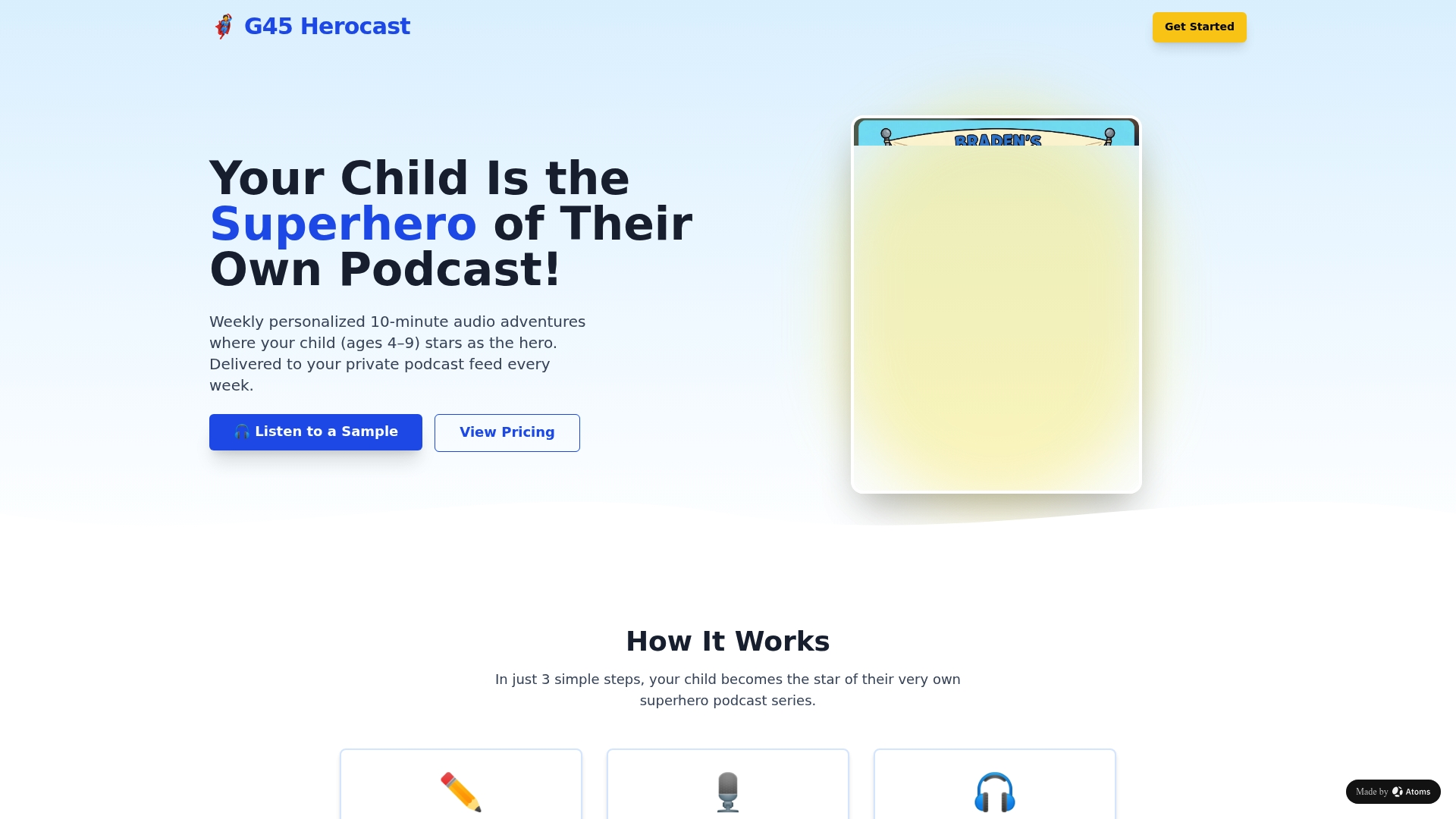
For families who want a low-effort, high-engagement listening routine that centers the child, this is the most direct path to it. Monthly and annual plans are available. Visit G45-hero-cast to start a subscription or send one as a gift.
Useful sources for parents
- Best Podcasts for Kids | Common Sense Media — age-filtered vetted picks across preschool through tween
- Apple Podcasts Kids & Family — platform category with age sub-navigation
- 6 Educational Podcasts for Elementary Students | Tinkercast — episode-length guidance and curriculum-aligned show picks
- The Curious Kidcast — example of a show that publishes age range and runtime on its homepage
- Best Podcasts for 8–10 Year Olds | G45-hero-cast blog — curated picks for older elementary listeners
Before playing any new show, check the platform's age filter and read the episode description. Those two steps catch most content mismatches before your child hears them.