
Name-based superhero stories are weekly audio episodes that write your child directly into the plot, by name, as the hero saving the day. They arrive on a private podcast feed, usually once a week, so listening becomes a routine rather than a one-off treat. For parents and grandparents, that combination of personalization and predictable delivery is what turns a podcast into something a 4 to 9 year old actually asks for.
TL;DR:
- Minimal personalization, such as just a child's name and a few traits, provides most of the emotional and engagement benefits without needing deep customization.
- Short episodes in the 8 to 15 minute range with serial cliffhangers encourage repeated listening and build anticipation across weeks.
- Incorporating interactive prompts and relatable characters boosts memory, comprehension, and emotional investment during and after listening.
- A true private podcast feed with offline download options offers convenient access and avoids unrelated content or ads, supporting reliable family routines.
- Staggering personalized episodes for multiple children still fosters shared listening experiences and sibling engagement without extra effort.
Table of Contents
- Does Personalizing a Story With a Child's Name Actually Help?
- What Makes a Weekly Superhero Episode Actually Work?
- How Should You Use Weekly Episodes With Your Child?
- What Should You Look For in a Superhero Podcast Subscription?
- Why Weekly, Name-Based Episodes Are Built This Way
- Ready to Make Your Child the Hero of Their Own Podcast?
- Sources
Does Personalizing a Story With a Child's Name Actually Help?
Yes, and the evidence is more specific than most parents expect. A randomized study on narratives personalized with the reader's name found that hearing your own name in a story improved comprehension transfer and boosted something researchers call social agency, essentially the sense that you're not just watching a story happen, you're inside it making choices.
That matters for a 6 year old the same way it matters for an adult reading a personalized letter instead of a form letter. The brain treats self-relevant information differently, paying closer attention and holding onto it longer.
A separate experiment on personalization in children's fables found something useful for parents comparing subscription options: minimal personalization, just a name and gender, produced a real jump in emotional engagement. Adding more personal details on top of that name didn't move the needle much further. In plain terms, the name is doing most of the work.
Audio itself carries its own benefits. A rapid literature review from the National Literacy Trust found that audiobooks support vocabulary growth, comprehension, and shared listening time between parents and kids, particularly in households where sitting down with a print book every night isn't realistic. A broader ERIC literature review echoes this, noting that audio storytelling models pronunciation and builds listening comprehension skills that transfer to reading.
Put those two research threads together and you get the logic behind name-based superhero podcasts:
- Hearing your name triggers deeper attention and emotional investment than a generic character ever will.
- That attention translates into better story comprehension and recall, not just a warm feeling.
- Audio format adds vocabulary exposure and screen-free listening time on top of the personalization effect.
- The gains show up with light personalization; heavier customization isn't required to get most of the benefit.
The research signal: minimal, name-based personalization delivers most of the engagement lift researchers measure, according to the F1000Research fables study. That's a useful thing to know before paying more for a service that promises deep customization beyond the name and a trait or two.
What Makes a Weekly Superhero Episode Actually Work?
Good design choices separate an episode your child forgets by dinner from one they beg to replay in the car. A few structural decisions do most of the heavy lifting.
- Episode length matched to attention span. Shorter episodes, generally in the 8 to 15 minute range for the younger end of the 4 to 9 bracket, hold focus better than long-form audio built for adults.
- Serial structure with cliffhangers. A 2026 study on children's podcasts found that serial narratives with unresolved threads are one of the strongest drivers of families returning week after week, more reliable than daily or irregular release schedules.
- Interactive prompts built into the audio. A pause or direct question, like asking what the hero should try next, converts passive listening into a two-way moment instead of background noise.
- Sound design and voice acting that stick. Distinct character voices and a consistent musical theme make episodes memorable enough that kids replay scenes during pretend play hours later.
- Private feed delivery for accessibility. A dedicated podcast feed means no ads, no algorithm surfacing unrelated content, and easy offline downloads for car rides or flights.
Caregiver-reported research from the Joan Ganz Cooney Center backs up the cliffhanger and relatability points directly, finding that parents consistently name serial formats and relatable characters as what keeps kids engaged episode over episode.
Pro Tip: Ask any provider you're considering how long a typical episode runs and whether episodes connect across weeks. A one-off standalone story is fine, but a serial arc is what builds the anticipation that makes Sunday delivery feel like an event.
How Should You Use Weekly Episodes With Your Child?
The episode itself is only half the value. What you do around it determines whether it becomes a genuine family routine or just another audio file.
Pick one consistent listening slot, bedtime, the school-run commute, or quiet play after dinner, and stick with it. Kids ages 4 to 9 build anticipation around routine, and a mixed-methods family study found podcasts integrate especially well into existing family rhythms rather than competing with them, even in busy or low-resource households.
During or right after listening, ask open-ended questions instead of yes-or-no ones. "What do you think Hero Alex will try next?" pulls far more language out of a child than "Did you like that?" according to shared-reading research from Loyola University Chicago. That kind of prompt asks the child to predict, not just recall, which is a heavier cognitive lift and a better learning payoff.
Three follow-on activities extend the episode past the audio itself:
- Act out the hero's big rescue scene using couch cushions as the disaster zone.
- Draw the villain or sidekick introduced in that week's episode.
- Retell the story in order, out loud, which quietly builds sequencing skills.
For households with more than one child, staggering separate personalized episodes per name still allows shared listening; siblings often enjoy hearing each other's episodes as much as their own, and it becomes a built-in reason to sit together rather than split off to separate screens. Our guide on audio learning for kids digs deeper into structuring these moments, and the storytelling tips from Mark Watson Books offer more prompt ideas worth borrowing.
What Should You Look For in a Superhero Podcast Subscription?
Not every personalized podcast subscription is built the same way, and a few questions separate a strong pick from a disappointing one.
Personalization depth. Name-only personalization covers most of the engagement research shown above, so don't assume you need a service that demands a long profile questionnaire. A name plus one or two bespoke traits is usually the sweet spot; save deeper customization for special occasions like a birthday episode.
Delivery and reliability. A true private podcast feed, the kind that plugs into standard podcast apps, is far less friction than emailed MP3 links you have to manually load onto a device. Check whether episodes download for offline listening, which matters for car rides with no signal.
Family features. Confirm sibling add-ons exist if you have more than one child, and check whether gift subscriptions are available for grandparents who want to contribute without managing billing.
- Ask what data is stored, for how long, and whether it's shared with any third party.
- Confirm whether you can preview a sample episode before committing.
- Compare monthly versus annual pricing to see which cadence actually fits your family's use.
- Check if a gift plan exists separate from a standard subscription.
Our comparison of podcasts versus story apps walks through the delivery-model tradeoffs in more depth if you're weighing formats beyond just providers.
Why Weekly, Name-Based Episodes Are Built This Way
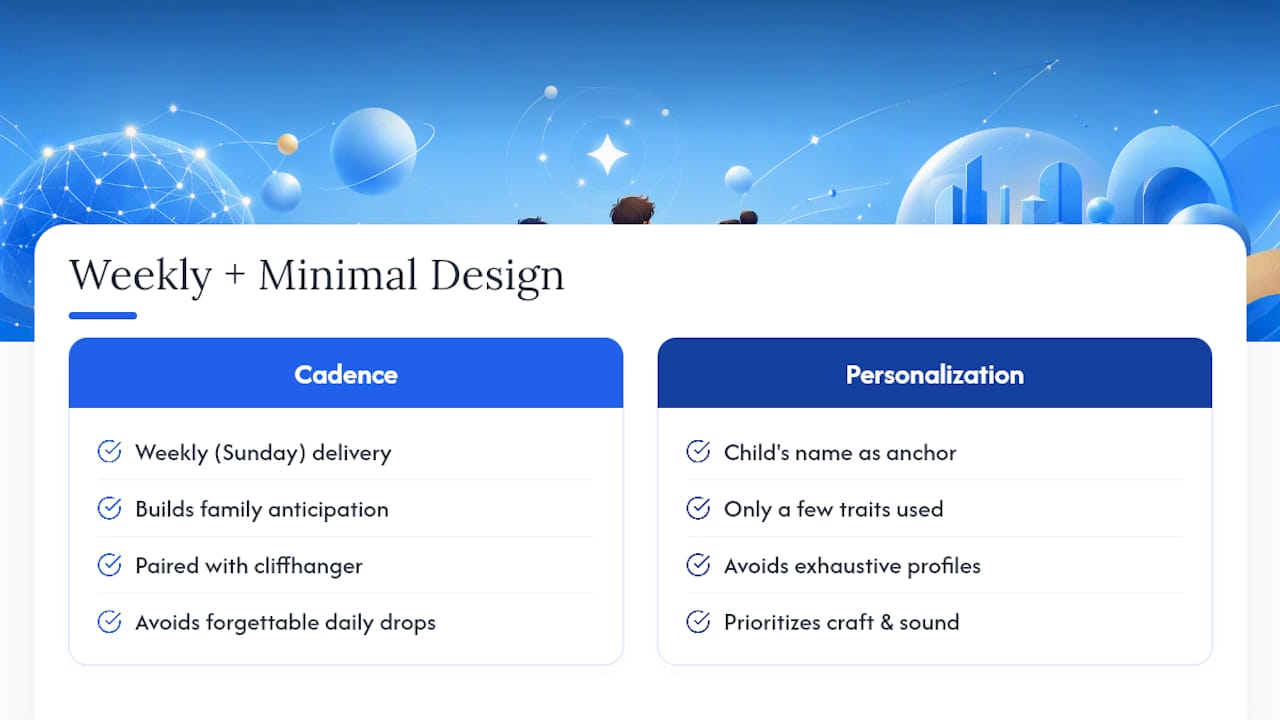
The research on serial formats convinced me that a weekly cadence isn't a scheduling convenience, it's the mechanism that makes anticipation possible. A daily drop gets consumed and forgotten. An irregular one never builds a habit. Sunday delivery, paired with a cliffhanger, gives a family something to look forward to together.
I'd also push back gently on the assumption that more personalization is automatically better. The fables research on minimal personalization suggests otherwise, and G45-hero-cast leans into that finding deliberately: the child's name carries the emotional weight, a couple of well-chosen traits carry the story hooks, and everything else is craft, voice acting, sound design, pacing, not data collection. That's a better trade for busy families than filling out an exhaustive profile every week.
— JG
Ready to Make Your Child the Hero of Their Own Podcast?
G45-hero-cast turns the research above into a Sunday routine: a new personalized superhero podcast episode lands in your child's private feed every week, built around their name, without demanding a mountain of data upfront to get the emotional payoff researchers keep finding. You get weekly delivery, a dedicated feed built for podcast apps and offline car listening, and sibling or gift plan options if you're setting this up for more than one child or buying it for a grandchild.
If you're ready to try it, check out the personalized superhero podcast plans to see episode samples and pick a monthly or annual plan, or set up a gift subscription for a birthday that's actually memorable past the wrapping paper.
Sources
- Personalizing text by using readers’ names – effects on reading comprehension and social agency — Springer
- Effect of personalisation in children's fables — F1000Research
- Tuning in together: Exploring joint media engagement in the United States through children’s podcasts — 2026 study
- Audiobooks and literacy — ERIC / National Literacy Trust (full review)