Yes, a weekly personalized superhero podcast can be safe for kids when the provider follows child-specific privacy law and real editorial oversight. The two anchors to look for are compliance with the Children's Online Privacy Protection Act (COPPA) and data minimization, meaning the company collects only what a story actually needs.
Before you subscribe to anything, confirm the provider offers:
- Verifiable parental consent, not just a checkbox
- Minimal personal data collection (first name, age, maybe a favorite animal, nothing more)
- A way to preview or edit an episode before your child hears it
- A private, access controlled podcast feed that isn't sitting in public search results
G45-hero-cast builds its subscription around these four points, and the FTC's COPPA guidance gives you the legal baseline to hold any provider to.
Key Takeaways
A personalized superhero podcast is safe for a child when the provider proves verifiable consent, minimizes data collection, allows previews, and secures the feed against public access.
| Point | Details |
|---|---|
| Consent must be verifiable | Look for a documented confirmation step, not just a checkbox at checkout. |
| Data should be minimal | Only a first name, age, and interests are needed; addresses or photos are red flags. |
| Preview access is non-negotiable | Ask to hear a sample episode and confirm you can request edits before delivery. |
| Feeds need real access control | A private feed should use a unique link or token, never a public search-indexed URL. |
| G45-hero-cast follows this checklist | The weekly subscription uses minimal data, a private feed, and preview access as built-in defaults. |
Table of Contents
- What Does Private Podcast Safety Actually Require?
- How Is Age-Appropriate Content Enforced?
- How Are Private Podcast Feeds Delivered Safely?
- What Does Real Parental Consent Look Like?
- What Should You Ask a Provider Before Subscribing?
- What Can You Do at Home to Keep Listening Safe?
- Why Practical Verification Beats Blind Trust
- A Subscription Built Around These Safety Checks
- Where to Verify These Claims Yourself
- Frequently Asked Questions
- Sources
What Does Private Podcast Safety Actually Require?
Private podcast safety, in the context of a personalized kids' show, boils down to three legal obligations under COPPA: notice, consent, and control. The law requires operators of services directed at children under 13 to give parents direct notice of what data is collected and to obtain verifiable parental consent before collecting it. Amendments finalized in April 2025 tightened these rules further, adding sharper expectations around data retention limits and security practices.
For a personalized superhero podcast, "reasonable data" means a first name, an approximate age, a pronoun, and maybe a favorite color or animal. That's what the story engine needs to write your child in as the hero. A home address, school name, or Social Security number has no business being on that form, and a provider asking for it is asking for more than the product requires.
Retention matters just as much as collection. Ask how long episode data sits on a server and whether you can request deletion. A legitimate children's privacy section will spell out:
- What triggers deletion (subscription end, parent request, or a set retention window)
- Whether any data goes to third parties, and under what circumstances
- Exactly how consent was obtained, described in plain language, not legal boilerplate
Brookings has argued that privacy-by-design, collecting only what's necessary and treating "optional" fields as genuinely optional, should be the default for any product built for kids. That's a good filter to run every provider through.
How Is Age-Appropriate Content Enforced?
Age-appropriate for a 4 to 9 year old means simple vocabulary, gentle emotional pacing, and conflict that resolves without lingering fear or graphic detail. A dragon can be scary for three sentences. It shouldn't be scary for the whole episode.
Reputable providers don't rely on a single filter. Practitioner accounts of children's media pipelines describe a layered approach: prompts are scrubbed of identifying details before generation, automated scanners flag risky language, a separate safety-auditor model checks the output independently, and a human reviews the episode before it ships. Deloitte's work on children's media safety points to exactly this kind of multi-layered check as the standard worth expecting, not a nice extra.
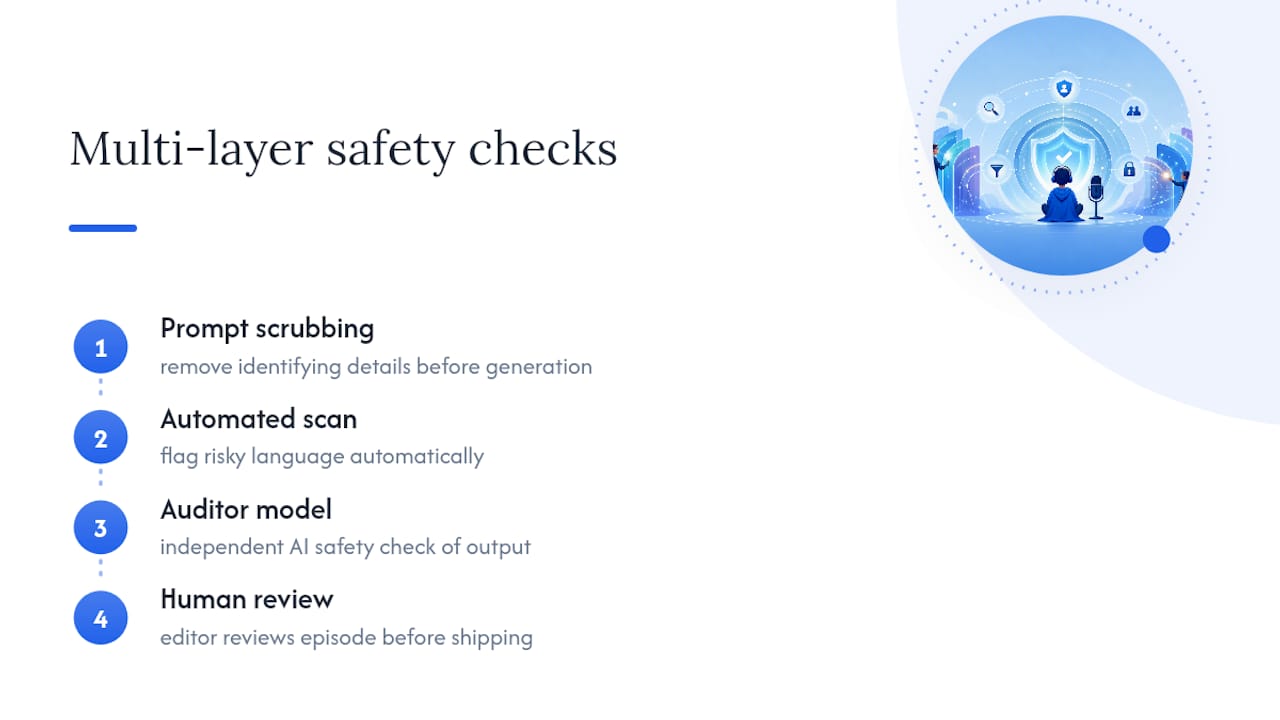
You should also be able to preview an episode, request an edit, and report something that felt off. Our own breakdown of filters and content boundaries in audio entertainment covers what "editorial review" should actually look like in practice.
Pro Tip: If a provider requires a photo upload to personalize a story, that's a red flag, not a feature. Voice and text personalization can do the same job without ever needing your child's image.
How Are Private Podcast Feeds Delivered Safely?
The mechanics behind a weekly episode are simpler than they sound, and understanding them helps you spot a sloppy setup fast.
- You subscribe and provide an email address, nothing more invasive than that.
- Each Sunday, the provider generates that week's episode and sends a private link, either a unique feed URL or a token tied to your account, straight to your inbox.
- You add that link to a podcast player (Apple Podcasts, Spotify, or a similar app), and new episodes appear automatically going forward.
- If the link is ever shared accidentally, a well built system lets you revoke or rotate it, generating a new private feed without losing your subscription history.
A private feed isn't the same as a public one with a long URL; proper IPTV security practices ensure that the feed requires a token to load and maintains strict access control. It should require the token to load at all, and it should never appear in a podcast directory's search results. Never post a feed link in a group chat, a public forum, or social media, even if it looks like gibberish. Our private podcast feed setup guide walks through exactly how that access control should work on the provider's end, and it's worth a skim if you want to understand what "secure by default" looks like technically rather than just taking a company's word for it.
What Does Real Parental Consent Look Like?
COPPA calls for "verifiable" parental consent, which is a higher bar than a single checkbox at checkout. In practice, for a subscription service, that usually means an email confirmation step tied to the payment method, plus a documented record that a parent, not a child, completed signup. The FTC's compliance guidance lists this kind of email-plus-confirmation model as one of several acceptable methods for lower-risk data collection.
Direct notice should live somewhere obvious, a dedicated children's privacy section, not buried three clicks deep in a general terms-of-service page. When a provider updates its policy, you should hear about it through an email, not stumble onto the change months later.
Ongoing oversight matters as much as the signup moment. Look for:
- A visible way to request your child's data be reviewed or deleted, with a reasonable turnaround (days, not months)
- An easy path to preview upcoming episodes before they're delivered
- A reporting mechanism if an episode misses the mark on tone or content
- Account-level controls to pause, edit your child's profile, or cancel without friction
If any of these require an email to a generic support inbox with no clear process behind it, treat that as a gap, not a formality.
What Should You Ask a Provider Before Subscribing?
Four questions cut through marketing copy fast:
- How do you get parental consent? A vague "we ask at signup" answer isn't good enough. You want a specific mechanism.
- What data do you store, and for how long? The answer should name specific fields and a retention window, not "as needed."
- Can I preview episodes before my child hears them? If the answer is no, ask why.
- How is the private feed secured? Listen for "unique link," "token," or "password protected." A shrug isn't an answer.
Pro Tip: A credible answer sounds specific and a little boring, like "we retain first name and age for the length of your subscription and delete both within 30 days of cancellation." A vague answer sounds like a slogan.
What Can You Do at Home to Keep Listening Safe?
Provider practices only cover half the equation. Keep your device software updated and use a strong, unique password on the email account tied to your subscription. Turn on two-factor authentication where it's offered.
Treat your feed link the way you'd treat a house key: keep it off shared drives and group texts, and rotate it if you ever suspect it's leaked. For younger kids especially, listen to the first episode together so you know what your child is hearing before it becomes a solo habit. UNICEF's parent checklist covers this kind of device and account hygiene in more depth if you want a broader family privacy routine. If something ever feels off in an episode, report it to the provider directly rather than just canceling quietly, since that feedback is often what tightens the safety pipeline for the next family.
Why Practical Verification Beats Blind Trust
Most parents don't read privacy policies end to end, and honestly, they shouldn't have to memorize legal text to feel confident about a kids' product. What actually protects your child is behavior you can observe: does the company let you preview before it ships, does it ask for a photo it doesn't need, does the feed link look like a real access-controlled address or a plain public URL you could Google your way into.
The uncomfortable truth is that "we take privacy seriously" on a landing page means nothing on its own. Governance frameworks for children's AI products consistently point to the same conclusion: continuous human oversight and specific, checkable commitments matter more than any single certification badge. Ask the boring, specific questions. The provider that gets more specific under pressure is the one worth trusting with a weekly window into your child's imagination.
A Subscription Built Around These Safety Checks
G45-hero-cast's weekly personalized superhero podcast was built around the exact checklist above, not retrofitted to match it. Every episode starts with minimal input (your child's first name, age, and a few interests), never a photo or home address, and arrives Sunday through a private feed tied to your account, not a public link anyone could stumble on.
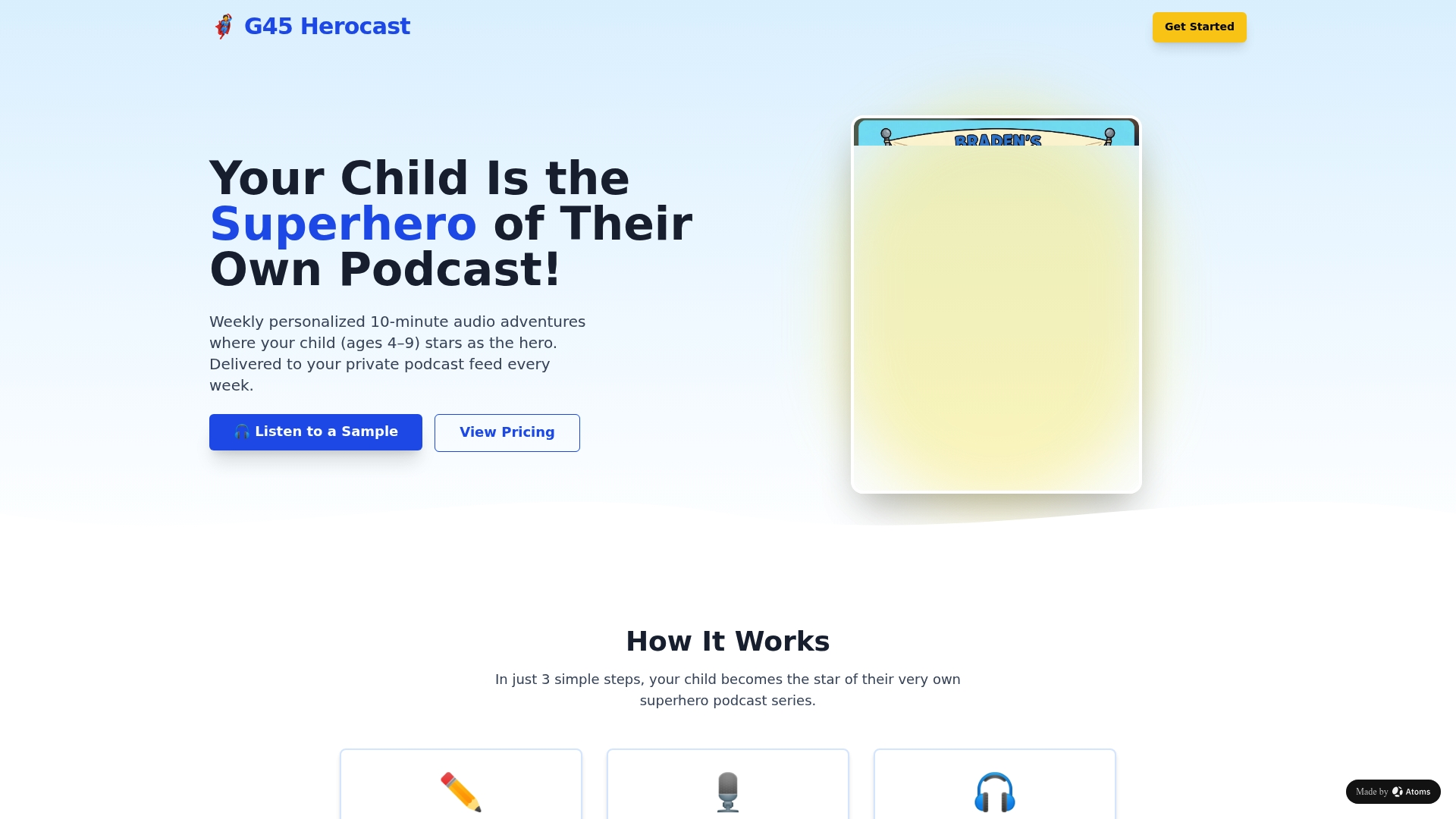
You can preview sample episodes and read the full privacy policy before you ever enter payment information at Superhero Sounds, where the children's data section spells out exactly what's collected and for how long. If you're weighing formats first, our comparison of personalized audio stories for kids is worth a read too. Either way, the next step is simple: check the sample episodes, check the policy, then decide if it's the right fit for your family's Sunday routine.
Where to Verify These Claims Yourself
- FTC COPPA guidance: the compliance checklist providers must follow
- Federal Register COPPA amendments: the 2025 rule updates
- UN child online safety resources: broader family safety guidance
- G45-hero-cast private feed setup: how the delivery mechanics work
Frequently Asked Questions
Is a personalized podcast covered by COPPA even if it's just audio? Yes. COPPA applies to any online service directed at children under 13 that collects personal information, regardless of whether that service delivers video, audio, or text.
What counts as personal information in a superhero podcast signup? A child's first name, age, or voice recording can qualify as personal information under COPPA, which is why minimal collection and clear retention policies matter even for a simple audio product.
Can I ask a provider to delete my child's data after we cancel? A COPPA compliant provider should honor a deletion request within a reasonable window, typically outlined in its children's privacy section.
How do I know if a private podcast feed is actually private? It should require a unique link or token to load, never appear in public podcast directory search results, and offer a way to rotate the link if it's ever shared by mistake.
Should I listen to episodes with my child the first time? Yes, especially for kids on the younger end of the 4 to 9 range. Co-listening lets you confirm the tone and pacing match what you'd expect before it becomes an unsupervised habit.
This article is general information, not a substitute for advice from a qualified lawyer. Consult a qualified legal professional about your own circumstances before acting on anything here.
Sources
- Federal Register: Amendments re: COPPA (April 22, 2025)
- FTC: Complying with COPPA — Frequently asked questions
- UN — Child and youth safety online
- Deloitte: Shaping a safer, smarter future for children's media
- Brookings: Children's privacy as policy on-ramp