
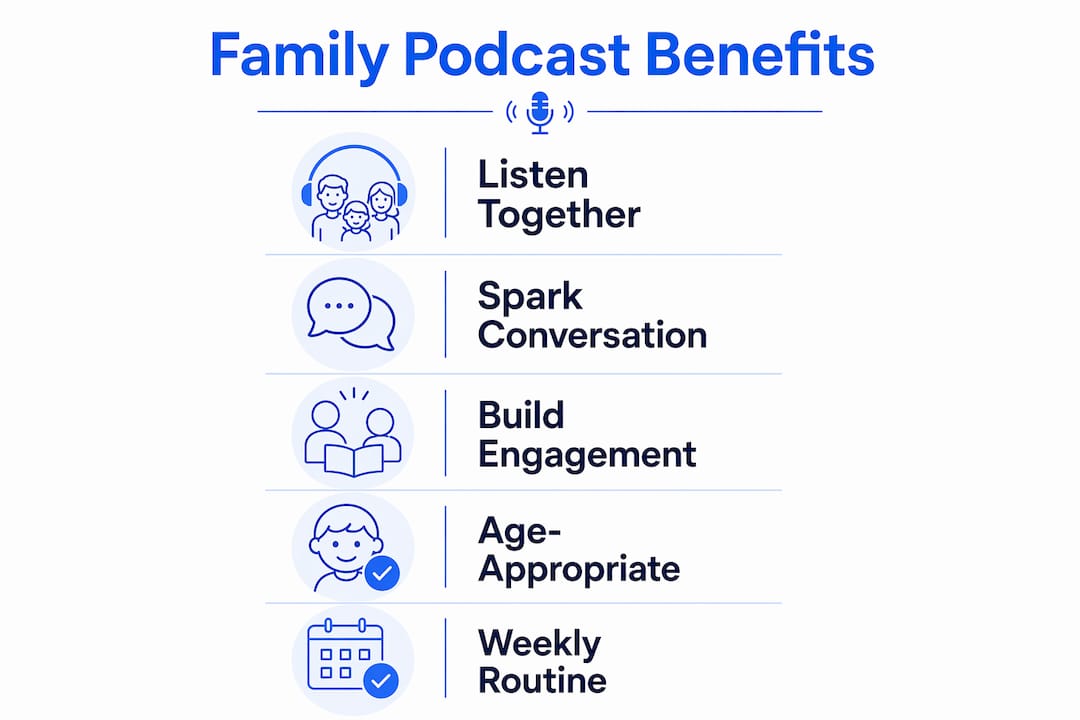
Podcasts turn ordinary routines into shared family moments by giving everyone in the car, kitchen, or bedroom the same story to react to at the same time. Dr. Sarah Nichols of Purdue's Children's Media Lab describes co-listening as creating a social connection similar to shared mealtime — something that disappears the moment each person retreats to their own screen. Three things make podcasts work especially well for families:
- They fit routines you already have. Car rides, bedtime, clean-up time, and errands all work without any extra setup.
- They support intergenerational learning. The Education Development Center found that co-listening sparks conversation and scaffolded learning across age groups.
- Personalization multiplies engagement. When a child hears their own name as the hero, repeat listens go up and the story becomes a family talking point all week.
Table of Contents
- Why do podcasts create connection between family members?
- When and where do podcasts fit into your family's day?
- How do you make podcast listening interactive for kids?
- How do you pick age-appropriate shows and manage subscriptions safely?
- What do personalized superhero podcasts add to family time?
- How do you introduce podcasts and build a listening habit in 2–6 weeks?
- Key Takeaways
- Why personalized audio works better than most parents expect
- G45-hero-cast: weekly superhero episodes built for family time
- Useful sources
Why do podcasts create connection between family members?
Audio-only storytelling does something screens rarely manage: it forces everyone to pay attention to the same thing, with nothing to look at. Without visuals, children build mental imagery and follow longer narratives — a genuine cognitive workout that strengthens attention and verbal comprehension. Parents often notice their kids asking questions mid-episode that they would never ask during a video.
The research backs this up. An EDC study of 110 families found that many families reported podcasts inspired follow-on activities, and most parents considered the episodes educational. The Joan Ganz Cooney Center reports that 46% of children ages 6–12 had listened to a podcast in 2024, with researchers noting high rates of joint engagement when episodes include interactive features like listener questions or quiz segments.
The concept researchers call "scaffolding" is worth understanding here. When a parent listens alongside a child and asks a question like "Why do you think the hero made that choice?", they are building a bridge between what the child already knows and something new. That is media mentoring in practice — no preparation required, just presence and one good question.
When and where do podcasts fit into your family's day?
The best podcast moments are the ones you are already having. Car rides top the list, and for good reason: a Frontiers in Communication study found that cars are low-distraction, enclosed spaces that convert passive travel time into focused joint listening. Every family in the study that listened to episodes during drives ended up in discussion.
Other moments that consistently work:
- Bedtime. A 10-minute episode replaces a screen and winds kids down with a story.
- Clean-up time. Play an episode on a speaker while everyone tidies — it makes the task feel shorter.
- Errands and waiting rooms. Short episodes (5–10 minutes) fit perfectly into unpredictable gaps.
- Weekend morning calm-down. Before the day gets loud, one episode sets a relaxed, connected tone.
Episode length matters more than most parents expect. The EDC found that parents of 4–6 year-olds preferred 5–10 minute episodes, while parents of 7–8 year-olds preferred 10–15 minute episodes. Matching length to attention span keeps the experience positive.
Pro Tip: Play episodes on a Bluetooth speaker instead of headphones. When everyone hears the same audio, conversation happens naturally — no one is isolated in their own earbuds.
How do you make podcast listening interactive for kids?
Passive listening is fine. Active listening is where the real family bonding happens. Three techniques work immediately, no prep needed:
- Pause and predict. Stop the episode at a tense moment and ask, "What do you think happens next?" Kids love being right — and love being wrong even more.
- Character role-play. After an episode, act out a scene together. Even two minutes of dramatic play cements the story in memory.
- Sound-effect games. Ask your child to make the sound of something from the episode. Silly, fast, and surprisingly effective at checking comprehension.
For conversation prompts, keep them open and age-appropriate. During the episode: "Does that remind you of anything?" After: "What was the bravest thing the hero did?" For older kids in the 7–9 range: "Would you have made the same choice? Why not?"
Follow-up activities that scale by age include drawing a scene from the episode, building the hero's "headquarters" out of blocks, looking up one fact the episode mentioned, or creating a treasure hunt based on the plot. The Joan Ganz Cooney Center notes that interactive design features — listener questions, quiz segments — are among the strongest drivers of family conversation, so prioritize shows that build those in.

Pro Tip: In the car, a quick glance in the rearview mirror is enough to cue engagement. A raised eyebrow or a nod signals "I heard that too" without anyone saying a word — and kids notice.
How do you pick age-appropriate shows and manage subscriptions safely?
A quick checklist before subscribing to anything:
- Age fit. Does the language, theme, and pacing match your child's stage?
- Episode length. See the table below.
- Interactive design. Does the episode invite participation (questions, guesses, listener contributions)?
- Series vs. standalone. Ongoing series build anticipation; standalone episodes are easier for irregular listeners.
- Privacy. Does the show use a private feed or a public platform? Private feeds give you control over who accesses the content.
| Child's Age | Suggested Episode Length | Why It Works |
|---|---|---|
| 4 years old | 5–8 minutes | Short attention spans; story should resolve quickly |
| 5–6 years old | 5–10 minutes | Growing focus; can follow a simple arc |
| 7–9 years old | 10–15 minutes | Ready for multi-part plots and richer vocabulary |
For podcast suggestions for preschoolers, look for shows with clear narration, repetition, and short episode arcs. Personalized subscriptions typically run on a monthly or annual basis, with episodes delivered weekly. Before committing to an annual plan, check whether a monthly option lets you test the format first.
On privacy: a private podcast feed means the episodes are not publicly searchable. Only someone with the feed link can access them — a meaningful difference from a public podcast app where any content can be discovered by anyone.
What do personalized superhero podcasts add to family time?
Standard podcasts create shared moments. Personalized ones create rituals. When a child hears their own name spoken by the narrator, their engagement shifts from passive to personal — they are not just listening to a story, they are living one. Parents report that kids ask to re-listen, quote lines at dinner, and bring the episode up days later.
Here is what personalization specifically adds:
- Name and trait integration. The child's name, age, and interests are woven into the plot, not just mentioned once.
- Sibling options. Both kids can be heroes in the same story, which turns listening into a shared identity experience.
- Weekly cadence. A new episode every Sunday creates a predictable ritual — something the child looks forward to all week.
- Private feed delivery. Episodes arrive directly to a private feed, keeping content safe and accessible only to your family.
- Gift-ready format. Grandparents in Minnesota and across the country regularly subscribe as a gift, which adds an intergenerational layer to the ritual.
G45-hero-cast builds all of these features into its weekly subscription. For families exploring personalized audio stories more broadly, the key differentiator is whether the personalization runs through the whole episode or just appears as a name drop at the start.
How do you introduce podcasts and build a listening habit in 2–6 weeks?
The habit forms faster than most parents expect. Follow this sequence:
- Pick the first episode together. Let your child choose the theme or character type — buy-in from the start matters.
- Listen on a speaker, not headphones. Shared audio creates shared experience.
- Ask one or two scaffolded questions during or right after. "What was the hero's problem?" is enough.
- Do a 5–10 minute follow-up activity. Draw, act it out, or just talk about it over a snack.
- Repeat on the same day and time each week. Sunday evenings work well for families with a weekly delivery subscription.
A simple script for the first time: "I found a podcast where you get to be the superhero. Want to hear what happens? Let's listen together and you can tell me what you think the hero should do."
Most families settle into a comfortable routine within three to four weeks. If the first episode does not land, try a different theme before abandoning the format entirely.
Troubleshooting common issues:
- Private feed not loading. Check that the link arrived in the correct email inbox and copy it directly into your podcast app rather than tapping from email.
- Audio cutting out. Download the episode over Wi-Fi before a car ride so playback does not depend on cell signal.
- Child loses interest mid-episode. Shorten the session — pause at a natural break and finish later. Two short listens beat one abandoned one.
Key Takeaways
Podcasts help family time most when they replace solo screen use with a shared audio experience that sparks conversation, fits existing routines, and gives every age group something to react to together.
| Point | Details |
|---|---|
| Shared listening beats solo screens | Co-listening creates conversation and connection that individual device use cannot replicate. |
| Fit podcasts into routines you already have | Car rides, bedtime, and clean-up time are the three most consistent settings for family listening. |
| One question makes it interactive | Pausing to ask "What do you think happens next?" turns passive listening into active family engagement. |
| Match episode length to age | Ages 4–6 do best with 5–10 minute episodes; ages 7–9 can handle 10–15 minutes comfortably. |
| G45-hero-cast adds a weekly ritual | Weekly personalized superhero episodes delivered to a private feed give children a story they own and families a predictable shared moment every Sunday. |
Why personalized audio works better than most parents expect
There is a tendency to treat podcasts as a quieter substitute for video — something to put on when screens feel like too much. That framing undersells what actually happens when a family listens together consistently.
The families who get the most out of shared listening are not the ones who find the most educational content. They are the ones who treat the episode as a conversation starter rather than a content delivery event. The episode is the excuse. The real value is the ten minutes of talking that follows.
Personalization accelerates this. A child who hears their own name in a story does not just listen — they report back. They tell grandparents. They ask to hear it again. That repetition is not just engagement; it is the mechanism by which a weekly podcast becomes a family ritual rather than a one-off activity.
The grandparent gifting pattern is worth noting specifically, as explained in Comment impliquer vos grands-parents dans le partage de photos familiales for fostering intergenerational connection. A subscription that arrives every Sunday gives a grandparent in another part of Minnesota a weekly touchpoint with a grandchild — something concrete to ask about on a phone call. That is a use case most podcast guides never mention, and it is one of the more quietly powerful things a personalized audio subscription can do.
G45-hero-cast: weekly superhero episodes built for family time
Every piece of advice in this article points toward one practical outcome: a short, shared audio moment your child looks forward to and you can build a conversation around. G45-hero-cast delivers exactly that, every Sunday, through a private podcast feed.
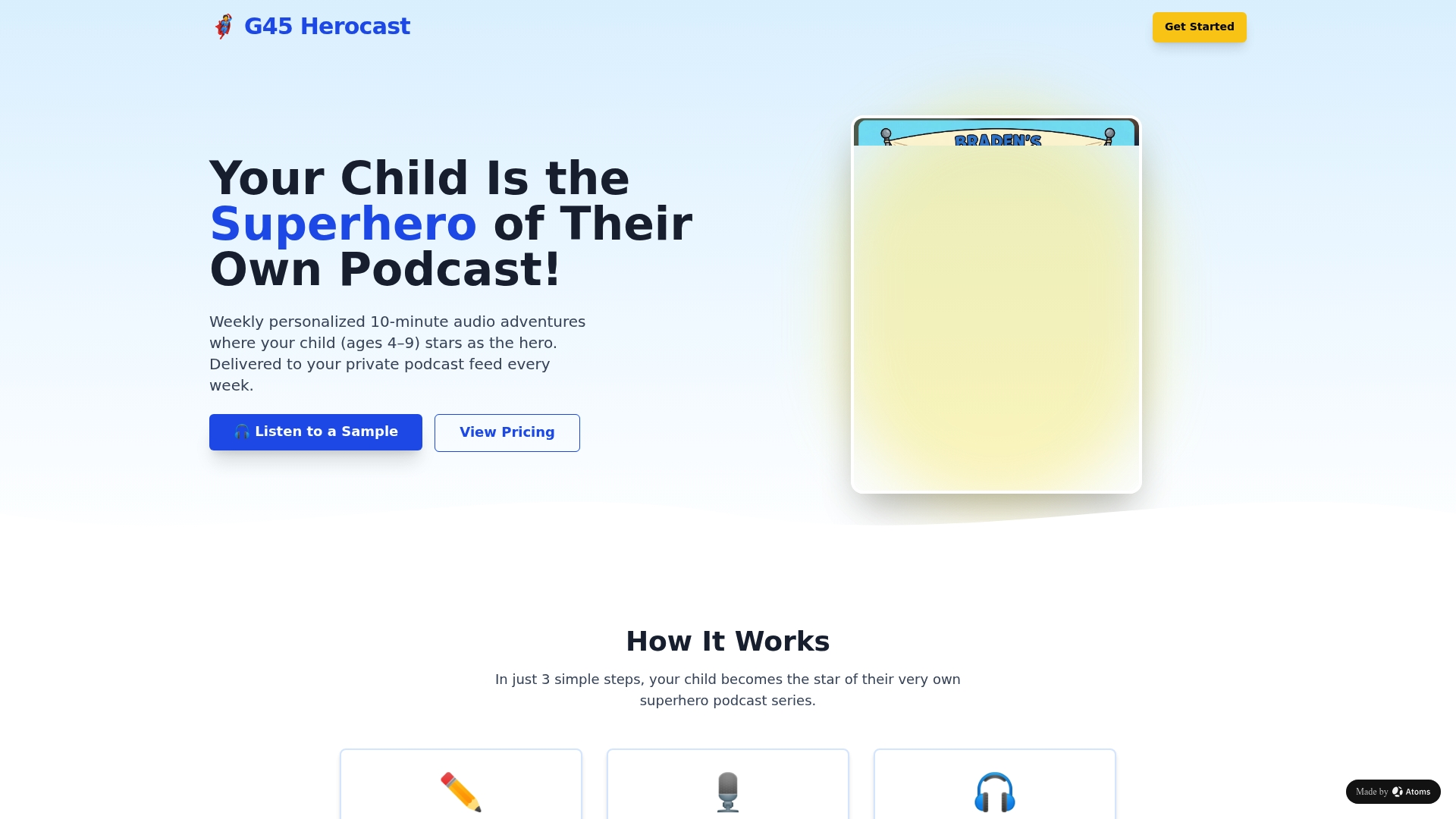
Each episode is built around your child as the hero, with their name, age, and interests woven through the plot. Siblings can share the adventure. Grandparents can gift a subscription. Monthly and annual plans are both available, so you can start without a long commitment. The private feed means no public app browsing, no ads, and no content your child stumbles into by accident.
Start your child's superhero story and turn next Sunday into the first episode of a weekly family ritual.
Useful sources
The claims in this article draw from peer-reviewed research, nonprofit media studies, and education-focused reporting. Here are the primary sources:
- Education Development Center — Listen to This! Podcast Study Report, April 2025
- Joan Ganz Cooney Center — "A Beautiful Interaction": How Children's Podcasts Support Joint Media Engagement, 2025
- Frontiers in Communication — Children's Podcasts as Facilitators of Vehicle-Based Family Joint Media Engagement, 2026
- EdSurge — Could Podcasts Fix Screen Time Woes for Children?, June 2025
- Screenwise — Family Podcasts: Screen Time That Sparks Conversation
- PBS KIDS for Parents — Listening to Podcasts Together Helps Children Learn
Product details for G45-hero-cast were drawn from the brand's own subscription information at g45-hero-cast.com.