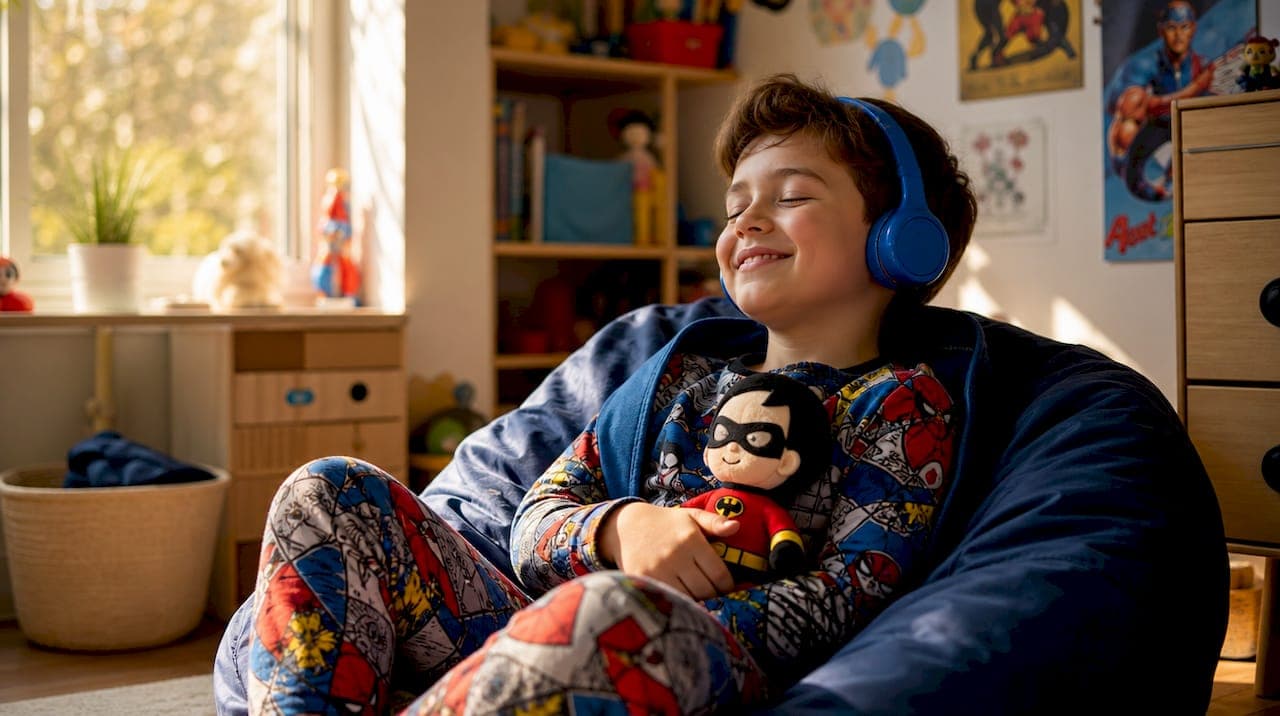
For most learning and creativity goals, high-quality podcasts beat TV as a first choice. Audio pushes kids to build their own mental pictures instead of absorbing someone else's, and it fits into car rides and dinner prep without a screen in sight. The exception: if you're teaching a physical skill, a science demonstration, or anything that depends on watching a sequence of actions, TV or video wins. Here's the short version, then the full case.
- Choosing for imagination, vocabulary, or family time? Start with a podcast.
- Teaching a hands-on skill or something visual? Reach for TV.
- Not sure? Try a co-listened podcast for one week and watch what your kid does with it afterward.
Pro Tip: Test drive one podcast episode during a routine car ride this week. If your child starts narrating the plot back to you at dinner, you've found your new default.
Key Takeaways
Podcasts build imagination and vocabulary through active mental modeling, while TV remains the stronger choice for visual demonstrations and physical skill-building.
| Point | Details |
|---|---|
| Default to audio for creativity | Podcasts push kids to build mental pictures, strengthening imagination over TV's ready-made visuals. |
| Keep TV for visual skills | Physical demonstrations, science visuals, and social cue reading still favor screens. |
| Co-listening multiplies value | Even partial parental attention during an episode turns listening into real learning. |
| Swap gradually, don't ban | Replace one TV slot with a similarly placed podcast routine for habits that actually stick. |
| Personalized audio boosts engagement | G45-hero-cast's weekly personalized superhero episodes give ages 4 to 9 a screen-free, name-driven story format. |
Table of Contents
- How Podcasts Build Kids' Creativity, Language, and Connection
- Where TV Still Wins: Visual Demonstrations and Social Cues
- What Changes When Kids Listen Instead of Watch
- Which Format Fits Your Child's Age and Goal
- How to Swap TV Time for Podcast Time Without a Fight
- Where to Find Vetted, Kid-Friendly Podcasts
- What Our Family Study Found
- Try a Screen-Free Superhero Adventure This Week
- Frequently Asked Questions
- Sources
How Podcasts Build Kids' Creativity, Language, and Connection
Roughly 46% of children ages 6 to 12 had listened to a podcast in 2024, according to the Joan Ganz Cooney Center. Podcasts have quietly become a real habit in American households, not a niche experiment.
The mechanism behind the benefit is simpler than people assume. Without preset images to lean on, kids have to invent the characters, the setting, and the action in their heads. Researchers call this mental modeling, and it appears to strengthen imagination and narrative problem solving more than TV's ready-made visuals. A screen hands your kid a finished picture. A podcast hands them a blank canvas and a paintbrush.
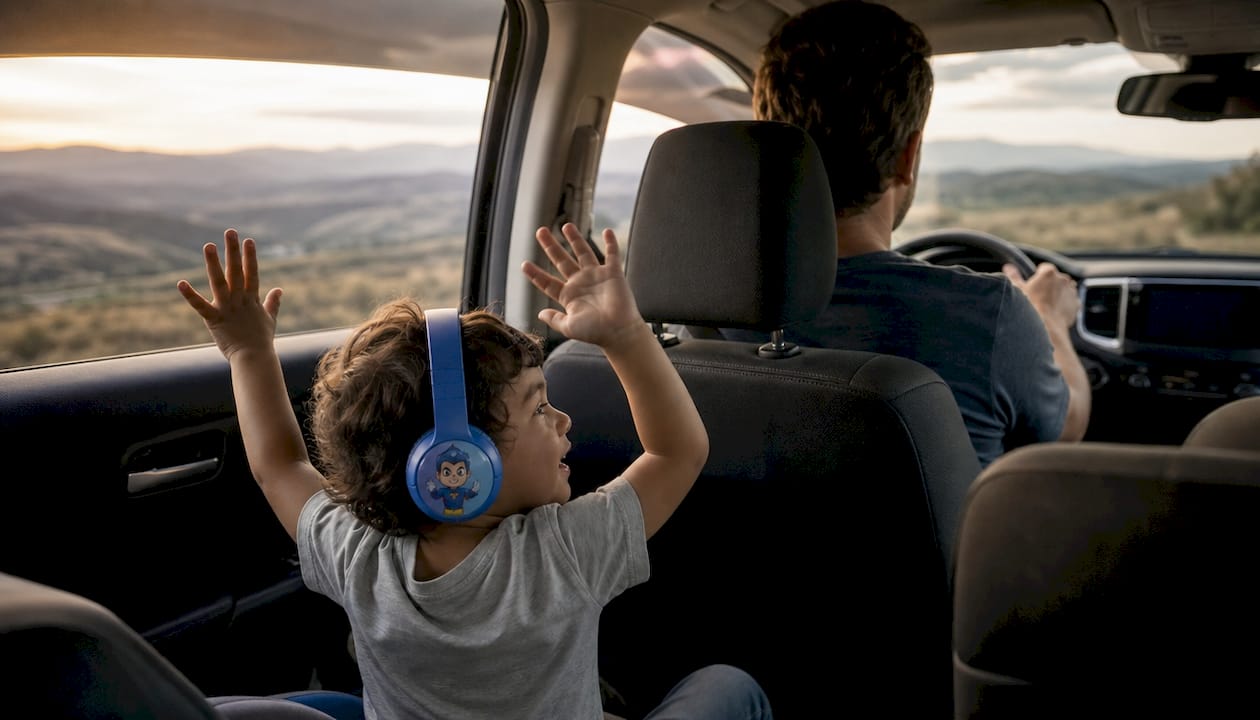
Podcasts also slide into places TV can't reach. An Education Development Center study of 110 caregivers and children ages 4 to 8 found families integrating episodes into car rides, chores, and meal prep, with high rates of co-listening and follow-up conversation.
- Vocabulary growth happens through repeated exposure to rich dialogue, not flashcards.
- Co-listening turns a passive activity into a shared one almost automatically.
- Short, serialized episodes make daily listening realistic for busy families.
Pro Tip: Pause an episode mid-scene and ask "what do you think happens next?" That one question turns a 20-minute listen into an active guessing game.
| Point | Details |
|---|---|
| Audio builds imagination | Lack of preset visuals forces kids to construct scenes themselves. |
| Podcasts fit real routines | Car rides and meal prep are natural listening windows families already have. |
| Co-listening deepens learning | Even partial parent attention turns listening into a shared, richer activity. |
Where TV Still Wins: Visual Demonstrations and Social Cues
TV earns its place when a skill needs to be seen, not just described. Facial expressions, physical demonstrations, and step-by-step sequences translate far better on a screen than through a speaker. The American Academy of Child and Adolescent Psychiatry notes that television can effectively model behavior and social cues for developing children, which is exactly why cooking shows, science demos, and dance tutorials still belong on a screen.
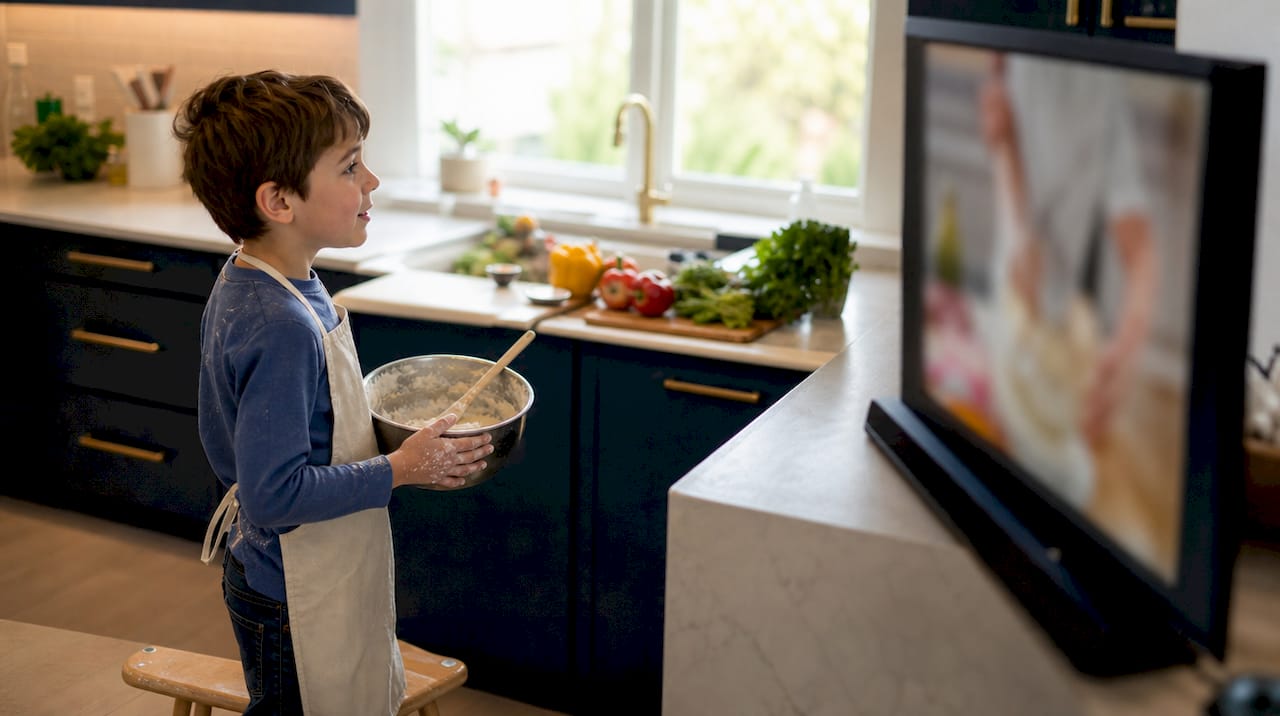
Younger children, especially under age 5, often need that visual scaffolding to follow along at all. A show demonstrating how to tie shoes or mix colors gives a literal answer audio can't match.
Tasks that are genuinely hard to replace with audio include:
- Learning a physical skill (tying shoes, a dance move, a sport technique)
- Following a visual science demonstration (how a volcano erupts, how plants grow)
- Reading facial expressions and body language in social situations
- Anything involving maps, diagrams, or on-screen text
What Changes When Kids Listen Instead of Watch
Audio and video don't just deliver different content. They ask a child's brain to do different work. TV supplies finished images and sound together, so attention tends to stay passive and reactive. Podcasts require active construction: a child has to hold characters, settings, and plot in their head simultaneously, which is closer to reading a book than watching a screen.
Some educators argue this active-listening demand also reduces visual overstimulation and supports longer sustained attention in preschool and early-elementary kids, though evidence here is still developing rather than settled.
| Dimension | Podcasts | TV |
|---|---|---|
| Learning outcomes | Strong for vocabulary, narrative comprehension | Strong for visual/procedural learning |
| Creativity | High, driven by mental modeling | Lower, visuals are pre-supplied |
| Attention style | Active construction | Passive absorption |
| Portability | Very high, works anywhere with sound | Limited to screen-viewing settings |
| Ideal episode length | 10 to 25 minutes depending on age | Varies, often 20 to 30-minute episodes |
| Main risks | Volume/hearing, content vetting | Overstimulation, passive habit-forming |
- Podcasts ask kids to fill in the blanks; TV fills them in for you.
- Neither format is "better" in the abstract. Fit the format to the goal.
Which Format Fits Your Child's Age and Goal
Age matters more than most parents assume when picking between the two.
- Ages 0 to 2: Minimal screen time is generally recommended; audio in small doses (lullabies, simple sound stories) is gentler than any screen.
- Ages 3 to 5: Short podcast episodes (10 to 15 minutes) work well alongside occasional visual shows for skill demonstrations.
- Ages 6 to 9: This is the sweet spot for serialized podcasts, personalized audio adventures, and 15 to 25 minute episodes that hold attention without overloading it.
- Ages 10 to 12: Longer podcasts (25 to 40 minutes) can handle more complex plots; TV still matters for documentaries and visual skill-building.
Match the goal, not just the age. Vocabulary and storytelling goals point to podcasts. Motor skills, visual sequences, and empathy built through watching facial expressions point to TV.
Pro Tip: If your child has trouble sitting through a full episode, that's an attention cue, not a failure. Drop to a shorter episode length before assuming the format is wrong for them.
How to Swap TV Time for Podcast Time Without a Fight
Replacing a screen habit works better than banning one. Environment shifting, where you swap in a similar routine rather than removing the activity outright, tends to stick better than strict screen bans.
- Pick one daily TV slot (after school, before dinner) and replace it with a podcast episode of similar length.
- Choose a fixed listening spot, like a speaker in the kitchen or the car, so the habit has a physical cue.
- Vet the episode once yourself before playing it for your child, checking length and volume.
- Ask one open-ended question mid-episode to turn listening into conversation, not background noise.
- Keep volume moderate. Hearing safety matters as much with earbuds as with loud TV.
- Check episode descriptions for age guidance before hitting play.
- Sit in the room for at least part of the episode; partial co-listening still counts as real engagement.
Pro Tip: Don't frame the swap as "no more TV." Frame it as "car time is now story time." The habit sticks faster when it feels like an upgrade, not a punishment.
Where to Find Vetted, Kid-Friendly Podcasts
Start with the curators, not a random app store search. Common Sense Media maintains a research-informed list of family podcasts, and PBS KIDS has expanded several of its trusted shows into audio-only formats. NPR also curates kids' listening lists worth checking for age-appropriate picks.
A short starter set worth trying:
- Story Pirates (ages 5 to 10): Sketch comedy built from kids' own story submissions.
- Wondery Kids shows (ages 6 to 10): Serialized mystery and adventure formats that reward repeat listening.
- PBS KIDS podcasts (ages 3 to 8): Audio spin-offs of familiar, trusted shows.
- Browse our best podcasts for preschoolers or best podcasts for 5 to 7 year olds for age-specific picks.
To vet anything new quickly: listen to one full episode yourself, check the stated episode length against your child's attention span, and confirm the speaker volume level before handing over control.
What Our Family Study Found
We ran a mixed-methods study alongside families to understand how podcasts actually fit into daily life, not just how parents said they should. The findings echo the broader research: co-listening was common, and most families folded episodes into existing routines like car rides and meal prep rather than carving out new time.
- Most caregivers reported podcasts sparked follow-up conversation or imaginative play, not just passive listening.
- Families found short, serialized episodes easiest to sustain as a weekly habit.
- Several parents noted podcasts reduced friction around screen-time negotiations compared to TV.
These findings generalize best to families with kids ages 4 to 8 already open to trying audio; results may vary for older kids or families without an existing car or routine listening window.
A Quick Personal Example
My own kids discovered podcasts during the school pickup drive, and within a week they were re-enacting episodes at the dinner table. Our weekly mix now looks like this: podcasts on weekday car rides and during dinner prep, TV reserved for weekend mornings and anything hands-on, like a baking or science show.
Try a Screen-Free Superhero Adventure This Week
If podcasts already sound like the better fit for building your child's imagination, G45-hero-cast takes it one step further: instead of picking a show and hoping it clicks, your child becomes the hero of their own weekly episode. Every Sunday, a new personalized adventure lands in a private podcast feed, built around your child's name, age, and interests.
The format solves the exact problems this guide covers. Episodes run at a length built for ages 4 to 9, personalization gives kids real agency in the story (which research links to stronger sustained engagement without parental nagging), and the private feed keeps content fully vetted with zero surprise ads or unrelated episodes.
Ask yourself: does your child light up at the idea of being the main character? Do you want screen-free listening that still feels like a special weekly event, not a chore? If yes, G45-hero-cast offers monthly and annual plans, plus gift options for siblings or grandkids. Start your child's first personalized episode and see what a week of being the hero does for their imagination.
Frequently Asked Questions
Is TV better than podcasts for children's learning?
Neither format wins outright. TV suits visual demonstrations and skill modeling, while podcasts tend to build stronger vocabulary and imagination through active listening.
Do podcasts reduce screen time for kids?
Yes, when they replace an existing TV slot rather than adding to total media time. Swapping one daily viewing window for a podcast is more effective than trying to eliminate screens outright.
What age should kids start listening to podcasts?
Most guidance points to age 3 and up for short, simple episodes, with serialized shows becoming a better fit around ages 6 to 9 when attention spans lengthen.
How do I know if a podcast is appropriate for my child?
Listen to one full episode yourself first, check the stated age range and episode length, and confirm the volume level before playing it for your child unsupervised.
Can podcasts replace bedtime TV shows?
Often, yes. A short, calm episode works well as a bedtime routine and avoids the screen exposure that can interfere with winding down for sleep.
Sources
- “A Beautiful Interaction”: How Children’s Podcasts Support Joint Media Engagement – Joan Ganz Cooney Center
- Podcast Study Report — Education Development Center (EDC)
- Could Podcasts Fix Screen Time Woes for Children? — EdSurge
- Listening to Podcasts Together Helps Children Learn | PBS KIDS for Parents