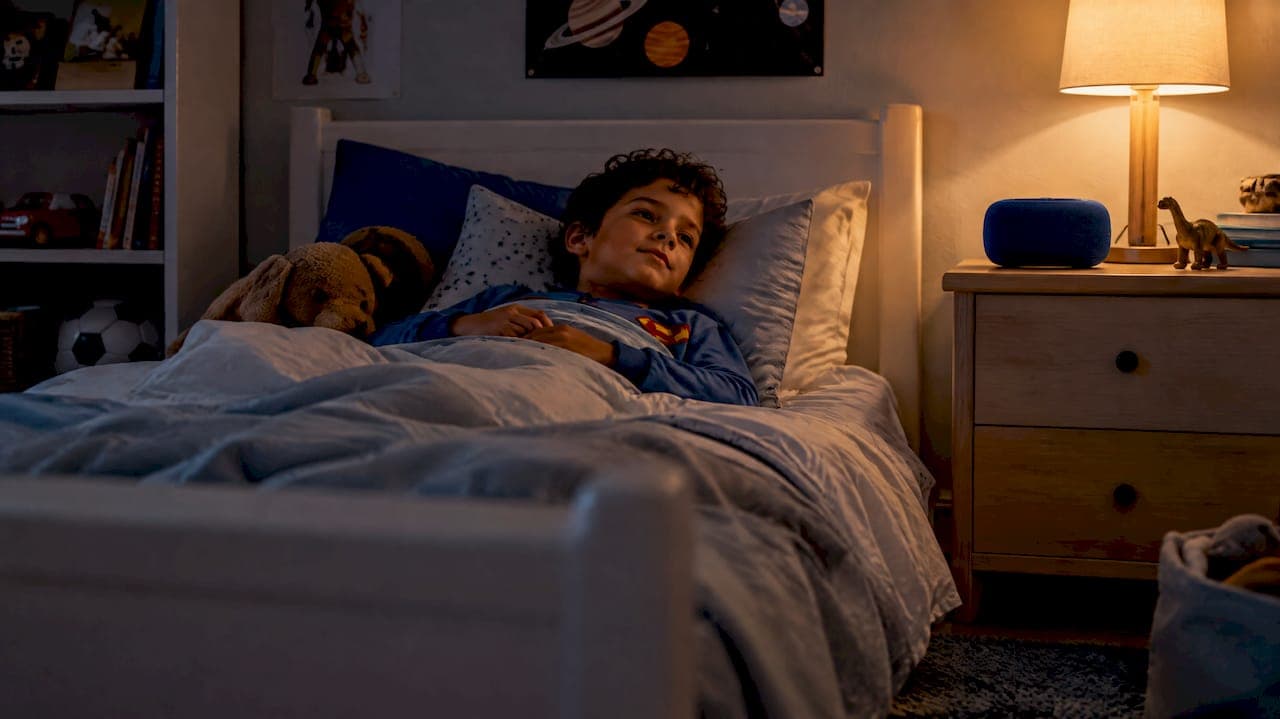
A sleep story can help a child with ADHD settle, but only when it sits inside a steady, screen-free routine. The story is one part of the wind-down, not a cure. Used well, it gives a restless mind one calm thing to follow while the body slows down. Below we cover what the research says, what makes a story work for an ADHD brain, and how to build the hour before bed around it. This is for parents and grandparents of children ages 4 to 9.
TL;DR
- Behavioral sleep approaches are the best-supported first step for children with ADHD, and a story works best as one piece of that routine.
- Choose audio over screens, and choose calm over action. High-intensity plots can undo the point of the story.
- Keep the same bedtime and wake time every day, weekends included. Consistency matters as much as the content.
- A story that features your child can make bedtime feel like a reward instead of a demand.
- If sleep problems are persistent, talk with your child's pediatrician before changing anything on your own.
Table of Contents
- Why bedtime is so hard with ADHD
- What the research says about sleep stories and ADHD
- Why audio instead of a screen
- What makes a sleep story work for an ADHD brain
- Build the hour around the story
- Our perspective: where personalized stories fit
- How to choose a sleep story for your child
- Common mistakes to avoid
- Try a story made for your child
- FAQ
- Sources
Why bedtime is so hard with ADHD
Parents often assume a tired child will simply fall asleep. With ADHD that is frequently not how it goes. Children can be exhausted and still find it genuinely hard to physically settle, a pattern often called bedtime resistance. The difficulty is less about wanting to sleep and more about the settling-down phase itself, where self-regulation is needed and ADHD makes it harder.
The American Academy of Pediatrics notes that sleep disorders can co-exist with ADHD, and that the two are tangled together. Poor sleep can look like ADHD, and ADHD can make sleep worse. That is why a bedtime fight is rarely just a discipline problem.
The stakes are real. The CDC reports that children ages 6 to 12 need 9 to 12 hours of sleep per 24 hours, and that not getting enough is linked to problems with attention, behavior, mood and school performance. For a child who already struggles with focus, a short night makes the next day harder, which makes the next bedtime harder.
What the research says about sleep stories and ADHD
Here is the honest picture. The strongest evidence is for behavioral approaches in general, not for stories specifically.
A 2024 umbrella review in the Journal of the American Academy of Child & Adolescent Psychiatry pooled 93 systematic reviews covering 393 randomized trials. It found that behavioral interventions, usually multicomponent ones that include parent training, help with sleep problems in children and adolescents. A separate systematic review and meta-analysis of behavioral sleep interventions for school-aged children with ADHD looked at the same question for ADHD specifically.
A word of caution: another systematic literature review applied strict methods and concluded that the evidence is uncertain for most of the outcomes it examined, because few studies met its bar. In plain terms, behavioral routines look helpful, the research base is still modest, and nobody should promise you a result.
On storytelling itself, a study published in the Asian Biomedicine journal examined storytelling as a sleep aid for children with ADHD and sleep difficulties. It is a small, early line of research. We read it as a signal that the idea deserves a fair trial in your home, not as proof that any story will work.
A more recent update of the literature on managing sleep disturbances in children with ADHD is a good place to start if you want to read further, or to bring to an appointment.
Why audio instead of a screen
The question most parents ask first is whether any nighttime media will wind up an ADHD brain. The useful distinction is screen versus audio.
The AAP explains that screen time can affect sleep, and recommends keeping devices out of the bedroom. Phones, tablets and TVs deliver light and fast, stimulating content right when your child needs to power down. They also come with a built-in fight at the end: "turn it off."
Audio has no such cliff. There is nothing to look at, no autoplay, no glowing rectangle on the nightstand. Your child lies in the dark and follows a voice. For many kids that single point of focus is exactly what a busy mind lacks. Many parents also find the transition easier, because the story fades into sleep instead of ending abruptly.
The CDC's guidance for parents is to build a consistent bedtime routine, and screen-free time before lights out is a standard part of it. We suggest at least 60 minutes of screen-free time before bed, and we treat the story as the last step of that hour.

What makes a sleep story work for an ADHD brain
Not every story helps. A few features matter more than the plot.
Calm content, slow pacing
This is the one most parents get wrong, especially with superhero fans. Action-packed, high-intensity stories can stimulate a child's brain and defeat the purpose. A bedtime story should be calming and non-stimulating, with a gentle pace, soft endings and low stakes. Chases and battles belong in the afternoon.
Predictable shape
Children with ADHD often do better when they know what is coming. A story with the same opening, a similar arc and a quiet ending each night gives the brain a pattern to settle into. Familiarity is a feature here, not a flaw.

A reason to pay attention
One reason personalized stories are worth considering is that a child hears their own name, their own favorite things, their own world. That personal hook can hold attention without needing noise or speed. It also changes the emotional tone of bedtime. Instead of being told what to do, your child is the star of something. That can take some of the pressure out of the power struggles common in ADHD households at night.
A rewarding transition
For many children, "time for bed" signals the end of fun and the start of frustration. A story they look forward to turns the same moment into the good part of the day.
Build the hour around the story
A story is not magic. Its effect depends on the structure around it. Here is a simple evening sequence you can adapt.
- Same time every night. Pick a bedtime that gives your child enough hours for their age, and hold it. For ages 6 to 12 the CDC range is 9 to 12 hours.
- Screens off 60 minutes before. Move devices out of the bedroom entirely, not just out of reach.
- Quiet activity. Bath, pajamas, teeth, a few minutes of low-key talk about the day. Keep it boring on purpose.
- Set the room. Cool, dark and quiet. Remove other distractions.
- Story in bed. Lights low, audio at a modest volume, you nearby for the first few minutes if that helps.
- Let it end. Resist adding one more thing. The routine's predictability does the work.
If your child needs a daytime outlet for focus and energy so that evenings are calmer, one family-friendly option is to look at a four-week chess practice alongside clinical care for ADHD. It is a daytime idea, not a bedtime one, and it should complement, not replace, whatever your child's care team recommends.
Do not skip weekends
This is the pitfall we would flag most. Children with ADHD often lose their gains when weekend sleep schedules swing widely. The CDC has documented how short sleep is common among U.S. students and linked to attention and behavior problems. When you introduce any new sleep tool, keep wake-up and bedtime rules the same on Saturday and Sunday for the first few weeks. Otherwise you cannot tell whether the story is helping.
Our perspective: where personalized stories fit
We make weekly personalized superhero podcasts for children ages 4 to 9, so we have a stake in this topic and we want to be straight about it.
Our view is that a custom story is useful for ADHD bedtimes for one reason: it gives a child something of their own to look forward to. Each of our episodes is written for one child, built around their real details, interests, age and traits, not just a name dropped into a template. That matters when a child resists being told what to do, because the story invites instead of instructs.
We also hold some firm opinions. A story does not treat ADHD or a sleep disorder, and we would never suggest it replaces medical advice. Its job is to make a good routine more appealing. And because action-heavy plots can work against a calm bedtime, we think parents of children with ADHD should decide on the tone of the story first and the superpowers second. A hero can be a gentle one. Our guide to gentle superheroes for sensitive kids goes into what that looks like.
Finally, we built this as a fully screen-free option for families who want fewer devices and more time together. Episodes arrive every Sunday in a private podcast feed, so there is a fresh adventure each week without a screen anywhere near the bed. The ritual, a parent beside the child with the lights low, is what we care about most.
— JG
How to choose a sleep story for your child
Whether you use our service or something else, check a story against these points before you commit to it for a month.
| What to check | What you want | Red flag |
|---|---|---|
| Pace | Slow, with pauses | Rapid plot, loud effects |
| Tone | Calm, warm, safe | Villains, danger, cliffhangers |
| Length | Fits your wind-down, ends cleanly | Open-ended autoplay |
| Delivery | Audio only, no screen needed | Requires a tablet or phone in bed |
| Personal fit | Matches your child's interests | Generic, one-size-fits-all |
| Consistency | Same time, same format | Irregular, hard to repeat |
If your child is anxious at night as well as restless, the techniques in our piece on short bedtime scripts and screen-free audio for anxious kids overlap with what works for ADHD. For a broader look at options, see alternatives to bedtime stories for kids ages 4 to 9 and our overview of the best custom bedtime stories.
Common mistakes to avoid
- Expecting overnight results. Give a new routine several weeks. Change one thing at a time so you know what is working.
- Letting the story become a negotiation. Decide the rules in the daytime, not at 8:45 p.m. when everyone is tired.
- Choosing stories for excitement. If your child asks for battles, save those for earlier in the day and keep the bedtime story gentle.
- Leaving a device nearby "just in case." Even a face-down phone invites a fight and a glance. Charge it elsewhere.
- Ignoring the daytime. Light, movement and a steady wake time all feed into how easily your child falls asleep.
- Skipping the doctor. If your child snores loudly, wakes often, takes more than about an hour to fall asleep most nights, or is very sleepy by day, ask your pediatrician about it. Sleep problems can have causes that a story cannot fix, and medication timing for ADHD can also affect sleep, which is a question for your child's prescriber.
Try a story made for your child
If you would like to test the idea, our weekly personalized superhero podcast makes your child the hero of their own audio adventure, delivered each Sunday to a private feed. The Bedtime Standard plan is $99 per month. The Grandparent Gift plan is $999 per year, a good fit if a grandparent wants to give a child something to look forward to every week. You can see both on our main page. For more on how the stories work, read about our superhero bedtime stories or how we help make evenings fun and engaging.
FAQ
Do sleep stories actually help kids with ADHD fall asleep?
They can help as part of a consistent routine, but the evidence for stories on their own is limited. The best-supported approaches are behavioral ones, and a story fits inside them as a calming, predictable last step. Treat it as a tool to try, not a guaranteed fix.
Is audio better than a tablet for an ADHD child at bedtime?
For most families, yes. The AAP advises keeping screens out of the bedroom because they can interfere with sleep. Audio gives your child something to focus on without light, visuals or autoplay.
Can a superhero story be calming enough for bedtime?
It can if the tone is gentle. Fast, high-intensity plots can stimulate a child instead of settling them, so look for slow pacing, low stakes and a quiet ending. A hero can use courage and kindness instead of battles.
How long before bed should screens go off?
Aim for at least 60 minutes of screen-free time before lights out, and keep devices out of the bedroom. Use that hour for a bath, quiet talk and the story.
Should I talk to a doctor about my child's sleep?
Yes, if trouble falling asleep is frequent or your child is very tired in the day, or if you notice loud snoring or frequent waking. Your pediatrician can check for other causes and advise on any ADHD treatment that may affect sleep.
Sources
- Umbrella review and meta-analysis of nonpharmacological interventions for sleep disturbances, JAACAP
- About Sleep, CDC
- ADHD and Sleep Disorders, American Academy of Pediatrics
- Screen Time Affecting Sleep, American Academy of Pediatrics
- The Effectiveness of Storytelling as a Sleep Aid for Children with ADHD and Sleep Difficulties
- Behavioral Sleep Interventions for Children With ADHD: A Systematic Review and Meta-Analysis
- Sleep interventions for children with ADHD: a systematic literature review
- The management of sleep disturbances in children with ADHD: an update of the literature
- Short Sleep Duration Among Middle School and High School Students, MMWR