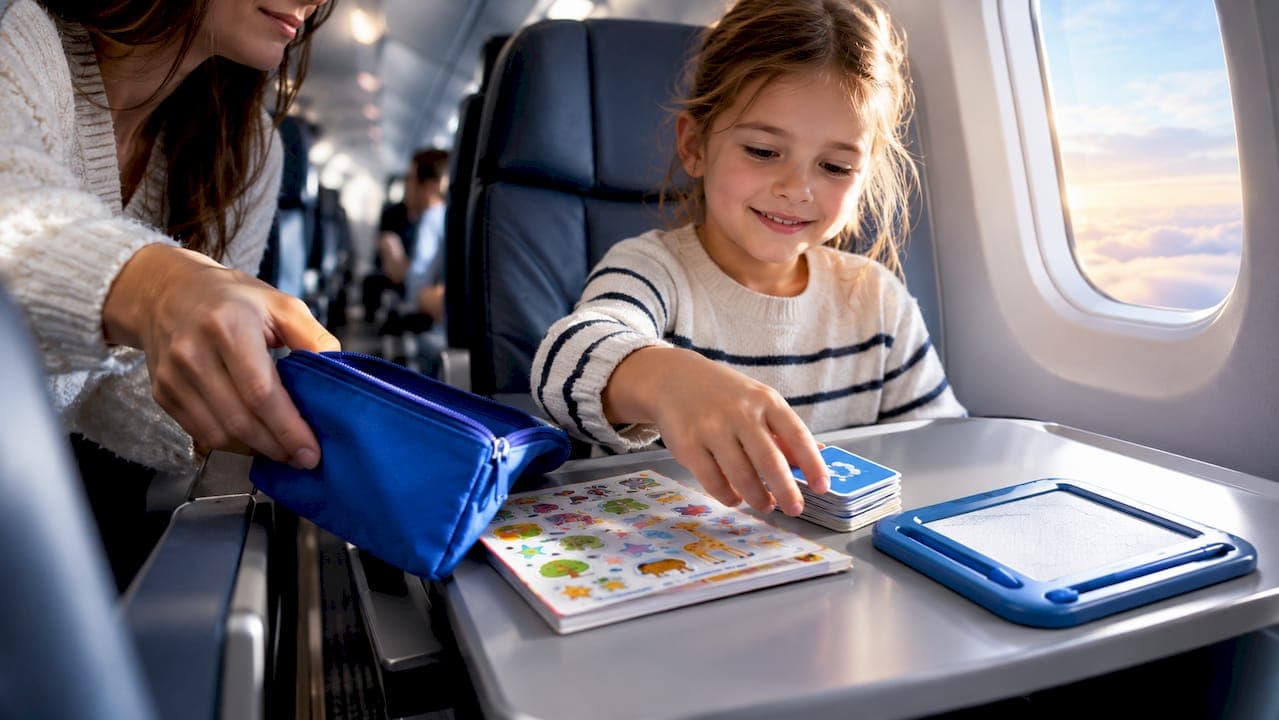
You can fly with young children without handing them a tablet, and many parents find the flight actually goes smoother because everyone stays more present. The three levers that make it work are paced, low-mess activities, a well-organized carry-on with a "surprise bag," and audio-first entertainment that occupies the mind without the glow of a screen. Add in some basic knowledge of security screening rules and a plan for ear pressure, and you have a full playbook.
TL;DR:
- Having multiple short, engaging activities with a surprise bag pacing plan helps keep young children calm and present during flights without screens.
- Prepacking low-mess snacks, change of clothes, and organized activity pouches simplifies in-flight management and reduces frustration.
- TSA's screening procedures for children under 12 are flexible, allowing them to keep shoes, jackets, and stay in strollers during security checks.
- Offering a bottle, gum, or chewy snacks during descent effectively prevents airplane ear discomfort in various age groups.
- Downloading personalized audio stories ahead of time and matching episode length to flight segments enhances screen-free entertainment without WiFi reliance.
Table of Contents
- Screen-free activities and the surprise-bag pacing plan
- Packing and preflight prep for a screen-free flight
- What TSA rules mean for traveling with young kids
- Preventing airplane ear and following FAA restraint guidance
- Building a screen-free flight schedule that actually holds
- Why audio works so well without a screen
- Quick fixes when the plan falls apart
- What producing personalized audio taught me about screen-free travel
- Use G45 Herocast as your screen-free flight companion
- Sources
- FAQ
Screen-free activities and the surprise-bag pacing plan
The trick with young kids on planes isn't finding one activity that holds their attention for three hours. It's having several short activities ready and releasing them at the right pace. Healthychildren frames air travel as a chance for a genuine "tech-free zone," pairing audio with a rotation of small, curated activities instead of passive screen time.
For babies and toddlers (0 to 2), stick to things that don't roll away or make a mess: soft board books, a small mirror toy, silicone suction toys for the tray table, and a few favorite snacks in a spill-proof pouch. Preschoolers (3 to 5) do well with sticker books, magnetic doodle boards, small figurines that can act out a story, and simple lacing cards. Kids 6 to 9 can handle more independent play: travel-sized board games, playing cards, a notebook for doodling or a "spot it" style visual search book, and simple craft kits with no loose glitter.
The surprise-bag tactic, a favorite noted by HealthyChildren.org, works by introducing one new small item every 30 to 45 minutes rather than dumping the whole bag out at boarding. Wrap a few items in tissue paper or small pouches so opening them becomes its own mini activity.
Parent-led games fill gaps between items and cost nothing:
- Play "I Spy" using objects visible from the window or cabin.
- Try a whisper-only guessing game where you describe an animal and your child guesses it.
- Take turns adding one line to a made-up story about a character flying somewhere new.
Combine a physical activity with a short audio episode to stretch focus. A doodle pad paired with a 10-minute story often buys twice the calm time of either alone, since the audio carries the narrative while little hands stay busy. For more screen-free ideas beyond the plane, this list of screen-free activities covers options that travel well too, and if you're also planning car trips around the visit, structuring entertainment for road travel uses many of the same pacing principles.
Pro Tip: Pack items in the order you plan to use them so you're never digging through the whole bag mid-flight.
Packing and preflight prep for a screen-free flight
A little organization before you leave home saves a lot of frustration in the air. Pack with easy access in mind, since you won't want to dig through a full suitcase at 30,000 feet.
- Pack snacks that are low-mess and slow to eat, like pouches, crackers, or dried fruit, plus one special treat reserved for takeoff or a meltdown moment.
- Bring one full change of clothes per child, along with wipes and a couple of extra diapers even for potty-trained kids, since accidents and spills happen.
- Use small zip bags to separate activity items by type so nothing gets lost in a diaper bag.
- Pack a dedicated activity pouch for the first hour and a separate surprise bag for the rest of the flight, each within arm's reach under the seat in front of you.
- Bring child-sized headphones with a volume limit, since even audio-only entertainment is more soothing at a lower volume.
- If you're traveling by car seat, check with your airline about using an FAA-approved child restraint system in its own purchased seat rather than as a lap infant, particularly for children under two.
- Schedule your flight around nap times when possible, and consider preboarding if your airline offers it for families, since a calmer boarding process sets the tone for the rest of the flight.
Getting this right before you leave the house means you spend the flight managing your child, not searching for supplies.
What TSA rules mean for traveling with young kids
Security screening is often the part parents dread most, but TSA's rules for young children are more forgiving than most people expect. According to TSA guidance for traveling with children, children 12 and under get modified screening: they can keep their shoes, light jackets, and headwear on, and they can stay in a stroller until it's their turn to go through screening.
Practical points to know before you get to the checkpoint:
- Strollers and car seats go through the X-ray machine, so plan to fold the stroller or hand off the car seat at that point.
- Children walk or are carried through the walk-through metal detector rather than facing the same procedures as adults.
- TSA PreCheck for families automatically permits children 12 and under to use PreCheck lanes when they're on the same reservation as a parent or guardian who has the PreCheck indicator, and kids up to 17 can use it when traveling with that eligible adult.
- Look for signage related to TSA's Families on the Fly program, which offers dedicated family lanes at some airports.
Before you travel, a short role-play at home helps: walk your child through taking off shoes, placing items in a bin, and walking through a "scanner" made of two chairs. Rehearsing the sequence, even loosely, reduces the number of surprises at the real checkpoint. If you're gate-checking a stroller, tag it clearly and keep the car seat's straps snug for the walk to the gate.
Preventing airplane ear and following FAA restraint guidance
Ear pain on a plane happens because cabin pressure changes faster than the middle ear can equalize, and according to HealthyChildren.org, it's most common during descent.
Prevention depends on age. Offer a bottle, pacifier, or sippy cup during descent for babies and toddlers, since sucking and swallowing help equalize pressure. For kids 6 and up, gum or chewy snacks work the same way. If your child tends to fall into a deep sleep, consider waking them a few minutes before descent begins so they're alert enough to swallow through the pressure change.

The FAA's Kids' Corner recommends securing children in an approved child restraint system in their own seat whenever possible, rather than relying on a lap-held infant arrangement, and it names CARES as an FAA-approved harness option for certain children who no longer need a full car seat.
If you're bringing a car seat, FAA Advisory Circular AC 91-62A outlines what makes a child seat acceptable for aircraft use and includes precautions for proper installation and evacuation. Check that your seat's label confirms it's certified for aircraft use before your trip, and if your child has an ear, sinus, or respiratory condition, call your pediatrician ahead of the flight for specific advice.
Building a screen-free flight schedule that actually holds
A loose schedule keeps a flight from feeling like one long stretch of unstructured time. For short flights under three hours, plan on one activity block during boarding and taxi, a snack and audio episode during climb, a second activity block midflight, and a calming routine starting about 20 minutes before landing.
Longer flights of four hours or more need more structure:
- Start with a quiet activity during boarding to avoid overstimulation before takeoff.
- Time a snack or meal for right after takeoff, since chewing and swallowing double as a natural way to ease pressure changes in little ears.
- Rotate through one or two audio episodes and a hands-on activity through the middle of the flight, aiming for a nap if the schedule allows.
- Reserve a calming routine, like a quiet sensory box or a short collaborative story, for the descent window.
Calming practices matter as much as the activities themselves. A simple "smell the flower, blow out the candle" breathing game slows a child down in under a minute, and a short story you build together line by line gives them something to focus on that isn't a screen. For seating, a window seat gives younger kids something to watch, while an aisle seat helps if you expect frequent trips to the bathroom. Don't hesitate to ask a flight attendant for a cup of warm water, extra napkins, or help stowing a stroller. Crew members handle these requests often and would rather help than watch a family struggle quietly.
Why audio works so well without a screen
Audio entertainment fills the same need a tablet does, occupying attention, without the overstimulation that comes from bright, fast-moving video. It also keeps hands free for a doodle pad or a small toy, which is part of why HealthyChildren.org recommends it as a lower-stimulation substitute for screen time on trips.
To make audio work on a flight, download episodes before you leave home rather than relying on in-flight WiFi. Test playback offline the night before, bring a compact power bank, and pack headphones sized for your child with a built-in volume limit.
- Preload two or three episodes so you're not stuck if WiFi is spotty at the gate.
- Match episode length to flight segments: a 10 to 20 minute episode fits neatly around takeoff or a snack break.
- Keep playback on one dedicated device to avoid mid-flight app switching or accidental purchases.
Personalized superhero episodes delivered weekly to a private podcast feed, with stories built around a specific child's name, age, and interests, can give audio-first travel a personal edge over generic story apps. For a flight, an episode in the 10 to 20 minute range lines up well with a takeoff or a pre-landing wind-down. Pairing an episode with a quiet tactile activity, like a doodle pad or a small figure to act out the story, tends to stretch a child's focus further than either one alone. For more on preparing audio for travel and timing episodes to trip segments, see this guide to audio adventures for travel.
Pro Tip: Save your child's favorite episode for the descent, when a familiar story can be more calming than a new one.
Quick fixes when the plan falls apart
Even a well-paced flight has rough patches. A few fast tools help you recover without reaching for a screen.
- Use a short, calm script like "I see you're upset, let's take three big breaths together" to de-escalate before offering a distraction.
- Keep one "instant surprise" item, like a small wind-up toy or a fresh sticker sheet, sealed and ready for genuine meltdown moments.
- Swap activities rather than adding more: trade the current toy for a new one instead of piling on options, which can overwhelm rather than calm.
- For family-friendly games that double as a swap option, this list of low-mess multiplayer games has quick setups that work in a cramped row.
- Ask a flight attendant for small favors, a cup of ice, extra napkins, or a spare pillow, since most crews are glad to help when asked directly.
- During long delays or missed connections, rotate through your existing activity pouch in shorter bursts rather than introducing everything at once, since kids tire faster when a trip runs longer than planned.
What producing personalized audio taught me about screen-free travel
Working on personalized audio for kids has shown me how much a familiar voice and a story built around a child's own name can hold their attention in a way generic content rarely does. Families don't need a perfect plan, they need two or three reliable tools and the flexibility to swap them when one stops working mid-flight.
Screen-free travel isn't about willpower or rigid rules. It's about giving a child's imagination something to do instead of something to watch. If your current strategy leans hard on a tablet, try replacing one leg of your next trip with an audio story and a simple hands-on toy, and see how the pacing feels.
— JG
Use G45 Herocast as your screen-free flight companion
Once your carry-on and audio playlist are ready, G45 Herocast gives you one more tool built specifically for screen-free moments. Some subscription plans offer new personalized superhero episodes delivered weekly to a child's private podcast feed, including options that let grandparents send ongoing gifts of episodes.
Before you fly, download that week's episode to your phone or a dedicated player, and pick a story length that matches your longest quiet stretch, whether that's takeoff, a nap window, or the descent.
- Download the current week's episode ahead of time so it plays without WiFi.
- Choose a 10 to 20 minute story to match a single flight segment rather than the whole trip.
- Keep playback on one device so your child isn't switching between apps mid-air.
See current plans and get your child's first personalized episode at G45 Herocast.
Sources
- Traveling with Children | Transportation Security Administration
- Kids' Corner | Federal Aviation Administration
- Healthychildren
FAQ
Do children have to go through airport scanners?
Yes, but TSA's modified screening procedures let children 12 and under keep their shoes, light jackets, and headwear on while walking or being carried through the detector. Strollers and car seats are screened separately by X-ray.
Why shouldn't you wear jeans on a flight?
This isn't a TSA or FAA rule, it's general travel comfort advice: stiff fabrics like heavy denim can be uncomfortable during long stretches of sitting and don't stretch easily if you need to move quickly through security or a tight aisle. Loose, breathable layers are generally more practical for both parents and kids on travel days.
What is the hardest age to fly with kids?
There's no official ranking of the hardest age, but many parents find toddlers between about 1 and 3 the most demanding, since they're mobile, easily overstimulated, and too young for most independent activities. Pacing short activities and audio in small bursts tends to help most at this stage.
Does a 2 year old need documentation to fly?
Requirements vary by airline and by whether the child flies as a lap infant or in their own seat, so check your specific airline's policy before booking. If you're using a car seat, the FAA's Kids' Corner recommends securing a child in an approved restraint system in a purchased seat rather than relying on a lap-infant arrangement.