
Annual billing usually saves money. If you know you'll use a service for at least 10–12 months, an annual plan almost always costs less than paying month to month. The typical annual subscription discount runs 15–20%, which Orbit Money's calculator frames as roughly "two months free." If you're still testing a service or your usage is seasonal, stay monthly until you're sure.
The break-even math and detailed tradeoffs are in the next section. The short version: divide the annual price by the monthly price. That number is your break-even month. If it's under 12, annual wins once you pass that month.
Key Takeaways
Annual billing saves money in almost every case where you use the service for 10 or more months, but monthly billing is the smarter starting point for any service you haven't tested yet.
| Point | Details |
|---|---|
| Run the break-even formula | Divide annual price by monthly price; if the result is under 12, annual saves money after that many months. |
| Annual wins for proven services | Once you've used a service consistently for one month, the annual plan's 15–20% discount almost always justifies the commitment. |
| Monthly protects new buyers | Start monthly for any unproven service; switch to annual after confirming you'll use it year-round. |
| Protect yourself from auto-renewal | Set a calendar reminder 30 days before your annual renewal date and use a dedicated card for subscriptions. |
| G45-hero-cast annual plan | Parents who confirm their child engages with weekly episodes save roughly 20% by switching from monthly to annual billing. |
Table of Contents
- How do you compare monthly vs annual subscription costs?
- What are the real advantages and disadvantages of monthly billing?
- When does an annual subscription plan actually make sense?
- Six questions to decide between monthly and annual billing
- How billing cadence affects seller retention, LTV, and cash flow
- What you need to know about auto-renewals, refunds, and payment methods
- Applying the rules to G45-hero-cast: a worked example
- How subscription billing affects your personal budget
- Why psychology drives more subscription decisions than math does
- Where monthly vs annual billing shows up across industries
- The case for trusting the math over your gut
- G45-hero-cast: weekly superhero podcasts for your child
- Sources
How do you compare monthly vs annual subscription costs?
The formula is simple. Take the annual price and divide it by the monthly price. The result tells you how many months of use it takes before the annual plan pays off.
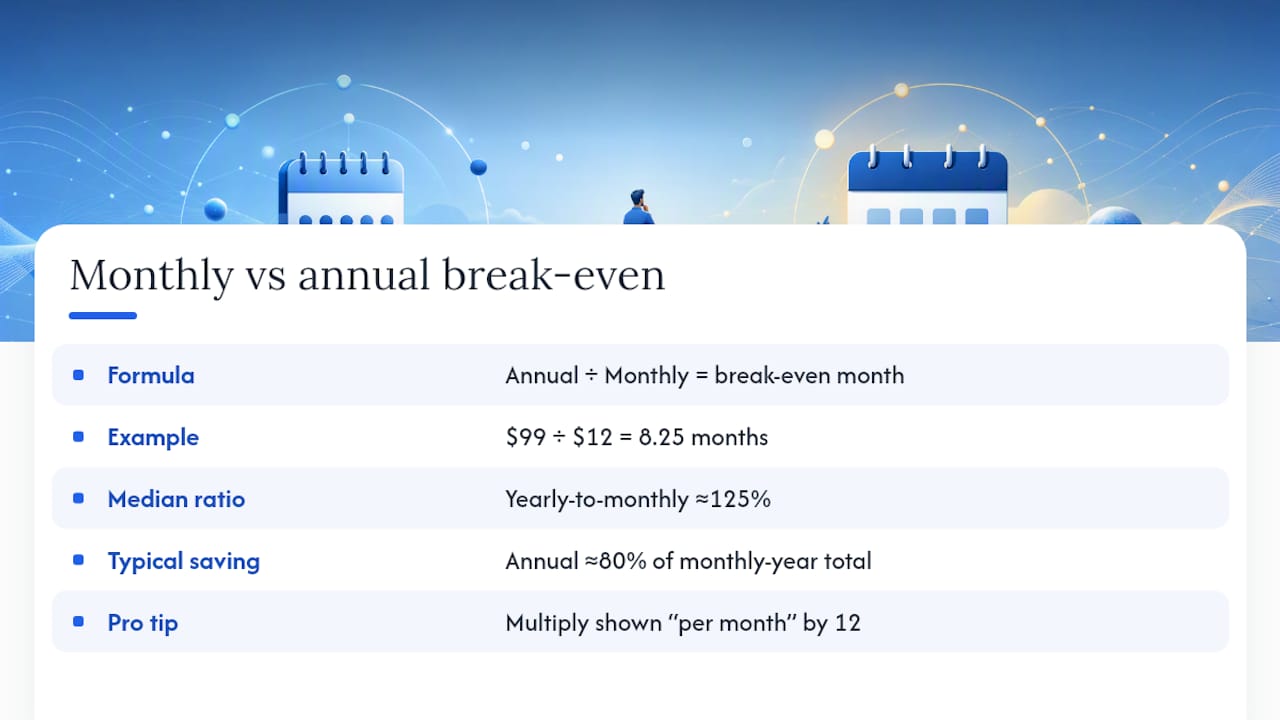
Break-even formula: Annual price ÷ Monthly price = Break-even month
Say a service costs $12/month or $99/year. Divide $99 by $12 and you get 8.25. After roughly eight months of use, the annual plan is cheaper. Every month past that point, you're saving money compared to rolling monthly payments.
The Orbit Money subscription calculator puts the median yearly-to-monthly pricing ratio near 125%, meaning the typical annual plan costs about 80% of what you'd pay month to month over a year.
How promos and trials change the math. A free trial doesn't affect the break-even calculation directly, but it does shift your decision window. If you have a 30-day trial, you're essentially getting month one free. Run the break-even formula on the post-trial prices, not the promotional ones. Plug the sale price into the formula, not the standard annual rate.
1. Find the monthly price. Write down what you'd pay each month on the monthly plan. 2. Find the annual price. Get the full upfront cost, not the "per month" equivalent the pricing page often shows. 3. Divide annual ÷ monthly. The result is your break-even month. 4. Ask yourself honestly: Will you use this service past that month? If yes, annual wins. If uncertain, stay monthly. 5. Factor in any active promo codes before you commit.
Pro Tip: Pricing pages often display annual cost as a monthly equivalent (e.g., "$8.25/month, billed annually"). Always multiply by 12 to see the real upfront charge before you enter your card number.
What are the real advantages and disadvantages of monthly billing?
Monthly billing has a straightforward appeal: you pay less upfront and you can walk away at any time. For a service you're not sure about yet, that flexibility is worth real money.
Advantages of monthly subscriptions:
- Low upfront cost, which fits tight or uneven cash flow
- Easy to trial a service without committing to a year
- Cancel anytime without losing prepaid months
- Useful for seasonal needs (a summer learning app, a holiday gift service)
- Simpler to manage if you're juggling multiple subscriptions
Disadvantages of monthly subscriptions:
- Higher effective annual cost, typically 15–20% more than an annual plan
- More billing events to track, which increases the chance of a forgotten charge
- Month-to-month plans often have higher involuntary churn for sellers (more card-expiry failures per year)
- Psychological friction: you re-evaluate the purchase every 30 days, which can lead to cancellation even when the service is delivering value
Monthly billing is the right call when you're in trial mode, when your income is variable, or when you genuinely only need the service for a few months. A parent buying a children's media subscription for a summer road trip, for example, has no reason to pay for a full year.
When does an annual subscription plan actually make sense?
Annual plans reward commitment. The discount is real, the billing is simpler, and you stop second-guessing the purchase every month.
For a $15/month service, two months free equals $30 back in your pocket.
The tradeoffs are real, though. You pay a larger sum upfront, and if you stop using the service in month three, you've prepaid nine months you won't use. Most services don't offer prorated refunds on annual plans. Auto-renewal is another friction point: annual plans renew quietly once a year, and if you miss the notification, you're locked in for another renewal period before you notice.
Annual billing makes the most sense when:
- You've already used the service for at least one full month and like it
- The service is something you'll use year-round, not seasonally
- You prefer predictable, set-and-forget billing over monthly tracking
- The upfront cost fits your current budget without strain
- You're buying a gift for someone who will use it consistently (a child's subscription, a family entertainment plan)
Stripe's billing guidance notes that annual billing brings cash upfront for the seller and reduces the number of renewal decisions a customer faces, which tends to lower effective churn. From the buyer's side, that same dynamic means fewer chances to accidentally cancel.
Six questions to decide between monthly and annual billing
Run through these before you tap "buy." They take about two minutes and will tell you which cadence fits your situation.
1. How long do you realistically plan to use this service? If the honest answer is "at least a year," annual almost always wins on cost. If it's "a few months," stay monthly.
2. Have you already used it for at least one billing cycle? Never commit to annual on a service you haven't tried. One month of actual use tells you more than any marketing copy.
3. Can you comfortably afford the upfront annual payment right now? If paying annually would strain your budget this month, the monthly plan is the right call even if it costs more over time.
4. Is your need for this service seasonal or year-round? Seasonal use (summer, holidays, a specific project) favors monthly. Year-round use favors annual.
5. Do you want predictable billing with no monthly decisions? Annual billing is genuinely simpler. One payment, one renewal date, no monthly tracking.
6. Are you buying this as a gift? Gift purchases often map better to annual plans or dedicated gift tiers. A personalized digital gift delivered weekly for a year is a more meaningful present than a one-month trial.
Red flags that should keep you on monthly:
- You haven't completed a free trial yet
- The service is new and unproven in your household
- Your income is irregular or you're managing a tight budget
- You've already subscribed to several other annual plans this year
How billing cadence affects seller retention, LTV, and cash flow
For small businesses and content creators selling subscriptions, the billing cadence decision isn't just about pricing. It shapes cash flow, retention, and the long-term health of the business.
Piano's benchmark data shows annual subscribers are more than four times as likely to still be active after four years compared to monthly subscribers, and annual subscribers carry more than double the lifetime value (LTV). That gap compounds over time. A business with a higher share of annual subscribers has more predictable revenue and a longer average customer relationship.
Baremetrics reinforces this: annual cohorts consistently show better retention metrics than monthly cohorts, and annual billing can meaningfully increase LTV across SaaS and publisher contexts. Monthly plans often convert more new customers (lower friction at signup), but annual plans contribute a larger share of total revenue and longer customer lifespans.
Cash-flow implications for sellers:
- Annual billing delivers a lump-sum payment upfront, improving runway and reducing dependency on monthly payment success rates
- That upfront cash is technically deferred revenue (you owe the service for 12 months), which matters for bookkeeping and MRR calculations
- To avoid distorting monthly recurring revenue (MRR) figures, normalize annual payments by dividing by 12 before adding to your MRR total
- A billing mix weighted toward annual reduces the frequency of failed payment events, since card details are verified once a year instead of monthly
Seller actions worth taking:
- Default your pricing page to show annual pricing first (anchoring effect)
- Offer the annual upgrade after a customer completes their first full month, not at initial signup
- Track cohort churn separately for monthly and annual customers so you can see the retention gap clearly
- Consider a targeted email at the 10-month mark for monthly subscribers, offering an annual upgrade before they hit a natural cancellation window
What you need to know about auto-renewals, refunds, and payment methods
Most subscription billing problems are avoidable with a little preparation before checkout.
Payment methods and why they matter. Credit cards and ACH (bank transfers) are the most reliable options for recurring subscriptions. Chargebee's payment method documentation notes that reusable payment methods and automatic retry features materially reduce failed payments and involuntary churn. A debit card tied to a low-balance account is the riskiest option: one failed payment can interrupt your service even when you intended to keep it.
Key billing protections to put in place:
- Set a calendar reminder 30 days before your annual renewal date
- Enable transaction alerts on the card you use for subscriptions
- Read the refund policy before buying annual. Most services offer no prorated refund after the first 7–14 days
- Check whether the service allows mid-term switching (monthly to annual or vice versa) and whether the price difference is credited or charged immediately
- For annual plans, note the exact renewal date in your calendar app the day you sign up
On refunds and cancellations. Monthly plans are straightforward: cancel before the next billing date and you stop being charged. Annual plans are trickier. Most services will cancel future renewals but won't refund the remaining months. A handful offer a prorated refund within a short window (often 30 days). Check the terms before you commit.
Pro Tip: Use a dedicated credit card for all subscriptions. It creates a single statement to audit monthly, and if a charge surprises you, disputing it is faster when your subscriptions are isolated from everyday spending.
Applying the rules to G45-hero-cast: a worked example
G45-hero-cast delivers weekly personalized superhero podcast episodes for children ages 4–9. Each episode features the child as the hero, with the story tailored to their name, age, and interests. Episodes arrive every Sunday to a private podcast feed. The service offers monthly and annual subscription plans, plus gift options for grandparents or family members.
How the math works (illustrative example). Suppose the monthly plan is $12.99/month and the annual plan is $119.99/year. Divide $119.99 by $12.99 and you get roughly 9.2. That means after nine months of use, the annual plan has already paid for itself. The remaining three months of the year are effectively free. At the standard monthly rate, a full year would cost $155.88.

Note: G45-hero-cast's current pricing is listed at G45-hero-cast. The figures above are illustrative. Check the pricing page for exact current rates.
Recommendation by buyer type:
- Parents already using it: Annual is the clear call. If your child looks forward to their Sunday episode every week, you're a year-round user. Lock in the savings and skip the monthly billing cycle.
- New parents trying it for the first time: Start monthly. One or two episodes will tell you whether your child is engaged. Then switch to annual.
- Grandparents buying a gift: The annual plan or a dedicated gift tier is the most meaningful option. A full year of weekly personalized episodes is a gift that delivers every Sunday, not just once.
Children's media engagement tends to be consistent once a child connects with a character or story format. Research on children's media consumption trends suggests that audio content holds attention well for the 4–9 age group, which supports the case for annual commitment once you've confirmed the fit.
Transparency: this article is published by G45-hero-cast. Plan details and current pricing are available at G45-hero-cast.
How subscription billing affects your personal budget
The billing cadence you choose has a direct effect on how easy your budget is to manage. Annual plans create one large, predictable expense. Monthly plans spread cost across the year but add more line items to track.
For families managing multiple subscriptions (streaming, education, entertainment, software), the monthly billing approach can quietly inflate total spending. Each individual charge feels small. Added together, they can represent a significant monthly outflow that's easy to underestimate. A single annual audit, where you list every active subscription and its annualized cost, often reveals charges for services you've stopped using.
Annual plans help with budgeting in a different way: you pay once and the expense is done. There's no monthly decision, no risk of forgetting to cancel, and the cost is visible as a single line in your annual budget. For small-business owners, annual subscriptions also simplify expense tracking and can be easier to categorize for tax purposes.
The tradeoff is cash-flow timing. Paying $120 in January for a full year of service is a larger hit than $10/month, even if the annual total is lower. If your budget is tight in a given month, that lump sum can create short-term pressure.
Why psychology drives more subscription decisions than math does
The break-even formula is simple, but most people don't run it. What actually drives the choice between monthly and annual billing is a mix of cognitive shortcuts and emotional responses to how pricing is presented.
Loss aversion plays a significant role. Annual plans are often framed as "save $30" or "get 2 months free" rather than "pay $120 upfront." The savings framing activates loss aversion: you feel like you're losing money by not choosing annual. That's intentional. Pricing pages that default to annual billing use the same principle. Showing the annual price first anchors the monthly price as the expensive option.
Commitment aversion works in the opposite direction. A 12-month commitment feels binding in a way that a 30-day plan doesn't. Even when the math clearly favors annual, some buyers choose monthly because the flexibility feels valuable, even if they never actually use it. This is especially common with new services where trust hasn't been established yet.
Sunk cost thinking affects annual subscribers differently. Once you've paid for a year, you're more likely to keep using the service to justify the spend. That's not always rational, but it does mean annual subscribers tend to engage more consistently, which reinforces the retention data from Piano and Baremetrics.
For parents buying children's subscriptions, the emotional framing matters too. A weekly personalized episode is an ongoing gift. Paying monthly can feel like you're constantly re-deciding whether your child deserves it. Annual billing removes that friction and lets the experience speak for itself.
Where monthly vs annual billing shows up across industries
The monthly vs annual subscription decision appears across nearly every consumer and business category. The typical discount and the right choice vary by how the service is used.
Streaming and entertainment (video, audio, podcasts): Monthly plans dominate for casual users. Annual plans make sense for households that watch or listen daily.
Software and productivity tools (project management, design, writing): Annual is the default for business buyers who need the tool year-round. Monthly suits freelancers with project-based work. Many SaaS companies default their pricing pages to annual to anchor the comparison.
Children's education and entertainment (learning apps, personalized content, audiobooks): Annual plans reward consistent engagement. A service like G45-hero-cast, which delivers a new episode every week, is a natural fit for annual billing once a parent confirms the child is engaged. The family podcast benefits of consistent weekly listening compound over a full year in ways a single month can't capture.
Fitness and wellness (gym apps, meditation, nutrition tracking): Highly seasonal. January signups skew monthly; users who make it to March tend to convert to annual.
News and publishing: Annual subscriptions dominate revenue even when monthly plans generate more new signups, consistent with the Piano and Baremetrics benchmarks on LTV.
The case for trusting the math over your gut
Most people choose monthly billing because it feels safer. That instinct is understandable, but it often costs more than it saves.
The break-even formula is the most useful tool in this decision. Run it before you sign up for anything. If the break-even month is under 10 and you're confident you'll use the service that long, annual is almost always the better financial choice. The flexibility premium of monthly billing is real, but it's only worth paying if you genuinely need the option to cancel.
For family subscriptions specifically, the calculus tilts toward annual faster than most parents expect. Children's habits are sticky. Once a child connects with a weekly routine, whether it's a podcast, a learning app, or a story series, they tend to keep it.
The one exception: never commit to annual on a service you haven't tried. One month of real use is worth more than any amount of research.
G45-hero-cast: weekly superhero podcasts for your child
Every child between ages 4 and 9 deserves to be the hero of their own story. G45-hero-cast creates that story every week, delivering a fully personalized superhero podcast episode to your inbox every Sunday. Your child's name, interests, and personality are woven into each adventure.

The monthly plan lets you try it with no long-term commitment. The annual plan locks in savings and means your child gets a new episode every single week for a full year, with no monthly billing to track. Gift plans are available for grandparents and family members who want to give something that keeps giving.
Compare current monthly and annual pricing at G45-hero-cast and pick the plan that fits your family.
Sources
- Monthly vs. annual subscriptions: why the answer isn't either-or — Piano
- What does annual vs. monthly billing mean? | Stripe
- Annual vs Monthly Pricing: Which Drives Better Retention — Baremetrics
- Annual vs monthly subscription calculator — Orbit Money
- What are payment methods? — Chargebee
This article provides general financial information for US consumers and small-business decision-makers. It is not a substitute for personalized financial advice. Verify current pricing and terms directly with any subscription provider before purchasing.