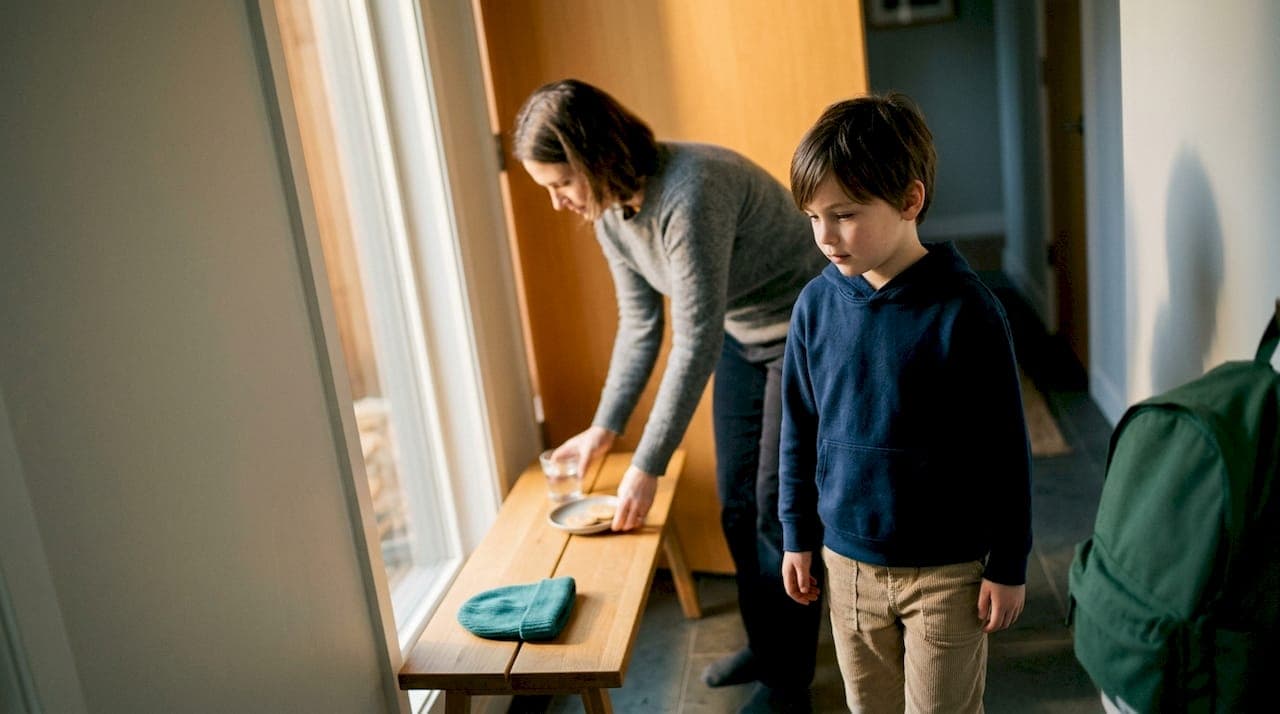
The first minutes after pick-up should be treated as recovery time. Welcome your child calmly without questions, offer a snack and water right away, and drop all demands for 20 to 45 minutes before bringing up homework, chores, or the school day. Save conversations about grades or behavior until your child shows signs of settling down.
TL;DR:
- Children need a calm, low-demand recovery period after school, focusing on food, quiet time, and reduced sensory input before addressing homework or chores.
- Signs of recovery include the child's willingness to engage in choices, slower breathing, or decreased emotional outbursts, not reaction to the initial meltdown.
- Matching activities to the child's state, such as calm, active, or sensory-focused options, improves their regulation and prevents fights or overstimulation.
- Implementing a predictable visual schedule and setting clear limits on screens and snacks beforehand helps reduce daily conflicts and supports self-regulation.
- For children with sensory differences or ADHD, extending low-demand time and individualizing strategies like sensory tools or space can significantly improve after-school transitions.
Table of Contents
- 2. Why kids fall apart after school: restraint collapse explained
- 3. A practical first-hour wind-down sequence to try tonight
- 4. Activity ideas grouped by child state: calm, active, and sensory
- 5. How to build a predictable after-school routine and visual schedule
- 6. Managing screens and snacks without power struggles
- 7. Adapting the wind-down for ADHD, autism, and sensory differences
- 8. When to seek help and what to share with teachers or clinicians
- 9. Why screen-free personalized audio can work as a wind-down
- 10. Role of parent or caregiver self-care during wind-down
- 11. Tips for creating a calming physical environment
- 12. How nutrition choices affect after-school wind-down effectiveness
- 13. Impact of after-school wind-down on children's emotional regulation and behavior
- 14. What actually matters in an after-school routine
- 15. A screen-free option worth adding to the routine
- Sources
- FAQ
2. Why kids fall apart after school: restraint collapse explained
Kids spend six or more hours holding it together: sitting still, following directions, managing friendships, and controlling impulses in front of teachers and peers. That sustained effort is exhausting, and once your child sees your face, the pressure to perform often drops all at once. A practical sequence that treats arrival as recovery rather than a debrief starts with a calm welcome, food and water, and reduced demands before quiet connection, movement, or sensory play, according to Understood.
The meltdown you see at 3:30 usually is not about the thing your child is yelling about. It is often the release valve for a full day of masking, layered on top of hunger, fatigue, and a nervous system running on stress hormones by the final bell.
Watch for these signals that your child is in recovery mode rather than acting out on purpose:
- Sudden crying or yelling over something minor, like a shoelace or a snack choice
- Going quiet or physically shutting down instead of talking
- Clinginess or refusal to separate from you at pick-up
- Meltdowns that fade once food, rest, or quiet time is offered
Children with sensory processing differences may need an especially low-demand first hour, including alone time and quiet self-regulation, since triggers and effective coping tools differ from child to child, notes the Child Mind Institute.
3. A practical first-hour wind-down sequence to try tonight
You do not need a new parenting philosophy to make this work. You need a sequence, applied the same way most days, so your child's body learns what comes next.
- Greet with calm presence. Skip "How was school?" and "Did you finish your test?" A hug, a smile, or simply "I'm glad to see you" is enough for the first few minutes.
- Offer a snack and water within minutes of pick-up. Blood sugar drops by mid-afternoon, and low blood sugar makes everything feel harder, from patience to problem-solving.
- Reduce sensory load and demands for 20 to 45 minutes. Dim harsh lighting, lower the volume, and hold off on chores, screen negotiations, or sibling refereeing during this window.
- Offer three choices and let your child pick. A quiet audio story, a few minutes of movement, or a sensory tool gives your child a sense of control without you having to guess what they need. A short, pre-agreed menu like this cuts down on negotiation and gives your child real agency during recovery, per Understood.
- Move to homework or chores only after you see regulation cues. Slower breathing, a softer voice, or simply asking "What's for dinner?" are signs your child has enough bandwidth left for a demand.
Pro Tip: Keep the first 20 minutes free of any question that starts with "why," "did you," or "how come." Save those for later, once your child is regulated enough to actually answer them.
The sequence takes about an hour from pick-up to homework time, adjusted to your child's pace, but the pace is set by your child's cues, not a clock.

4. Activity ideas grouped by child state: calm, active, and sensory
Not every child needs the same reset. Some kids need to burn off energy, others need quiet, and some need physical input like pressure or texture. Matching the activity to the state your child is actually in, rather than the one you wish they were in, saves you a fight.
Calm activities work well for kids who seem overstimulated or on the edge of tears:
- A personalized audio story or podcast episode, played in a dim, comfortable spot
- Reading aloud together on the couch
- Coloring or a simple craft with no "right" outcome
- A blanket wrap with quiet background music
Active activities suit kids who are wired, restless, or visibly bouncing off the walls:
- A 5 to 10 minute dance break to a few favorite songs
- Backyard play or a quick bike ride around the block
- A timer-based movement game, like "beat the clock" tidying that turns into a race
Sensory options help kids seeking input or trying to self-soothe through touch and pressure:
- A fidget toy or a small sensory bin with rice, beans, or sand
- A weighted lap pad during a quiet activity
- A chewy or crunchy snack, which can double as a calming sensory tool and blood sugar fix
Useful low-demand options include a quiet room, calming music, a blanket wrap, coloring, headphones, movement, or simply sitting near your child without requiring conversation, according to Understood. The goal is not to pick the "best" activity. It is to offer a menu your child can choose from without you having to read their mind every afternoon.
5. How to build a predictable after-school routine and visual schedule
Kids, especially younger ones, do better with a routine they can see rather than one they have to remember. A simple visual flow, arrive, snack, wind-down, homework or activities, dinner, bedtime, removes the guesswork and the daily negotiation over what happens next.
A predictable visual routine eases the after-school transition, particularly for younger children and kids with ADHD or autism, using simple pictures or words to show each step, according to Pediatrics of Florence.
Build it with these pieces:
- A picture chart or checklist taped near the door showing the day's sequence
- A visible timer for wind-down time, so your child can see how much quiet time is left
- A set homework window, but with some flexibility your child helps choose
- Praise for completing each step, rather than a lecture when a step gets skipped
Pediatric guidance on homework timing recommends flexibility: some kids do best tackling assignments right after a short unwind period, while others need the whole evening to reset first, per Healthychildren. Letting your child have some say in the schedule, within limits you set, cuts down on daily arguments.
Pro Tip: Praise completed steps out loud, "You did your snack and your quiet time, nice job," instead of narrating what went wrong. It reinforces the routine without turning wind-down into a performance review.
6. Managing screens and snacks without power struggles
Screens and snacks cause more after-school fights than almost anything else, usually because the rules show up after the device is already in hand or the cookie jar is already open.
Set the plan before pick-up, not during the meltdown. A family media plan with clear limits, announced in advance, works far better than a rule invented on the spot, and pediatric guidance recommends using device time settings, giving advance warnings, and teaching kids to set their own timers to build self-regulation, according to HealthyChildren.org (AAP). Screen time tantrums often happen when a child is already tired, hungry, or stressed, so the timing of the shut-off matters as much as the rule itself.
Practical tactics that hold up over weeks, not just one good afternoon:
- Set a visible timer before the screen turns on, not when it's time to turn it off
- Use built-in device time limits instead of relying on memory or willpower
- Offer a snack that pairs protein and carbohydrate, like apple slices with peanut butter or cheese and crackers, since steady blood sugar supports steadier behavior
- If screens genuinely help your child decompress, build a short, predictable window into the routine instead of treating it as an open-ended reward
For families actively working to cut screen reliance, a family media plan and a screen-free family time approach both give structure without turning every afternoon into a negotiation. Research on screen light and evening routines also points to a link between screen exposure and disrupted sleep, which is worth factoring in if bedtime battles are part of the pattern, according to Lumina Filter.
7. Adapting the wind-down for ADHD, autism, and sensory differences
The standard sequence works as a starting point, but some kids need more room to individualize it. For autistic children or kids with significant sensory needs, the first hour may need to be even lower-demand than usual, with alone time and quiet self-regulation prioritized over connection or conversation, since triggers and effective coping tools vary by child, according to the Child Mind Institute.
A few adjustments that make a real difference:
- Skip forced eye contact, hugs, or "tell me about your day" until your child initiates it
- Offer a genuinely quiet space, not just a quieter room, if your child needs full solitude to reset
- Keep a rotating set of sensory tools on hand and let your child pick, rather than assigning one
- If collapses happen most days, share a short log with the teacher and ask about sensory or movement breaks at school
Forcing interaction during high distress commonly backfires. Clinicians generally recommend low-demand support and tools chosen for that specific child instead, per the Child Mind Institute.
8. When to seek help and what to share with teachers or clinicians
Occasional after-school meltdowns are common and not a red flag on their own. Persistent, severe episodes, changes in sleep or appetite, or any safety concerns are worth raising with your child's teacher or a clinician, according to Roberts Academy.
A simple log makes those conversations useful instead of vague. Track arrival time, food eaten, sleep the night before, school events, sensory triggers, the behavior itself, and what helped. Keeping this for one to two weeks tends to reveal patterns that speed up diagnosis and support planning, per Roberts Academy.
Bring that log to the teacher or clinician and ask directly about sensory or movement breaks, reduced classroom transitions, or whether an evaluation for additional support makes sense.
9. Why screen-free personalized audio can work as a wind-down
Focused audio, unlike a screen, gives a child something to engage with without the visual stimulation that can prolong overstimulation. A story your child can just listen to, eyes closed or hands busy with something else, fits naturally into the "quiet connection" slot in the wind-down menu.
That is the idea behind weekly personalized superhero podcasts for children, delivered to a private feed. Each episode features the child as the hero of their own story, providing a screen-free option for quiet decompression time.
10. Role of parent or caregiver self-care during wind-down
The wind-down is not just about the child's nervous system. Yours is running on the same afternoon fumes, especially if you spent your own day managing work, traffic, or other demands before pick-up.
A parent arriving at pick-up already depleted has less patience for a meltdown in the parking lot, and kids tend to pick up on that tension even when nothing is said out loud. Building in something small for yourself, a few minutes of quiet in the car before your child gets in, a snack in your own bag, or simply lowering your own expectations for those first 20 minutes, changes how the whole interaction goes.
This does not require a separate self-care routine bolted onto an already busy day. It can be as small as:
- Taking three slow breaths before your child reaches the car
- Keeping your own snack in the car so you are not running on empty either
- Letting go of the urge to fix or discuss everything the moment you reunite
- Accepting that a quiet, low-conversation ride home is a win, not a missed opportunity
When you treat your own regulation as part of the plan, the calm you're asking your child to find becomes something you are modeling instead of demanding.
11. Tips for creating a calming physical environment
The physical space your child walks into after school shapes how fast they settle, sometimes more than anything you say. A bright, loud, chaotic entryway asks a lot of a nervous system that is already stretched thin.
A few environmental changes make the wind-down window more effective:
- Dim harsh overhead lighting in the entry and main living area during the first 20 to 45 minutes
- Lower background noise: turn off the television, put phones on silent, and hold off on vacuuming or other loud chores
- Set up one predictable, comfortable seat or spot, a corner with a beanbag or a favorite chair, that your child associates with quiet time
- Keep the wind-down zone free of visual clutter like piles of mail or half-finished projects that add to sensory load
None of this requires a redesigned playroom. It is about removing friction during a window when your child has the least capacity to filter out noise, light, or mess.
12. How nutrition choices affect after-school wind-down effectiveness
Hunger is one of the fastest paths to a meltdown, and by 3:30 in the afternoon, most kids have gone several hours since lunch. Low blood sugar affects mood and impulse control before it affects anything else, which is why offering food within minutes of pick-up, rather than after homework, changes the whole tone of the afternoon.
A snack that pairs protein or fat with carbohydrate tends to hold steadier than sugar alone. Apple slices with peanut butter, cheese and crackers, or a handful of nuts with dried fruit all give a more even energy curve than a snack that is pure sugar and crashes 20 minutes later.

Timing matters as much as content. A snack offered the moment your child gets in the car or through the door does more for behavior over the next hour than the same snack offered after homework is already a fight. If your child tends toward sensory-seeking behavior, a crunchy or chewy snack can double as a small sensory reset alongside the nutritional boost.
13. Impact of after-school wind-down on children's emotional regulation and behavior
A consistent wind-down does more than prevent one bad afternoon. Over weeks, it teaches a child's nervous system what recovery feels like and how to get there, which is a skill that carries into other parts of the day.
Children who go straight from school into homework or chores with no buffer tend to have a harder time settling into either task, because the nervous system never gets the signal that the demanding part of the day is over. A predictable recovery window, on the other hand, gives that signal clearly: snack, quiet or movement, then a return to expectations.
This is also where the choice-based approach pays off. A child who picks their own wind-down activity, rather than having one assigned, practices identifying what they need and asking for it, which is a form of self-regulation that does not show up on a homework sheet but matters just as much. Over time, kids who go through this sequence regularly often need less coaxing to transition into homework, because the transition itself has become familiar rather than a daily negotiation.
14. What actually matters in an after-school routine
Most after-school advice treats the meltdown as the problem to solve. It is not. The meltdown is information, and the actual problem is usually a nervous system that never got a real recovery window before being asked to perform again.
Where a lot of well-meaning advice falls short is in treating every child's wind-down the same way, usually built around whatever calms an adult down fastest: sit quietly, talk it out, watch something soothing. That works for some kids and backfires for others, especially sensory-seeking or autistic kids who need movement or solitude, not conversation, to reset.
If you take one thing from all of this, prioritize the food and the demand-drop before anything else. The specific activity, whether it is a story, a sensory bin, or ten minutes outside, matters far less than making sure your child is fed, unbothered by questions, and given a real choice for those first 20 to 45 minutes. Get that part right consistently, and most of the rest sorts itself out.
— JG
15. A screen-free option worth adding to the routine
If your child gravitates toward audio during the quiet part of your wind-down menu, G45-hero-cast turns that instinct into something built specifically for it: a weekly personalized superhero podcast where your child is the hero of their own story, delivered to a private feed every week.
- Fits kids who settle best with a story rather than a screen or a conversation
- Works well as the "quiet audio" choice in your wind-down menu, no negotiation needed once it is part of the routine
- Available as weekly episodes or longer-term gift options
Check available plans and get started at G45-hero-cast.
Sources
- After-school routines | Understood
- School success kit: kids with sensory processing issues | Child Mind Institute
- Understanding after-school restraint collapse | Roberts Academy
FAQ
Is restraint collapse linked to ADHD?
Restraint collapse is not a diagnosis and is not exclusive to ADHD, but kids with ADHD often mask more effort throughout the school day to meet classroom expectations, which can make the after-school release more intense. Adjusting the wind-down with more movement time or sensory tools, rather than quiet sitting, often helps kids with ADHD more than a one-size-fits-all approach.
What is the 3-3-3 rule for children?
Definitions of the "3-3-3 rule" vary across parenting sources and it is not a term used by Understood, the Child Mind Institute, or the AAP in their after-school guidance. Rather than relying on an unverified rule, the first-hour sequence of calm welcome, snack, and reduced demands for 20 to 45 minutes is the version backed by child development sources.
Is it normal for kids to be exhausted after school?
Yes, exhaustion after school is common and expected, since kids spend hours managing attention, behavior, and social demands in the classroom. A snack, water, and a low-demand recovery window typically help more than pushing straight into homework.
My 7-year-old cries at school drop-off. What should I do?
Morning drop-off crying and afternoon after-school collapse often share the same root cause, which is difficulty managing the transition between environments and expectations. A predictable goodbye routine in the morning and a calm, low-question pickup in the afternoon both help a child feel more secure around these transitions; if the crying is daily and intense, it is worth mentioning to the teacher.