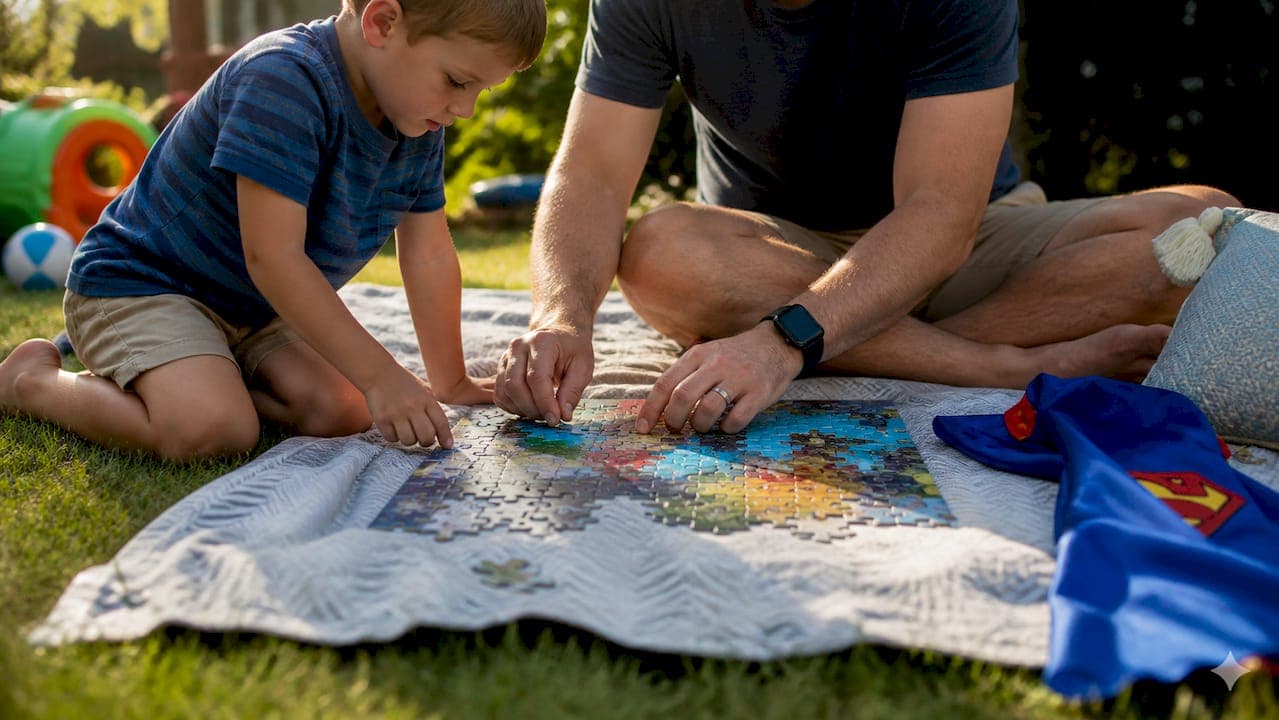
The single most effective parent-child bonding idea is also the simplest: 10 to 15 minutes of daily, undivided, child-led attention. That's the recommendation from pediatric child development research, and it beats the occasional big outing every time. Tonight, try one of two things. First, child-led story improvisation: sit down, hand your kid the plot, and let them narrate while you play sidekick for five minutes. Second, a 5-minute scavenger hunt: name three household objects, set a timer, and race together to find them.
- Pick one activity. Not three. One.
- Let your child choose how it goes, even if their version makes no sense.
- Put your phone in another room. Ten minutes of full attention beats thirty minutes of half attention.
Statistic to remember: just 10–15 minutes of focused daily time is enough to strengthen a parent-child bond and support a child's emotional development, according to pediatric researchers at the Indiana University School of Medicine.
Key Takeaways
A daily, undivided, child-led attention period that lasts a short time builds stronger parent-child bonds than infrequent elaborate outings ever will.
| Point | Details |
|---|---|
| Start with 10 to 15 minutes | Daily, undivided, child-led time is the single most evidence-backed bonding habit for ages 4 to 9. |
| Attach it to a fixed trigger | Link the bonding window to an existing routine, like after dinner or before bath time, so it actually repeats. |
| Match activity to mood | Choose quiet, messy, active, or interactive formats based on your child's energy that day, not a fixed schedule. |
| Shrink before you cancel | If your child resists, drop to five minutes and let them lead rather than skipping the ritual entirely. |
| Add a repeatable ritual | A weekly personalized podcast from G45-hero-cast builds anticipation and gives families a low-effort, screen-free listening ritual to share. |
Table of Contents
- Parent Child Bonding Ideas for Kids Ages 4 to 9
- Building a Daily Ritual That Actually Sticks
- Matching the Activity to Your Kid's Mood
- When Bonding Time Backfires
- Bonding Ideas for Infants and Toddlers
- Bonding Ideas for Preteens and Teenagers
- Why Communication and Emotional Responsiveness Matter More Than the Activity
- Using Family Traditions to Deepen the Bond
- What Ten Years of Small Rituals Actually Taught Families
- A Weekly Ritual That Does the Bonding Work for You
- Sources
Parent Child Bonding Ideas for Kids Ages 4 to 9
Kids this age want two things from you at once: your full attention and permission to be a little ridiculous. The activities below work because they give both, and none require a shopping trip or a Pinterest board.
- Blanket fort building. Grab couch cushions and a sheet, give your child the design authority, and climb in together. Fifteen minutes. The bonding mechanism here is shared physical space and a small shared goal, which naturally lowers everyone's guard.
- Cooperative cooking. Let them crack eggs, stir batter, or arrange toppings. Ten to twenty minutes. Kids feel like real contributors, not helpers, and that distinction matters to a 6 year old.
- Creative storytelling with a twist ending. You start a story, they finish it, then swap. Ten minutes. Laughter does a lot of the bonding work here.
- A 10-minute building challenge. Blocks, cardboard, pillows. Set one silly rule ("no hands, only elbows") and see what happens.
- Backyard or living-room scavenger hunt. Five to ten minutes, zero prep if you use items already in the room.
- Drawing each other's dreams. Ask what they dreamed about, then both of you draw it badly. Ten minutes, guaranteed laughs.
- Obstacle course with couch cushions. Great for active kids who need to move before they can connect.
- "Interview" your child with a pretend microphone (a spoon works fine) for five minutes about their day. This is child-led play in disguise: they set the topic, you follow.
- Puzzle time. A shared, wordless goal is one of the fastest ways to shift from parent-in-charge to teammates, which practitioner guidance on child-led play points to directly.
- Nature walk with a "collect five things" rule. Twenty minutes, works for ages 4 through 9 with almost no adjustment.
- Bedtime shadow puppets. Five minutes, calms an overtired kid, and doubles as a wind-down ritual.
- Family dance party in the kitchen. Three songs, no rules, maximum silliness.
For younger kids (4 to 5), keep instructions to one step and expect the "plan" to change mid-activity. For 8 and 9 year olds, hand them more control. Let them design the fort layout or write the scavenger hunt clues themselves. The Connected Families guide to repeatable bonding makes a point worth remembering here: a simple activity your family actually repeats beats an elaborate one you do once.
Building a Daily Ritual That Actually Sticks
Ten minutes sounds easy until 6 p.m. hits and everyone's tired. The fix isn't willpower. It's a fixed trigger.
Pick a moment that already happens every day, like right after dinner or right before bath time, and attach your bonding window to it. That predictability is what turns a good intention into an actual habit, and it's the same logic behind the 10-week structured activity program that measurably reduced parental stress and anxiety in families who stuck with it.
During that window, follow child-led play guidance: let your child choose the activity and the direction it takes, and resist correcting them, even when they're "doing it wrong." That correction instinct is the fastest way to turn a bonding moment into a power struggle. Once the ten minutes end, you can reintroduce normal structure and rules without any tension.
- Set a phone timer so you're not clock-watching.
- Choose an activity format needing no more than two prep steps.
- Keep the same time window most days. Skipped days happen. Just return to the trigger tomorrow.
Pro Tip: Your job during child-led play isn't to teach anything. It's to follow. The learning happens on its own.
Matching the Activity to Your Kid's Mood
A hyper kid handed a coloring book will resist you. A drained kid handed a scavenger hunt will melt down. Match the activity to the energy in the room first.
Low-prep and quiet: drawing, a shared puzzle, audio storytelling, a quiet card game, "would you rather" questions, sorting a junk drawer together.

Creative and messy: finger painting, a scrap-box craft project, playdough sculpting, kitchen "chef" time, sidewalk chalk art.
Active and loud: a cushion obstacle course, backyard tag, a dance party, a mini scavenger hunt, jumping-jack contests.
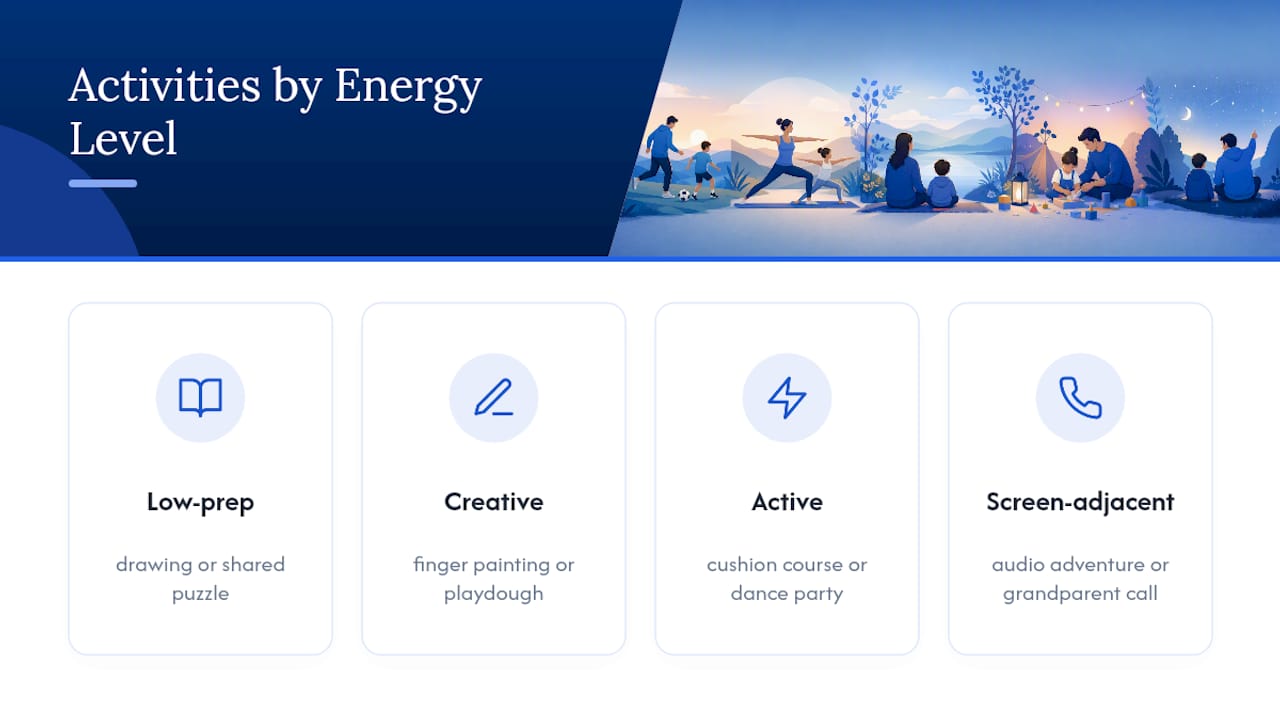
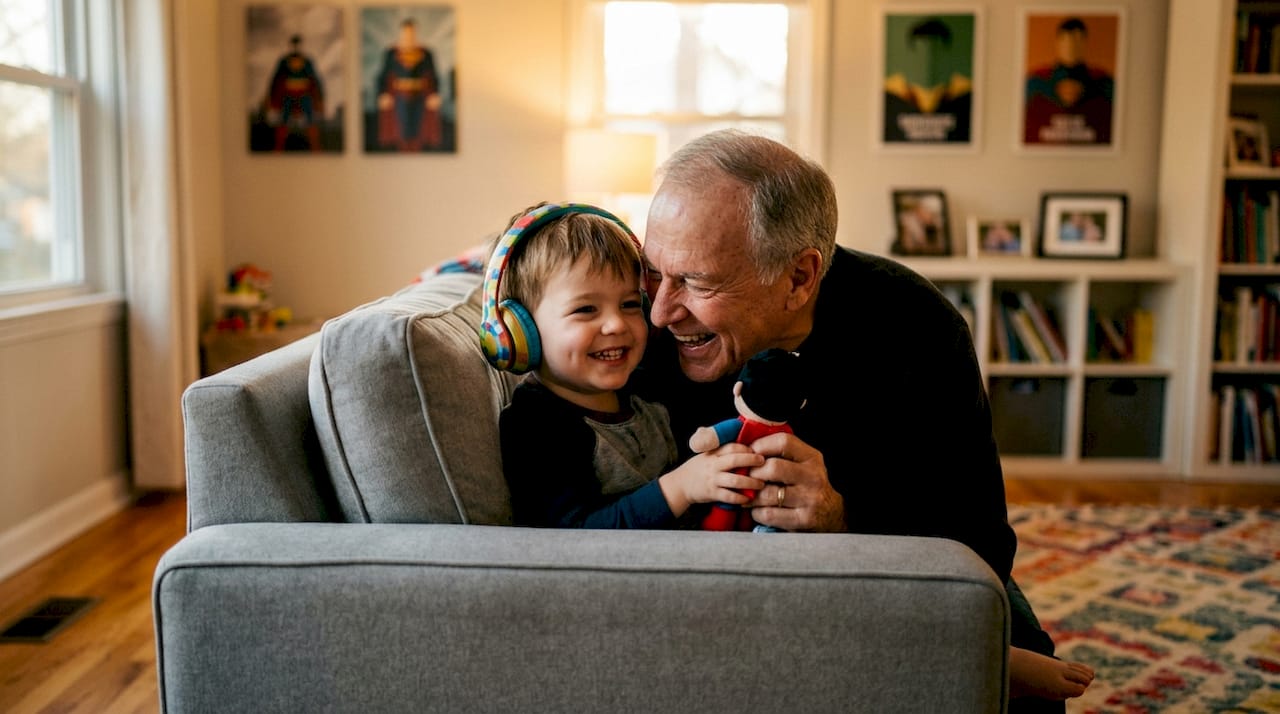
Screen-adjacent interactive: listening to a personalized audio adventure together and talking about it afterward, a shared video call with a grandparent, taking turns picking songs for a playlist.
Cooperative formats (working toward one shared goal) tend to build connection faster than competitive ones for this age group, though a little friendly competition works fine once your child is around 7 or older and can handle losing without a meltdown. A 4 year old usually needs the activity simplified to one instruction at a time. A 6 year old can follow two-step directions and enjoys mild silliness. A 9 year old often wants more say in what you do at all, so ask them to help choose from the list instead of assigning it.
When Bonding Time Backfires
Some days your child will flat-out refuse. That's not failure, it's information.
- Shrink the window. Offer five minutes instead of fifteen.
- Let them choose the activity, even if it's something you find boring.
- Change the tone entirely. If they're irritable, drop the structured game and just sit near them.
- Try a short repair script: "That didn't go how either of us wanted. Want to try something different?"
If resistance is constant over weeks, not days, or comes with signs of ongoing distress, that's worth a conversation with your pediatrician rather than another activity swap.
Pro Tip: A five-minute session your child actually enjoyed beats a fifteen-minute one you had to force. Shrink before you cancel.
Bonding Ideas for Infants and Toddlers
Bonding at 0 to 3 looks different than it does at 4 to 9, but the underlying rule doesn't change: consistent, attentive, low-tech contact. For infants, that means face-to-face talking during diaper changes, singing during feeding, and skin-to-skin time when possible. Babies bond through repetition and your voice, not through activities with a beginning and end.
For toddlers, short is everything. A 2 year old's attention span for a "planned" activity might genuinely be 90 seconds, and that's fine. UNICEF's parenting guidance recommends folding connection into routines you're already doing, like narrating what you're cooking while your toddler watches, or turning bath time into a naming game for body parts and bubbles.
Peekaboo, stacking blocks, reading the same picture book for the fortieth time, and simple call-and-response games ("where's your nose?") all count as real bonding. Toddlers also respond strongly to physical play, being swung, chased slowly, or bounced on a knee, because their nervous systems are still learning to regulate through your calm presence. Don't underestimate boring repetition here. A toddler asking for the same song for the tenth time isn't a sign your bonding attempt failed. It's the opposite.
Bonding Ideas for Preteens and Teenagers
Once your child hits 10 or 11, the format has to change even if the ten-minute principle doesn't. Preteens and teens will often refuse anything that looks like a scheduled "activity," but they'll talk for twenty minutes in a car with no eye contact required.
Car rides, in fact, become one of the best bonding windows for this age group precisely because there's no pressure to perform closeness. Cooking together still works, but let them run the recipe. Watching one show together on a loose weekly schedule, without your commentary, builds more trust than a forced heart-to-heart. Shared physical activity, a walk, a bike ride, shooting hoops, still carries the mental-health benefits seen in structured parent-child activity research, even when the conversation is minimal.
The biggest shift: with preteens, availability matters more than initiation. Be around, be unbothered by silence, and let them come to you on their timeline. Ask about their interests as a genuine question, not an interrogation, and drop it if they don't want to talk. The relationship you built with 10 minutes of undivided attention at age 6 pays off now, mostly by making you a person they still trust to be near.
Why Communication and Emotional Responsiveness Matter More Than the Activity
The activity is the vehicle. Your responsiveness is the actual bond.
A child who says "look what I built" and gets a real look, not a distracted glance, learns that their experiences matter to you. That small, repeated signal builds more trust over a year than any single elaborate outing. Practitioners who study child-led play point to this exact shift: when parents follow rather than correct, kids experience the interaction as partnership instead of evaluation, and they open up more.
Emotional responsiveness also means naming feelings out loud, both theirs and yours. "You seem frustrated that the tower fell" does more bonding work than silently rebuilding it for them. Kids as young as 4 can start connecting a feeling to a word when you model it consistently.
This matters just as much during ordinary moments as during planned activities. A five-second pause to actually answer a mid-dinner question, instead of a reflexive "not now," adds up across a week in ways that are easy to underestimate. Consistency, not intensity, drives the effect. One researcher-backed insight worth internalizing: small, repeatable, emotionally attentive moments outperform occasional grand gestures for building lasting connection, according to guidance on family bonding consistency.
Using Family Traditions to Deepen the Bond
Traditions do something daily activities can't: they give your child a sense of belonging to something bigger than one afternoon.
This doesn't require anything elaborate. A weekly family date night at home, same night, same low-key format, works because kids start anticipating it days ahead, and that anticipation is its own bonding mechanism, according to guidance on simple, repeatable family rituals. Cultural or heritage traditions carry extra weight: cooking a family recipe together, celebrating a holiday the way your own parents did, or teaching a phrase or song passed down from a grandparent gives your child an identity anchor, not just a fun afternoon.
Even invented traditions count. A "Friday pancake shape contest" you started three years ago is now a family tradition with the same emotional weight as one that's been passed down for generations. What makes it powerful isn't its origin. It's the repetition and the fact that your child knows it's coming.
If your family has a specific cultural or religious tradition, involve your child in the actual preparation, not just the final event. Letting a 7 year old help fold dumplings before a holiday meal, or help set up a Diwali display, builds far more connection than simply attending as a spectator.
What Ten Years of Small Rituals Actually Taught Families
Families who stick with a small daily ritual, not a perfect one, are the ones who report the strongest connection years later. The five-minute story swap that felt too small to matter usually turns out to be the thing your kid remembers.
The research backs up something practitioners have said for a while: consistency beats intensity, and following your child's lead beats correcting them. G45-hero-cast built its work on how audio play fuels imagination and connection around that same principle, treating a shared listening habit as a real bonding tool, not a babysitting shortcut.
If you want proof this works without spending a month planning it, try a 7-day experiment. Pick one micro-ritual, ten minutes, same trigger every day, and just track how your child responds by day seven. Most parents are surprised by how fast the resistance drops.
— JG
A Weekly Ritual That Does the Bonding Work for You
Some nights you don't have the energy to invent a scavenger hunt or referee a puzzle. That's where a fixed, anticipated ritual earns its place, and it's exactly the gap G45-hero-cast was built to fill.
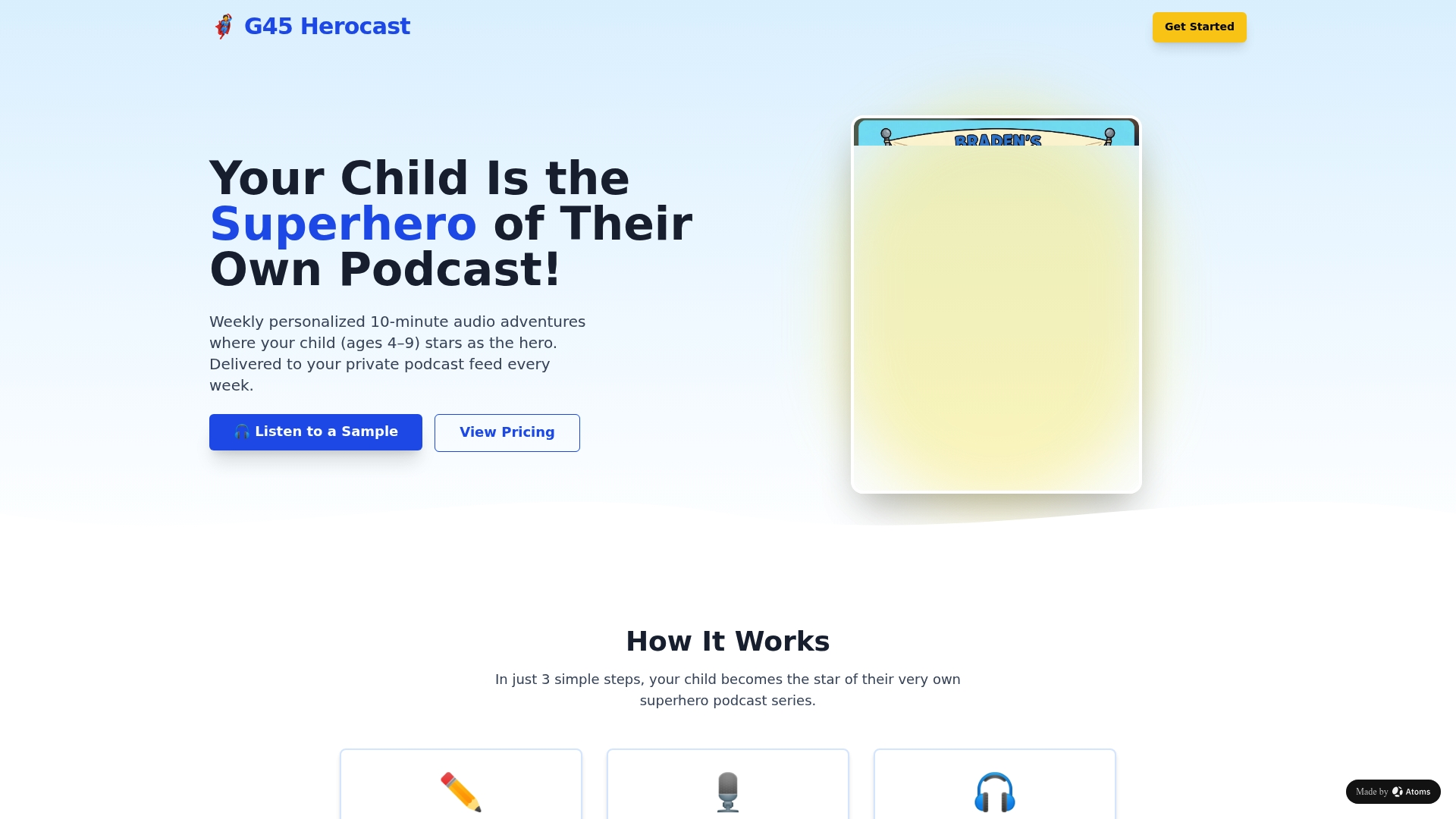
Every week, your child gets a brand-new personalized superhero podcast episode built around their name, their interests, and their age, delivered straight to a private podcast feed every Sunday. The anticipation itself becomes part of the bonding, kids start asking about "their" episode days before it drops, the same way they'd anticipate a family tradition. Listening together, then talking about what happened afterward, gives you a built-in conversation starter without any prep work on your end. It works especially well folded into an existing routine: queue it up during the car ride or make it part of the wind-down before bed as an alternative to the usual bedtime story.
Plans run monthly or annually, with sibling options if you've got more than one hero in the house, and gift subscriptions for grandparents who want in on the ritual too. Head to the G45-hero-cast landing page to see this week's episode options and get your child's first personalized adventure into their feed by Sunday.
Sources
- Child Development — The Importance of Positive Attention (IU School of Medicine Pediatrics blog)
- Effects of a structured parent–child physical activity program (PMC)
- Child-led play (CDC parenting guidance)