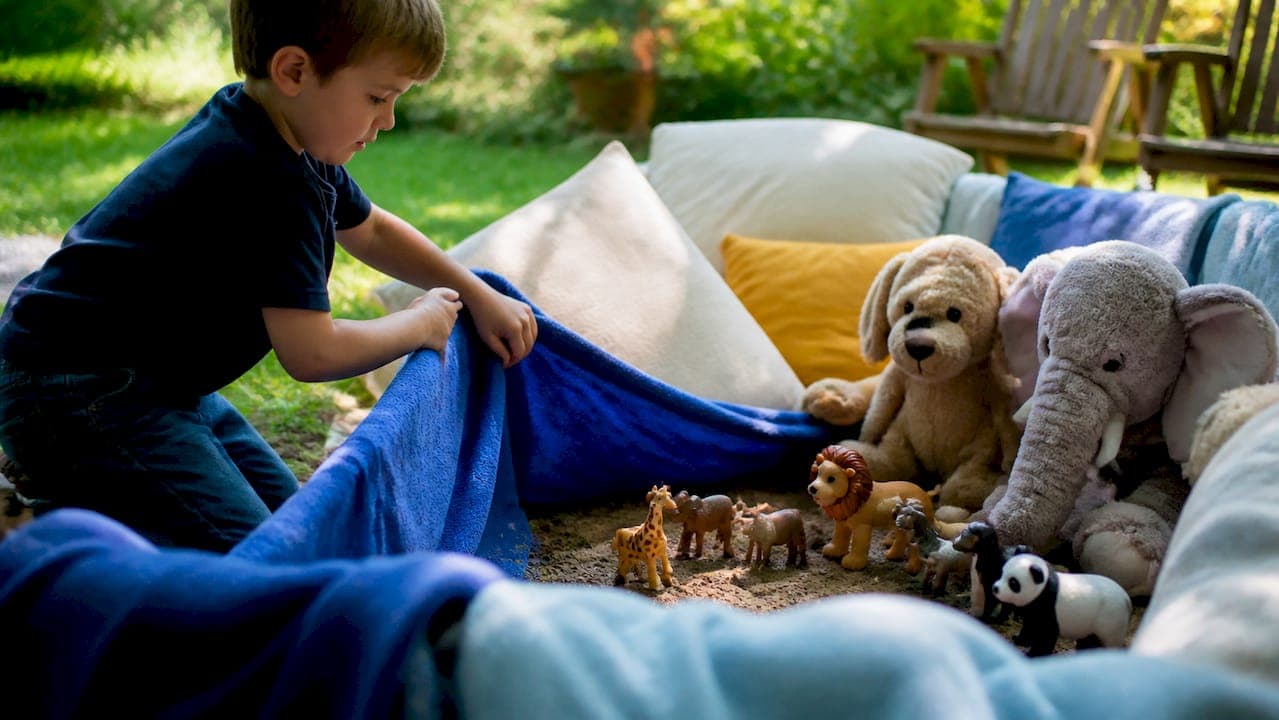
Try these 10 imagination-building activities to spark symbolic thinking, storytelling, and creative problem-solving in children ages 2–8. Most take around ten to twenty minutes and use items already available in your home.
Quick-start checklist — pick one today:
- Storytelling prompts | a short session of story-telling prompts lasting around ten to fifteen minutes | Toddlers through early elementary
- Pretend play with household objects | a brief period of pretend play with household objects lasting ten to twenty minutes | Toddlers through preschool
- Build-a-make-believe world (forts, block towns) | 20–45 min | Preschool through early elementary
- Puppet shows | a puppet show session lasting around fifteen to twenty-five minutes | Toddlers through preschool
- Open-ended art and collage | 15–30 min | Toddlers through early elementary
- Imagination walks (outdoor prompts) | 20–30 min | Preschool through early elementary
- Loose-parts and empty-box play | 15–30 min | Toddlers through preschool
- Story boxes (themed prop collections) | a story box activity lasting around fifteen to twenty minutes | Preschool
- Cardboard slotted creature construction | 30–45 min | Preschool through early elementary
- Audio-story role-play | a brief period of pretend play with household objects lasting ten to twenty minutes | Toddlers through early elementary
The sections below cover age tweaks, sample prompts, materials, and a full step-by-step cardboard project you can run on a weekend afternoon.
Key Takeaways
Short, frequent imagination-building activities using everyday household materials are among the most effective ways to develop symbolic thinking, language, and creative problem-solving in children ages 2–8.
| Point | Details |
|---|---|
| Start with what you have | Household objects, cardboard boxes, and scarves are enough to run most activities. |
| Frequency beats duration | Daily 10–15 minute sessions build more imaginative fluency than occasional long ones. |
| Follow the child's lead | Open prompts like "I wonder..." extend play without taking it over. |
| Slotted cardboard construction | Slot-and-connect building develops spatial reasoning and lets kids disassemble and rebuild across sessions. |
| G45-hero-cast audio extension | Weekly personalized superhero episodes extend imaginative play into car rides, quiet time, and bedtime. |
Table of Contents
- What imagination actually means for young children
- Why building imagination matters for development
- 10 imagination-building activities with materials, prompts, and age tweaks
- How caregivers can support imaginative play without taking over
- How often to do these activities, and what they cost
- Build a cardboard slotted creature: step-by-step
- Why imagination practice is worth protecting
- Personalized superhero audio as an imagination extension
- Sources
What imagination actually means for young children
Imagination, in the developmental sense, is the ability to use one thing to stand for another. A wooden spoon becomes a microphone. A blanket becomes a castle wall. That mental swap is called symbolic thinking, and it is one of the earliest and most important cognitive skills children build.
When a three-year-old pretends to pour tea for a stuffed bear, she is not just playing. She is practicing the same mental flexibility that later helps her understand that the letter A stands for a sound, or that a number represents a quantity. Pretend play supports symbolic thinking, language development, social negotiation, and emotional regulation in ways that single-purpose toys rarely match.
The messy, noisy, sometimes chaotic parts of imaginative play are not a sign that nothing is happening. They are the cognitive work in progress.
Preschoolers also develop narrative skills through play, learning to sequence events ("first the dragon came, then the knight..."), assign roles, and negotiate with playmates. That is early empathy and social reasoning, built one pretend scenario at a time. Drama, craft, music, and dance all contribute to this growth when children are given time, space, and the freedom to lead.
Why building imagination matters for development
The benefits of creative play activities are well-documented and span multiple developmental domains:
- Symbolic thinking: Children learn to represent ideas mentally, a foundation for reading, math, and abstract reasoning.
- Language growth: Role-play generates rich, varied vocabulary. Kids narrate, negotiate, and describe in ways that structured lessons rarely prompt.
- Social-emotional learning: Taking on a character requires perspective-taking. Playing "doctor" means imagining what the patient feels.
- Executive function: Research associates pretend and creative play with gains in cognitive flexibility and some executive function skills, though study designs vary and these are associations rather than guaranteed outcomes.
- Problem-solving: Open-ended play constantly throws up small problems. How do you make the fort stay up? What happens when the dragon wins?
At home, these benefits show up in concrete ways: richer dinner-table conversation, longer attention spans during self-directed play, and more flexible responses when plans change. A child who has spent some time negotiating a pretend restaurant scenario has practiced more social skills than many structured activities deliver in a similar period.
10 imagination-building activities with materials, prompts, and age tweaks
1. Storytelling prompt games
Description: One person starts a story with a single sentence; the next person adds one more. No wrong answers.
Materials: None required. Optional: a jar of story-starter slips (write 10 prompts on paper scraps).
Sample prompts:
- "One morning, a tiny dragon showed up at the front door..."
- "The spaceship landed in the backyard, and out stepped..."
- "A map appeared under the pillow. It led to..."
Age tweaks: Toddlers respond best when you do most of the narrating and pause for them to fill one word ("...and the dragon said roar because he was..."). Preschoolers can add full sentences. Early elementary kids can take turns being the "story boss" who decides plot twists.
Extension: Draw the story's main character when you finish. Parenting experts recommend role-based scenarios where the child is the hero to sustain engagement — try putting your child's name directly into the opening line.
2. Pretend play with household objects
Description: Hand a child a colander, a wooden spoon, and a dish towel and say nothing. Watch what they build.
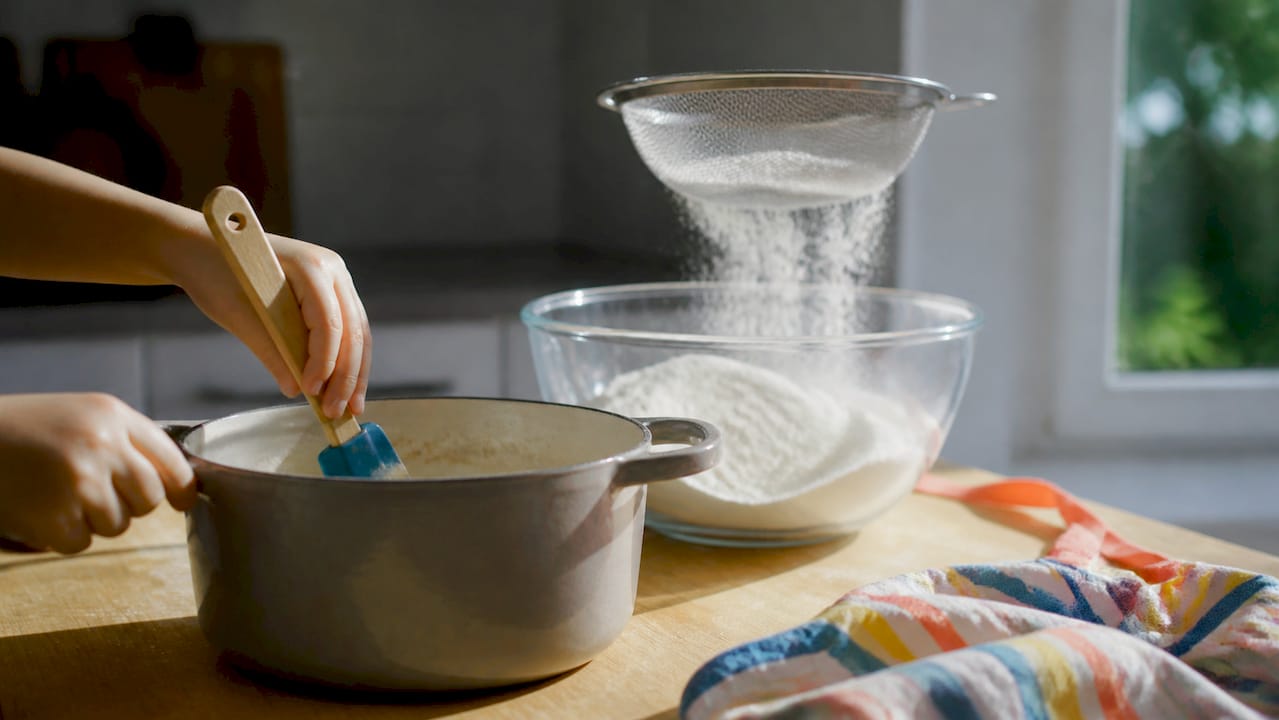
Materials: Kitchen utensils, scarves, cardboard tubes, empty containers, old hats.
Sample prompts:
- "What could this colander be if it wasn't a colander?"
- "You're the captain of a ship. What do you need?"
- "This box just arrived from a faraway kingdom. What's inside?"
Age tweaks: Toddlers need fewer objects (two or three at most). Preschoolers thrive with a small "prop basket" they can raid. Early elementary kids often prefer a loose scenario to kick things off, then take over completely.
Extension: Add a "mystery object" each day — one new item dropped into the basket without explanation.
Quick win: Parents consistently notice richer language samples during this kind of play than during screen time. Real-world materials with weight and texture tend to produce more meaningful pretend scenarios than single-purpose plastic toys.
3. Build-a-make-believe world
Description: Forts, block towns, couch-cushion castles. The structure itself becomes the story's setting.
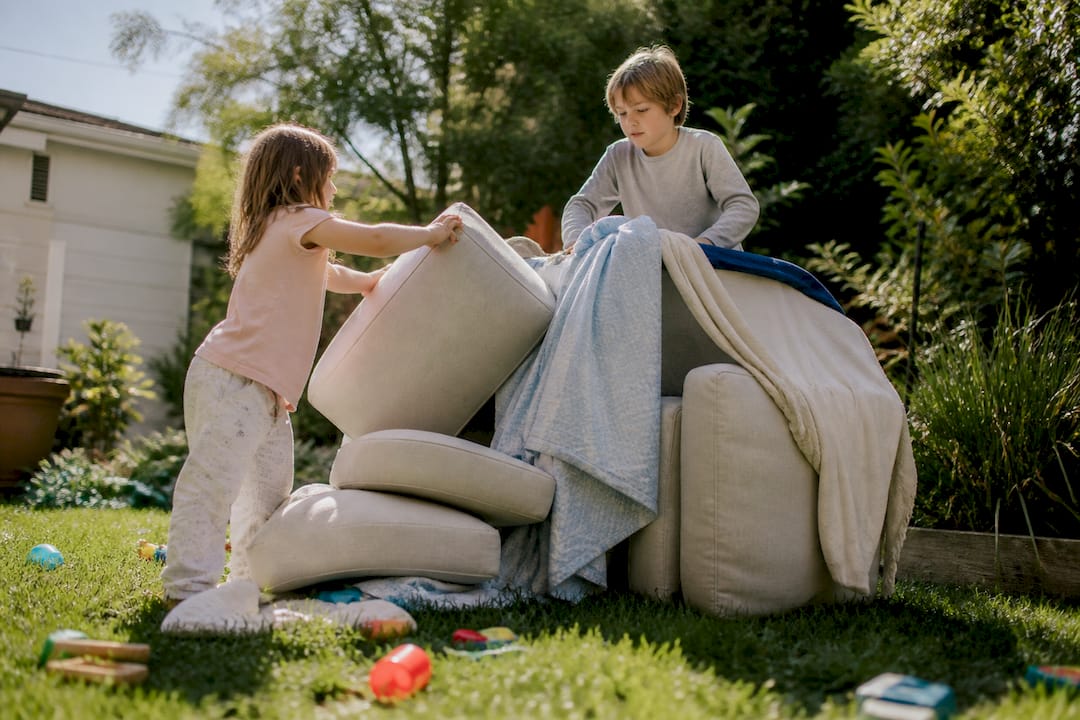
Materials: Blankets, couch cushions, cardboard boxes, blocks, small figurines.
Sample prompts:
- "Who lives in this fort? What are the rules of the kingdom?"
- "The town needs a hospital, a bakery, and a secret hideout. Where do they go?"
- "A storm is coming. How does everyone get ready?"
Age tweaks: Toddlers love the building phase but may lose interest in the narrative. Stay in the building phase with them. Preschoolers will populate the world with characters. Early elementary kids often write "laws" or draw maps.
Extension: Leave the structure up overnight. A world that persists gets richer stories the next day.
4. Puppet shows
Description: Sock puppets, paper bag puppets, or finger puppets perform a short scene. The child writes the script by talking.
Materials: Old socks, markers, googly eyes, paper bags, tape.
Sample prompts:
- "Your puppet just discovered a hidden treasure. What does it do?"
- "Two puppets disagree about something. How do they work it out?"
- "The puppet is scared of something. What helps it feel brave?"
Age tweaks: Toddlers love watching more than performing. Hold the puppet and let them direct. Preschoolers will perform enthusiastically with minimal setup. Early elementary kids can build a puppet theater from a cardboard box.
Extension: Record a short video of the show. Watching themselves perform is highly motivating for repeat sessions.
5. Open-ended art and collage
Description: No template, no "right" outcome. Provide materials and a loose starting point.
Materials: Old magazines, tissue paper, glue sticks, crayons, watercolors, fabric scraps, stickers.
Sample prompts:
- "Make a picture of a place you'd like to visit that doesn't exist yet."
- "What does your favorite feeling look like as a color?"
- "Build a creature from magazine cutouts. Give it a name and a superpower."
Age tweaks: Toddlers need large paper and chunky crayons. Preschoolers can work with scissors (rounded) and glue. Early elementary kids can add written labels or captions.
Extension: Display the finished piece and ask the child to give a one-minute "gallery talk" about it.
6. Imagination walks
Description: A walk with a creative lens. Every object outside becomes a prompt.
Materials: Just your feet. Optional: a small notebook for sketching finds.
Sample prompts:
- "That cloud looks like it could be a... what?"
- "If this tree could talk, what would it say?"
- "We're explorers on a new planet. What do we name this rock?"
Age tweaks: Toddlers respond to simple "what's that?" wonder questions. Preschoolers love assigning names to things. Early elementary kids can build a running story across the whole walk.
Extension: Collect one small natural object (a leaf, a pebble) and use it as a story prop when you get home.
7. Loose-parts and empty-box play
Description: A pile of open-ended materials with no instructions. The child decides what they are.
Materials: Cardboard tubes, bottle caps, fabric scraps, wooden spools, pebbles, pinecones, ribbon, empty boxes of any size.
Sample prompts:
- "What can you build with only these five things?"
- "Make a machine that does something impossible."
- "This is a city. What does it need?"
Age tweaks: Toddlers need larger, safer loose parts (avoid small pieces). Preschoolers can sort and categorize before building. Early elementary kids often invent elaborate systems with rules.
Extension: Multi-use, open-ended materials invite reinvention and collaborative play far longer than single-purpose toys. Rotate the loose-parts collection weekly to keep it fresh.
8. Story boxes
Description: A shoebox filled with five to eight themed props that suggest a scenario without dictating one.
Materials: A shoebox, small figurines, a piece of fabric, one or two small objects (a key, a coin, a tiny jar).
Sample prompts:
- "Everything in this box belongs to one character. Who are they?"
- "Something in this box is magic. Which one? What does it do?"
- "These characters just met for the first time. What happens?"
Age tweaks: Toddlers do best with three props maximum. Preschoolers can handle five to eight. Early elementary kids often prefer to build their own story box from scratch.
Extension: Swap boxes with a neighbor or cousin. Playing with someone else's story box sparks entirely different narratives.
9. Cardboard slotted creature construction (teaser)
Description: Children cut slots into cardboard panels and connect them without glue to build 3D creatures. Full step-by-step instructions appear in the dedicated section below.
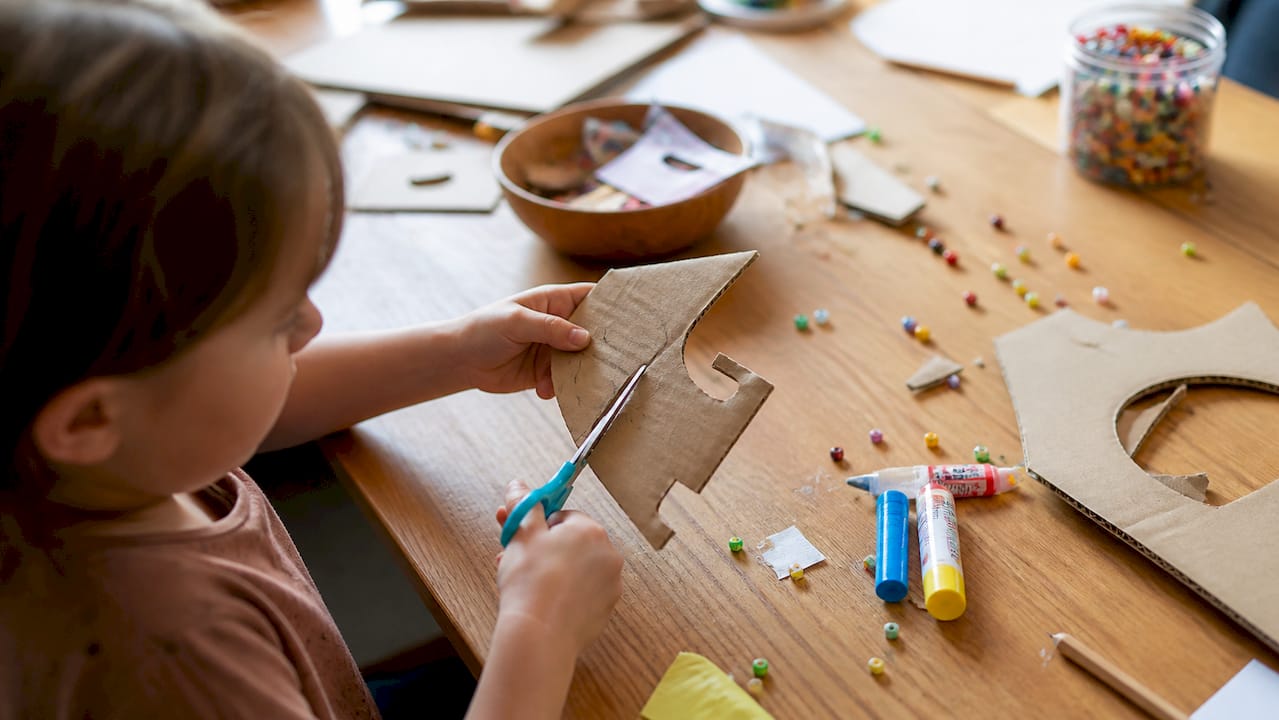
Materials: Cardboard boxes, child-safe scissors, markers.
Quick win: The slot-and-connect method means kids can disassemble and rebuild, which keeps the activity going across multiple sessions.
10. Audio-story role-play
Description: A story plays through a speaker or headphones. The child acts out scenes, adds dialogue, or plays a character alongside the audio.
Materials: A phone or speaker, a story podcast or audio adventure.
Sample prompts:
- "The hero in the story needs a sidekick. That's you. What's your power?"
- "Pause the story here. What do you think happens next?"
- "The villain just showed up. What does your character do?"
Age tweaks: Toddlers respond to simple sound cues and single actions ("roar like the dragon"). Preschoolers can sustain a parallel character for 10–15 minutes. Early elementary kids can write or draw their version of the story's ending.
Extension: For audio adventures that inspire kids to imagine and build, look for story-driven content where the child's name or role is part of the narrative.
How caregivers can support imaginative play without taking over
The single most effective thing you can do is follow the child's lead. That means resisting the urge to redirect, correct, or "improve" the scenario. A dragon that breathes ice cream is not wrong. It is a child testing the limits of possibility.
Caregiver behaviors that work:
- Follow the child's lead. Join the play on their terms, not yours.
- Use open prompts. "I wonder what would happen if..." beats "Why don't you try...?"
- Model role play. Pick up a puppet, take a character, show them how it's done without dominating.
- Offer loose parts quietly. Drop a new object near the play space without announcing it. Let them discover it.
- Keep cleanup simple. A bin that takes 60 seconds to fill means the activity actually repeats.
- Give time and space. Letting children lead and providing uninterrupted time supports creativity across ability levels.
Scripts you can use right now:
- "I wonder what this character is feeling right now."
- "What happens next in your story?"
- "Can I be someone in your world? Who should I be?"
- "That's interesting. Tell me more about that."
- "What does your character need to solve this problem?"
Pro Tip: Add one small constraint to deepen the play rather than extend it indefinitely. "The bridge is out — how do your characters get across?" forces creative problem-solving without ending the scenario. Constraints are the secret engine of imaginative play.
Parenting resources recommend "I wonder..." prompts specifically because they invite expansion rather than a yes/no answer. They signal that you are curious, not evaluating.
How often to do these activities, and what they cost
Short, frequent sessions beat long, infrequent ones. A 10–15 minute storytelling prompt at dinner five nights a week builds more imaginative fluency than a two-hour Saturday session once a month.
Suggested rhythm by age:
- Toddlers (ages 2–3): 10–15 minute sessions, once or twice daily. Attention spans are short; repetition is welcome.
- Preschoolers (ages 3–5): 15–30 minute sessions, daily if possible. They can sustain a scenario longer and benefit from returning to it.
- Early elementary (ages 5–8): 30–45 minute sessions, three to five times per week. They can plan, build, and revisit across days.
| Session length | Best activity types | Low-cost swap |
|---|---|---|
| 10–20 minutes | Storytelling prompts, audio role-play, imagination walks | Story-starter slips from scrap paper |
| 20–45 minutes | Pretend play, open-ended art, story boxes, puppet shows | Old socks for puppets, magazine scraps for collage |
| 45+ minutes | Fort building, loose-parts construction, cardboard creatures | Flattened delivery boxes, bottle caps, fabric scraps |
Budget tips:
- Cardboard boxes from online deliveries are free and endlessly useful. Flatten and store them.
- A "prop basket" costs nothing. Fill it with kitchen items, scarves, and old hats.
- Simple, low-cost activities like nature walks, dress-up boxes, and recycled-material construction are among the most effective for preschooler imagination.
- Rotate materials weekly. The same objects feel new after a two-week break.
Build a cardboard slotted creature: step-by-step
This project comes directly from the Exploratorium's Tinkering Studio approach. Slotted cardboard construction fosters hands-on building, recombination, and creative problem-solving because children can assemble, disassemble, and reinvent without glue or tape locking anything in place.
Why it works: Connecting flat panels into 3D forms requires spatial reasoning and planning. When a child tests whether a slot fits, adjusts the width, and tries again, that is iterative problem-solving in its purest form.
Materials:
- Flattened cardboard boxes (mixed thicknesses work well)
- Child-safe scissors or a box cutter (adult use only)
- Markers, paint, or stickers for decorating
- Optional: googly eyes, pipe cleaners, fabric scraps
Pre-work (adult): Flatten boxes and cut panels into manageable pieces (roughly 4" x 6" to 8" x 10"). Remove any staples. For children under 5, pre-cut some slots so they can focus on assembly.
Step-by-step:
- Cut your panels. Start with six to ten pieces of varying sizes. Rectangles, ovals, and irregular shapes all work.
- Cut the slots. Each slot should be roughly half the width of the cardboard's thickness and about one-third of the panel's length. Cut from the edge inward. Make some slots at the top of a panel, some at the bottom, some on the sides.
- Test the fit. Slide two panels together at their slots. They should hold without tape. If the fit is too loose, cut a narrower slot. If too tight, widen it slightly.
- Design your creature. Lay all panels flat and sketch a rough idea: legs, a body, a head, wings, a tail. No plan is too wild.
- Assemble. Connect panels slot-to-slot. Stand the creature up and adjust. Pieces that wobble can be reinforced with a second slot connection at a different angle.
- Test before decorating. Walk around the creature. Does it stand? Does it look like what you imagined? Adjust now, before the markers come out.
- Decorate. Markers, paint, stickers, googly eyes. Let the child lead this phase entirely.
- Name it and give it a story. "What is this creature called? Where does it live? What does it eat?"
Safety callout: Adults should handle box cutters at all steps. Child-safe scissors work for lighter cardboard. Supervise closely during the slot-cutting phase regardless of tool type.
Pro Tip: Use two or three different cardboard thicknesses in the same creature. Thicker pieces make sturdy legs and bodies; thinner pieces flex into wings and tails. The contrast in texture also makes the finished creature more visually interesting.
Pro Tip: Build two creatures at the same time and let siblings or friends each make one. When both are done, the natural next question is: "Do they know each other?" That question launches 20 more minutes of collaborative storytelling.
Why imagination practice is worth protecting
Most parents already know that play matters. What gets underestimated is how quickly the window for unstructured imaginative play narrows. Scheduled activities, screen time, and academic pressure tend to crowd it out well before children are developmentally ready to lose it.
The activities in this article are not enrichment extras. They are the core work of early childhood. A child who spends 15 minutes building a pretend restaurant is practicing language, math (how many plates do we need?), social negotiation, and narrative sequencing simultaneously. No worksheet covers that ground as efficiently.
What I find most compelling about the research is not the cognitive gains, which are real but modest in any single session. It is the cumulative effect. Children who have rich imaginative play histories tend to be more comfortable with ambiguity, more willing to try things that might not work, and more capable of generating their own ideas when boredom strikes. Those are not small outcomes.
The cardboard creature project is a good example of why hands-on making belongs alongside storytelling and pretend play. The physical act of testing a slot, adjusting it, and trying again teaches persistence in a way that is immediate and satisfying. The child sees the result of their adjustment in seconds. That feedback loop is rare in most childhood activities.
One more thing worth saying: you do not need to be a creative person to run these activities. You need to be willing to say "I wonder..." and then get out of the way.
Personalized superhero audio as an imagination extension
Every activity in this article works on its own. For parents who want an audio layer that fits into the gaps — car rides, quiet time, the 10 minutes before dinner — G45-hero-cast offers something genuinely different from a standard story podcast.
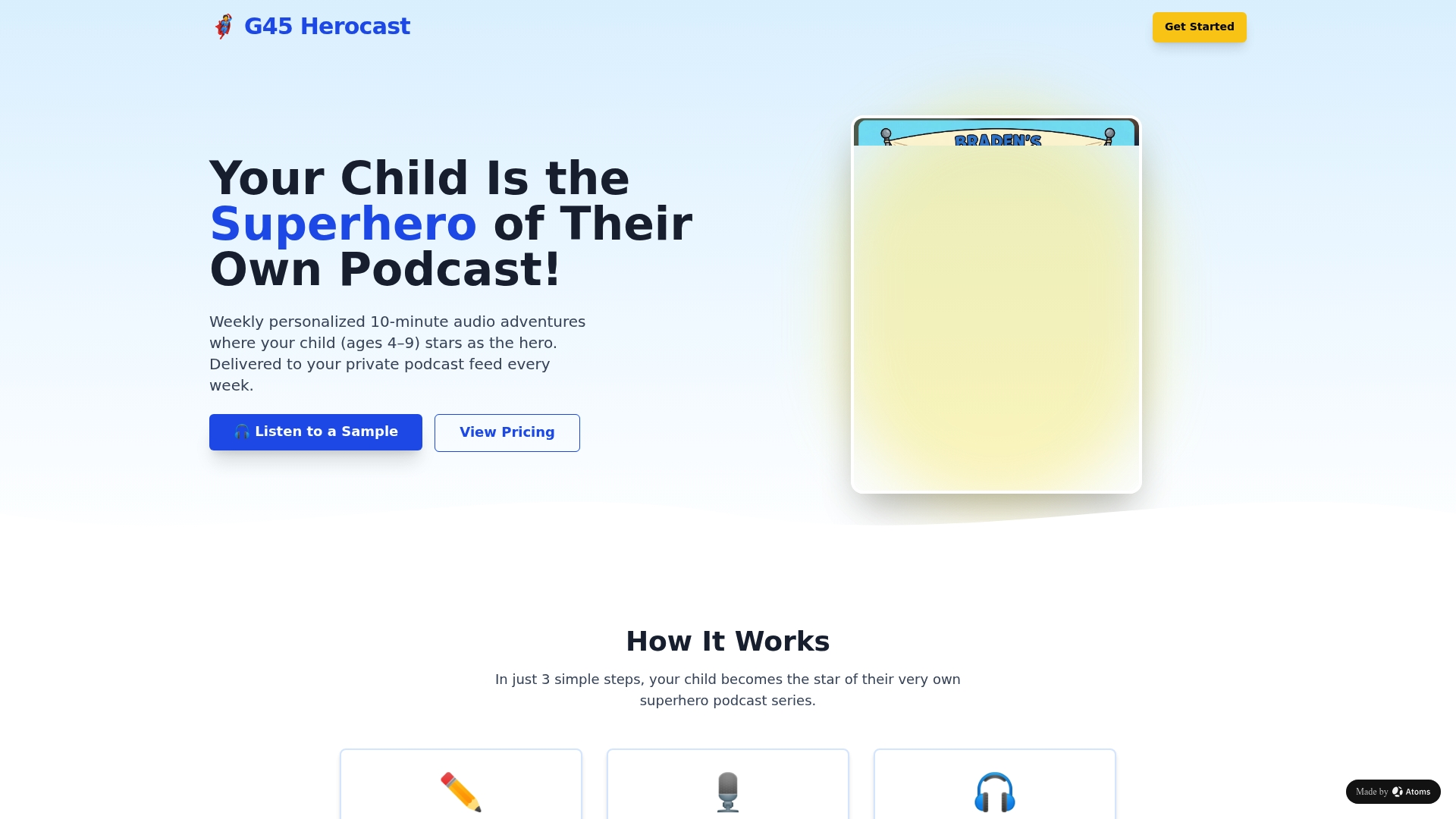
Each week, G45-hero-cast delivers a personalized superhero podcast episode where your child is the named hero of the adventure, tailored to their age, interests, and traits. It arrives every Sunday to a private feed. For a child who just built a cardboard creature or acted out a puppet show, hearing their own name in an audio adventure extends that imaginative momentum into a calm, screen-free moment. Parents use it during car trips, as a bedtime story alternative, or as a quiet-time anchor after active play.
Subscriptions are monthly or annual, and sibling plans are available. If you want to try it, visit G45-hero-cast and start a subscription for your child this week.
Sources
- Pathways
- Pretend play & learning opportunities — Bright Horizons
- Creature construction — Exploratorium Tinkering Projects
- Creative play & activities: preschoolers | Raising Children Network
- PMCID article on play and cognitive development — NCBI/PMC
- Creative play benefits & activities — Superspace (Play Magazine)