The smartest approach mixes free and paid sources: use library apps and public-domain collections like LibriVox for breadth, add a couple of DRM-free purchases for anything tied to a multi-year curriculum, and build one weekly playlist so listening becomes routine rather than an afterthought. Start today by picking one audiobook, one podcast episode, and one memory-work song, then queue them up for tomorrow morning.
TL;DR:
- Consistency and repetition are key; using a single playlist or private feed each week helps solidify habits and improves retention.
- Public library apps like Libby and OverDrive provide free, downloadable audiobooks and podcasts, but ownership is needed for long-term access to key curriculum content.
- Shorter audio formats such as memory songs and podcasts are ideal for quick, focused lessons, while audiobooks and dramatized dramas suit longer, engrossing learning periods.
- Adjust playback speed and utilize transcripts or captions for children with hearing or learning difficulties to enhance comprehension without overstimulation.
- Tailoring audio resources to each child's learning style and keeping content simple and routine-driven maximizes engagement and long-term effectiveness.
Table of Contents
- Types of Homeschool Audio Resources and What Each Does Best
- How to Use Audio in Your Homeschool Day
- Where to Find Free Audio Resources
- Streaming vs. Owning: When to Buy Instead of Borrow
- Devices, Apps, and Simple Workflows That Actually Stick
- Why Audio Works for Homeschoolers, According to the Evidence
- How to Tell If an Audio Resource Is Actually Worth Your Time
- Fitting Audio Into Your Curriculum, Whatever Style You Use
- Matching Audio to How Your Child Actually Learns
- Making Audio Work for Learners With Hearing Differences or Other Needs
- What Actually Matters Once the Novelty Wears Off
- G45-hero-cast: Weekly Personalized Audio Made for This Exact Routine
- Sources
Types of Homeschool Audio Resources and What Each Does Best
Not all audio pulls its weight the same way. Matching the format to the goal saves you from forty-five minutes of Peter Pan when what your second grader actually needed was five minutes of skip-counting set to music.
Audiobooks work for sustained attention and vocabulary exposure. Kids ages 6 and up can usually sit through 20 to 30 minutes; younger listeners do better in 10-minute chunks. Dramatized audio dramas (full cast, sound effects) hold attention longer because they mimic a movie without the screen, making them ideal for history units or literature that would otherwise feel dense on the page.
Educational podcasts fit shorter windows and work well for science, current events, or geography. Many are freely available on major platforms, and the Ultimate Homeschool Podcast Network curates shows specifically built for homeschool listening.
Memory-work songs are the workhorse for facts you want to stick, math skip-counting, Latin roots, states and capitals, because repetition set to melody beats flashcards for retention over time.
Curriculum audio lessons (paired with a textbook or workbook) work best for auditory learners who process spoken instruction faster than written text.
- Audiobooks: sustained listening, vocabulary, literature units
- Audio dramas: history and classic lit that needs a hook
- Podcasts: science, geography, current events, shorter attention spans
- Memory-work music: math facts, grammar rules, geography drills
- Curriculum audio: direct instruction paired with workbooks
Pair any of these with a two-question oral recap afterward. It takes 90 seconds and tells you instantly whether the content landed.
How to Use Audio in Your Homeschool Day
You don't need a new schedule. You need three slots you already have, repurposed.
- 10 to 15 minutes, morning warm-up. Play a memory-work song or two during breakfast cleanup or while kids get dressed. No screen, no seat required.
- 20 to 30 minutes, subject block. Swap a written science or history lesson for an educational podcast episode, then follow with a hands-on prompt, a simple experiment, a map to label, and a timeline to add to.
- 30-plus minutes, read-aloud time. Use this for a full audiobook chapter or an audio drama episode, ideally during quiet time, car rides, or right before rest time.
Pairing examples that actually work: a history audio drama followed by pointing out the setting on a wall map; a nature podcast followed by a backyard scavenger hunt tied to what was mentioned; memory songs as the fixed opener to math time, every single day, same order.
For kids with reading difficulties, slow playback speed to 0.75x on tricky material, and look for titles with a printed transcript so they can follow along visually while listening. Repetition helps more than most parents expect. A song or passage that feels redundant to you by week two is often exactly when it clicks for your child.
Pro Tip: Keep a single running playlist per week instead of building a new one daily. Add to it Sunday night, then just hit play each morning. This one change eliminates most of the daily friction that makes audio routines fall apart after two weeks.
Where to Find Free Audio Resources
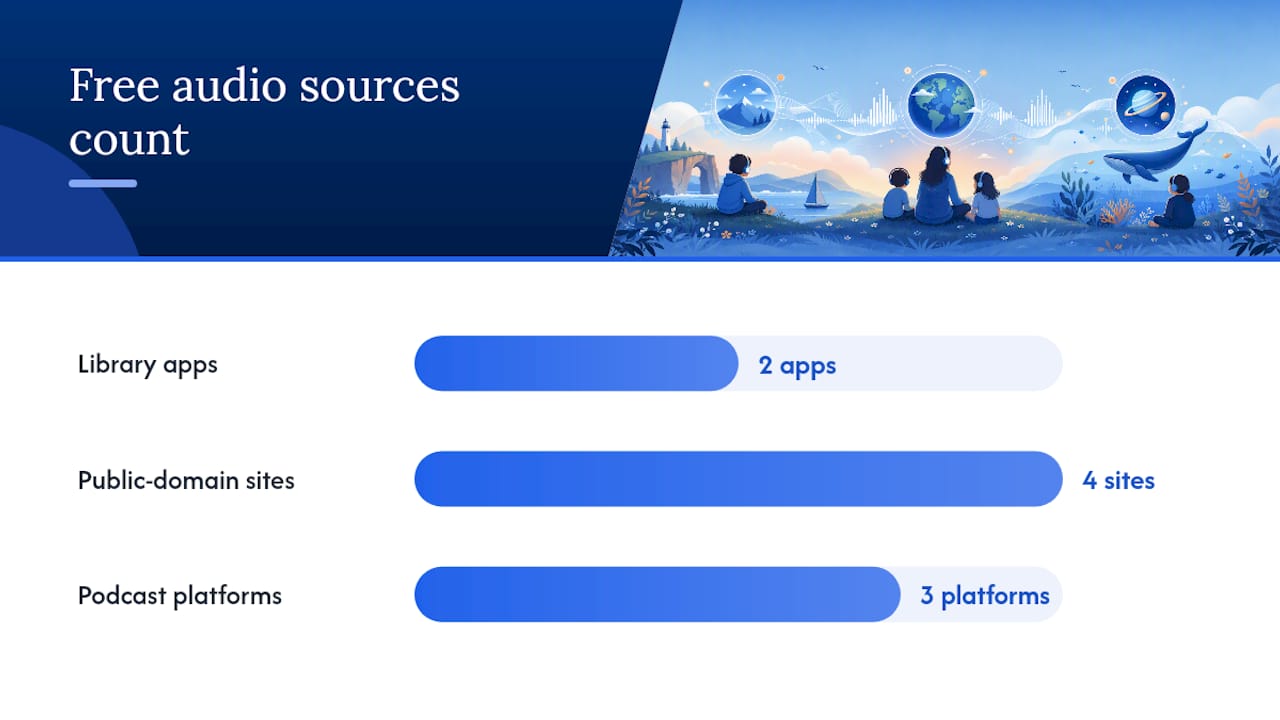
Library apps are the fastest on ramp. Libby and OverDrive connect to your existing library card, let you search by age range or subject, and place holds on popular titles the same way you'd reserve a physical book. Once borrowed, titles download for offline listening, so a spotty car ride Wi-Fi signal never matters.
Public-domain collections fill in what libraries don't carry:
- LibriVox offers volunteer-read public-domain audiobooks perfect for family read-alouds, though recording quality varies by volunteer.
- Project Gutenberg hosts a deep catalog of public-domain audiobooks and text-to-speech recordings, heavy on classic literature.
- Lit2Go, built by the University of South Florida, curates free audiobooks with companion materials designed for educators, including printable guides.
- Internet Archive rounds things out with a large audio collection of books and dramatized readings, useful when the other three come up empty on an obscure title.
Free educational podcasts round out the mix, and many homeschool-specific shows are already sitting on Apple Podcasts, Spotify, and Amazon Music at no cost, a point the Best Nigerian Podcasts To Add To Your Feed Right Now also illustrates with curated global podcast examples, helping parents decide where to start.
Between library apps, four public-domain sites, and free podcast networks, most families can build a full month of listening without spending a dollar. The real cost is time spent searching, which is exactly why a saved playlist matters more than the source itself.
Streaming vs. Owning: When to Buy Instead of Borrow
Free covers most of your needs. But subscriptions and library holds share one weakness: access can disappear. A title gets pulled, a service changes its catalog, or a hold expires mid-chapter.
That's where DRM-free MP3 downloads earn their keep. Buying permanent, DRM-free copies protects you from losing access right when a title becomes central to a multi-year study, which matters most for:
- Curriculum-aligned audio you'll reuse across siblings or multiple years
- Dramatized history series tied directly to your history cycle
- Anything you'd be frustrated to lose mid-unit
Streaming wins on breadth and convenience. Ownership wins on permanence. You rarely need to choose one exclusively, just be intentional about which titles deserve the second category.
Devices, Apps, and Simple Workflows That Actually Stick
The fewer taps between "I want to listen" and actually listening, the more consistent your kids will be. A private podcast feed or dedicated app removes the friction of navigating file folders or asking you to find the file every time.
- Use a dedicated device or a locked-down tablet profile for younger kids, not a shared device loaded with games.
- Set a sleep timer so audio doesn't run unattended for hours.
- Rotate content weekly into one playlist or private feed instead of hunting for a "next" episode daily.
- For personalized content or private feeds, our guide on podcasts versus story apps breaks down which format fits which age and temperament.
Mini-workflow: borrow or download the week's audio Sunday night, load it into one playlist or feed, then set the device to a restricted "kid mode" so your child can hit play without wandering into unrelated content.
Pro Tip: Give each child their own named playlist, even if you're using the same device. Kids as young as 5 recognize "my playlist" and take ownership of hitting play without being asked.
Why Audio Works for Homeschoolers, According to the Evidence
Auditory learners process spoken content faster than text, and audio removes the decoding barrier for kids who aren't yet fluent readers but are cognitively ready for advanced material. That's the real value of a good audiobook: a second grader can access fifth-grade vocabulary and ideas through listening long before they could read the same book independently.
Curriculum developers behind memory-work music consistently point out that songs work best as a low-pressure, repeated routine rather than a rigid daily requirement, consistency over intensity. The same logic applies to app-based delivery: a private podcast feed lowers the barrier to daily use because kids access their own content without you pulling files each morning.
Publishers that specialize in personalized audio, including weekly custom episodes built for ages 4 to 9, follow the same principle: consistent delivery on a fixed schedule turns listening into a habit rather than a special occasion. Slot that kind of content into the same quiet-time or car-ride windows described earlier, and it becomes part of your rhythm instead of one more thing to remember.
How to Tell If an Audio Resource Is Actually Worth Your Time
Not every free audiobook or podcast episode is created equal, and the biggest quality gap isn't between paid and free. It's between content built for kids and content that happens to be safe for kids.
Check narration quality first. A volunteer-read title on a public-domain site can be excellent or genuinely hard to follow depending on who recorded it, so preview the first two minutes before committing your child's afternoon to it. Look for consistent pacing, clear enunciation, and audio that doesn't clip or distort.
Check content alignment second. A podcast tagged "educational" doesn't guarantee it matches your child's age or your family's values. Skim an episode description or listen to the first five minutes yourself before handing over the device.
Check for supporting materials third. The strongest resources come with something beyond the audio itself, a companion worksheet, a vocabulary list, discussion questions. Lit2Go's printable companion materials are a good example of what "reliable" actually looks like in practice: the audio and the follow-up activity were built together, not bolted on after the fact.
Finally, watch how your child responds after a week, not after one sitting. A resource that gets requested again on its own is doing its job. One that needs constant prompting probably isn't worth the real estate on your playlist.
Fitting Audio Into Your Curriculum, Whatever Style You Use
Audio doesn't require you to abandon your curriculum. It slots into whatever structure you're already running.
Classical and Charlotte Mason homeschoolers already lean on read-alouds and living books, so audio dramas and public-domain audiobooks are a natural swap for read-aloud time when your voice needs a break. Dramatized history series pair especially well with a chronological history cycle, since you can match each era to a corresponding audio title.
Unit study and project-based families benefit most from podcasts, since a single episode can anchor an entire week's theme, ocean life, ancient Egypt, simple machines, without requiring a textbook purchase.
Traditional or textbook-based homeschoolers can use curriculum-aligned audio lessons as a direct swap for a written lesson on a day when a child needs a change of pace, or as reinforcement the night before a test.
Eclectic and relaxed homeschoolers have the most flexibility, and often get the most value from memory-work songs specifically, because they require zero prep and fit into transition moments (car rides, cleanup, breakfast) that already exist in the day.
The common thread: audio works as a supplement to your existing structure, not a replacement for it. Trying to build an entire homeschool day around audio alone usually backfires, kids need the mix of hands-on work, discussion, and listening to retain material long term.
Matching Audio to How Your Child Actually Learns
Auditory learners are the obvious fit, but audio resources serve other learning styles too if you pair them intentionally.
For visual learners, add a physical component alongside the listening: a map to trace during a history drama, a timeline to fill in, or illustrations to look at while an audiobook plays. The audio carries the story; the visual task keeps their hands and eyes engaged.

For kinesthetic learners, movement and audio combine well. Let them build with blocks, draw, or do a simple craft while listening rather than requiring them to sit still. Podcasts and audio dramas work better than dense audiobooks for this group, since the content is punchier and doesn't demand unbroken focus.
For auditory learners, lean into everything: audiobooks, podcasts, memory-work music, dramatized readings. This is the group audio was practically built for, and you can push toward longer sessions without losing engagement.
For readers who struggle, use audio to access content above their current reading level. A child who reads at a second-grade level can absolutely comprehend fourth-grade material through listening, closing a gap that would otherwise limit what they can learn about.
The mistake most parents make is assuming one child's learning style applies to every sibling. Test formats individually. A memory-work song that clicks for one kid might bore another who needs the narrative pull of a full audio drama instead.
Making Audio Work for Learners With Hearing Differences or Other Needs
Audio-first learning assumes clear hearing, and for kids with hearing impairments or auditory processing differences, that assumption needs adjusting rather than dropping the format entirely.
Look for titles with synchronized transcripts or closed captions where available, since many podcast apps and some public-domain platforms now support text-along features. Pairing audio with a visible transcript lets a child with partial hearing loss follow along visually while still building listening skills at whatever level works for them.
Adjust playback speed rather than volume alone. A slower speed (0.75x) often helps more than turning the volume up, since it gives kids with auditory processing differences more time to parse each word without distortion.
For children with sensory sensitivities, dramatized audio with heavy sound effects or abrupt music cues can be overstimulating. Straightforward narration, a single voice, steady pacing, is often the better starting point before introducing full-cast productions.
None of this means audio is off the table for these learners. It means the format needs the same kind of accommodation you'd already apply to a printed worksheet: adjusted pacing, added visual support, and permission to repeat content as many times as needed without treating repetition as a sign something isn't working.
What Actually Matters Once the Novelty Wears Off
Every homeschool audio guide tells you to "make listening fun," as if the challenge were enthusiasm. It isn't. The challenge is that most families abandon audio routines within a month, not because kids stop liking it, but because the parent stops curating.
Here's what the evidence in this guide actually supports: consistency beats variety. A memory-work song repeated daily for six weeks does more for retention than six different songs played once each. A private feed or saved playlist that removes the "what do we listen to today" decision does more for follow-through than any amount of content quality. The families who stick with audio long-term aren't the ones with the best resources. They're the ones who removed the friction of choosing.
Where conventional advice falls short is treating audio like a curriculum to build instead of a habit to protect. You don't need forty podcasts queued up. You need three or four sources you trust, one playlist you refresh weekly, and the discipline to let repetition do its work instead of chasing novelty every time attention dips.
Start with the routine, not the resource list. The content matters less than whether it actually plays every day.
— JG
G45-hero-cast: Weekly Personalized Audio Made for This Exact Routine
Everything above assumes you're the one curating, borrowing, downloading, building playlists, previewing episodes. That works, but it takes ongoing effort every single week. A personalized superhero episode can be delivered to a private podcast feed weekly, built around a child including their name, interests, and a hero story.
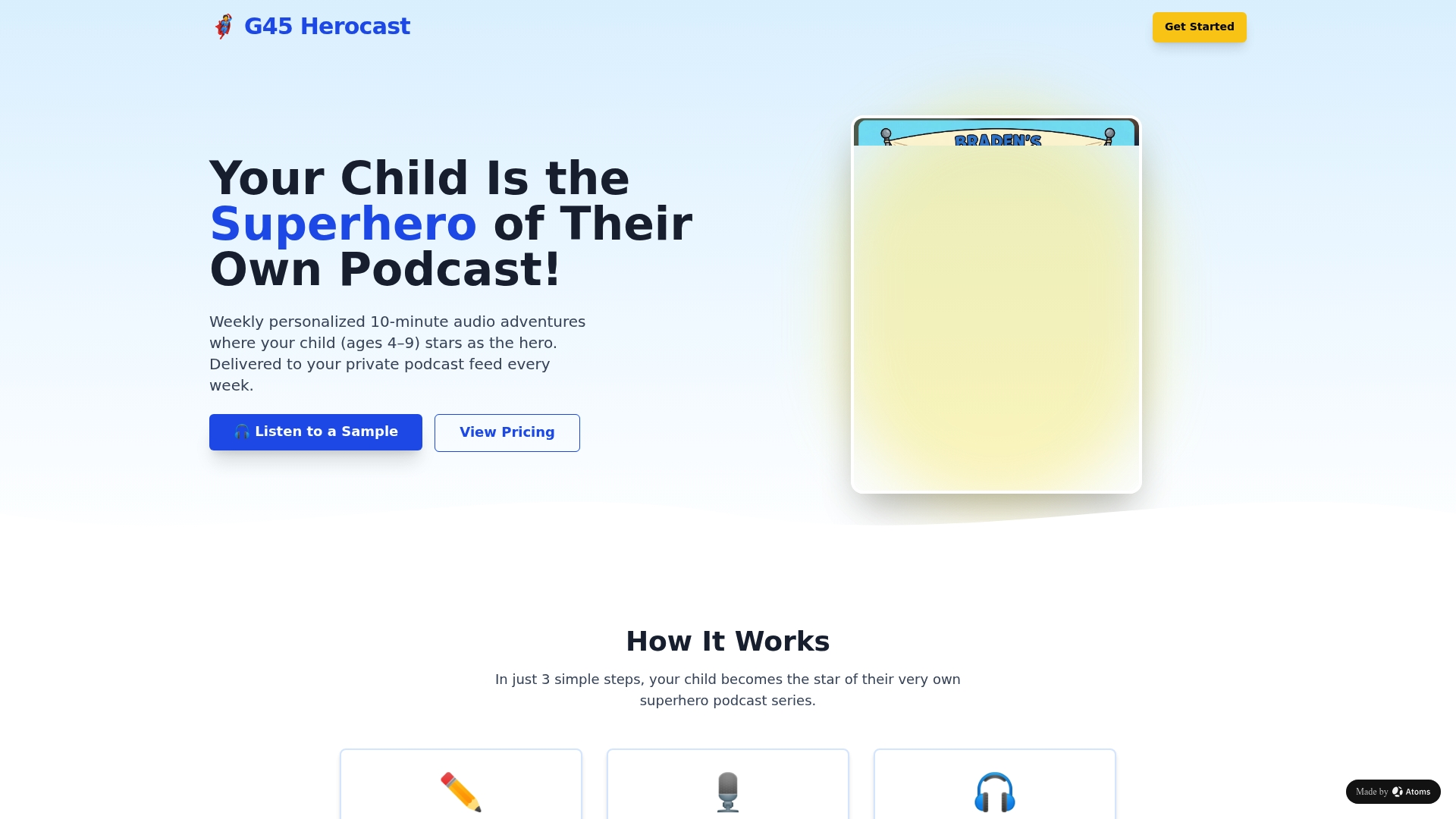
It drops directly into the quiet-time or independent-play slot described earlier in this guide, no searching, no previewing, no deciding what to queue up. Multiple personalized feeds and gift subscription options may be available, with different subscription plans. If the biggest obstacle to a consistent audio routine is the weekly curation itself, start a subscription at G45-hero-cast and let Sunday's episode show up already done.