
Start with short, interactive episodes from shows like Wow in the World, Ear Snacks, But Why, and PBS KIDS podcasts, then run three simple habits: preview a word or question before pressing play, pause once mid-episode for a listening game, and ask for a one-sentence retell afterward. That combination, not the show alone, is what actually trains a child's ear. Pick one episode this week and try one activity from it.
TL;DR:
- Structured activities before, during, and after listening significantly enhance children's comprehension and engagement compared to passive listening.
- Short episodes, approximately 6 to 15 minutes, with clear vocabulary and rhythmic breaks suit different age groups and maintain attention.
- Rotating a variety of podcast formats across genres prevents disengagement and trains diverse listening skills.
- Active listening exercises like prediction, guessing, and retelling improve retention and can be integrated easily into routine family moments.
- Consistent, low-distraction practice scheduled during familiar routines yields faster development of listening and language skills.
Table of Contents
- The Fastest Way to Start: 6 Listening Skills Podcasts for Kids
- Why Podcasts Actually Improve Listening, Language, and Focus
- Before, During, and After: Active Listening Activities That Work
- Matching Podcast Complexity to Your Child's Age
- The Full Catalog: 15 Shows Worth Rotating Through
- Why This Advice Holds Up
- Tracking Whether Listening Skills Are Actually Improving
- When a Child Struggles to Listen or Stay Engaged
- Fitting Podcasts Into Real Family Schedules
- What Changes Fast and What Takes Time
- A Different Kind of Listening Practice: Personalized Superhero Episodes
- Sources
The Fastest Way to Start: 6 Listening Skills Podcasts for Kids
You don't need a spreadsheet of forty shows to get started. You need one good episode and a reason to pay attention to it. These six cover the range of formats that show up again and again in recommendations from PBS and Common Sense Media, and each trains a slightly different listening muscle.
- Wow in the World (best for ages 5 to 9): The hosts talk directly to kids and pepper episodes with sound effects and mini quizzes, which forces active tracking instead of background noise. Try an episode about space or animals, then ask your child to explain the "wow fact" back to you.
- Brains On! (best for ages 6 to 9): Real kid co-hosts ask the questions, and each episode ends with a listener-submitted mystery sound the child has to guess. That guessing game is a built in listening skills exercise. Use the mystery sound segment as your pause-and-predict moment.
- Ear Snacks (best for ages 4 to 6): Built around music, rhythm, and short segments, it rewards kids for noticing patterns in sound rather than following a plot. Try an episode and have your child clap along or repeat a rhythm back.
- But Why: A Podcast for Curious Kids (best for ages 5 to 9): Real children submit the questions, and the episode structure trains sequential listening since answers build in stages. Pick a question close to your child's own curiosity and pause to predict the answer before it's revealed.
- PBS KIDS podcasts (best for ages 4 to 8, depending on the show): Familiar characters and predictable formats make these a gentle entry point, especially for kids new to audio-only content. Try a story episode and ask your child to draw the main event afterward.
- A Kids Listen directory pick (best for ages 4 to 9, since the Kids Listen catalog spans music, story, and interactive shows): Use the directory to rotate genres so your child doesn't lock into one format. Pick whichever category your child hasn't tried yet.
Notice none of these need a screen. That's the point. Audio-only content removes the visual crutch and puts the entire comprehension load on the ears, which is exactly the skill you're trying to build.
Why Podcasts Actually Improve Listening, Language, and Focus
The mechanism is simpler than it sounds: when a child can't see what's happening, their brain has to build the scene from sound alone. That's a heavier cognitive lift than watching TV, and it's the reason many top-rated kids' shows lean on interactive segments like games, music, and question-and-answer formats to keep that lift manageable, according to a literacy-focused review from the University of Iowa's education research center.
The research on structured audio use backs this up in a more formal way. Studies on audio learning show that systematic use, meaning episodes chosen with a purpose and paired with activities before and after, produces measurable gains in listening comprehension and motivation, and the effects are stronger with graded complexity than with unstructured listening. That's a meaningful distinction: just playing a podcast in the background during breakfast is not the same intervention as playing it with a plan.
Structured programs that combine a short pre-teach of key vocabulary, a focused listen, and a post-listen teach-back activity consistently outperform passive, unstructured listening in comprehension gains, according to research on audio learning strategies.
PBS reinforces this from the family side rather than the classroom side. Their guidance on family co-listening treats the parent's presence as part of the intervention. When you sit with your child and model what focused attention looks like, asking a follow-up question, reacting out loud to a plot twist, you're not just supervising. You're demonstrating the exact behavior you want them to internalize.
Here's the honest caveat: attention span is a real constraint, not a character flaw. Most children in the 4 to 9 range start tuning out somewhere around a typical attention span under twenty minutes unless the content actively pulls them back in. That's why interactivity isn't a nice bonus feature. A show that pauses to ask a question, invites a guess, or breaks into a song is resetting the child's attention clock in real time. A show that talks at them for 25 straight minutes is fighting biology.
One more thing worth knowing before you dive into a full rotation: podcasts genuinely support language development, not just listening stamina. Vocabulary introduced through story and dialogue tends to stick because it arrives with context and emotional stakes, not as a flashcard. If you want a deeper look at how audio compares to screen time for language growth, this guide on podcasts versus TV for kids breaks down what each medium is actually doing to a young brain.
Before, During, and After: Active Listening Activities That Work
A podcast episode by itself is entertainment. A podcast episode wrapped in three deliberate steps is a listening lesson. Here's how to structure any episode, regardless of which show you picked.
Pre-listen: set up the brain before you press play
- Preview one or two vocabulary words the episode will use. If the show is about volcanoes, mention "magma" or "erupt" beforehand so your child recognizes it instead of getting stuck on it.
- Ask a prediction question. "This one's called 'Why Do Zebras Have Stripes?' What's your guess?" Predicting primes the brain to listen for confirmation or surprise, which keeps attention anchored.
- State the purpose out loud. Something as simple as "Let's see if you can tell me the answer at the end" gives the listening a job to do instead of letting it drift.
During: five games that turn passive ears into active ones
- Signal-response. Have your child raise a hand, clap, or say a keyword every time they hear a specific word or sound cue. This works especially well with music-based shows like Ear Snacks.
- Detective listening. Assign a mystery to solve during the episode, such as "how many animals get mentioned," and check the count together afterward.
- Fill-in-the-blank. Pause right before an obvious word and let your child guess what comes next. It's a low-stakes way to test whether they're tracking sentence structure, not just sound.
- Call-and-response. Some shows, including Brains On!, build this in already with their mystery sound segment. If yours doesn't, invent one. Repeat a phrase the host says and have your child echo it back.
- Short replay chunks. If a segment is confusing or important, rewind 30 seconds and play it again. Repetition at the point of confusion does more for comprehension than pushing forward and hoping it clicks later.
Chunking a longer episode into five to seven minute segments with a short pause in between preserves attention far better than a single uninterrupted 20 minute stretch, particularly for kids on the younger end of the 4 to 9 range, based on guidance from University of Arizona's extension program on listening with young children.
Post-listen: lock in what actually landed
- One-sentence retell. Ask your child to summarize the episode in a single sentence. This is harder than it sounds and reveals exactly how much they absorbed.
- Sequencing check. Ask "what happened first, and what happened next?" Sequencing is a distinct comprehension skill from simple recall, and podcasts with a clear narrative arc train it well.
- Draw or act it out. For younger kids especially, drawing the main event or acting out a character's line does more for retention than a verbal quiz.
- Quick comprehension question. Keep it to one or two questions max. The goal is a temperature check, not a test.
Pro Tip: Reuse the same episode two or three times across a week instead of always reaching for something new. Familiarity frees up cognitive space for your child to notice details they missed the first time, and repeated short sessions build retention better than one long listen.
For classroom settings, the same structure holds, just scale the group interaction. A signal-response game works well with a whole class raising hands together, and the post-listen retell can become a partner-share activity instead of a one-on-one conversation. Keep total focused listening time to that same a maximum listening time of less than half an hour even in a classroom, and split longer episodes across two days if needed.
Matching Podcast Complexity to Your Child's Age
A 4-year-old and an 8-year-old need fundamentally different audio diets, and the mismatch is usually where "my kid won't sit still for podcasts" complaints come from. Here's what to actually look for at each stage.
- Ages 4 to 5: Look for episodes under a quarter of an hour, simple sentence structures, a slow and clear narrator pace, and frequent musical or rhythmic breaks. Shows like Ear Snacks or early PBS KIDS episodes fit here. Visual companion books help but aren't required.
- Ages 6 to 7: Episodes in the episodes roughly between a quarter and a third of an hour work well, with more complex vocabulary and light multi-step plots. This is the sweet spot for But Why and many Wow in the World episodes, since both explain concepts in layered steps that reward sustained attention.
- Ages 8 to 9: Kids at this stage can typically handle podcast episodes in the upper range of twenty minutes, denser vocabulary, and multiple characters or subplots. Brains On! and longer PBS KIDS story arcs fit well, and this is also the age where transcripts (if the show offers them) become a genuinely useful comprehension aid rather than a crutch.
Increase difficulty gradually rather than jumping genres and length at once. If your child has mastered episodes about a quarter of an hour, add five minutes before you add plot complexity. And keep an eye on narrator pace specifically: a fast, news-anchor style delivery that works fine for a 9-year-old will lose a 5-year-old in the first thirty seconds, regardless of vocabulary level. For more on matching shows to the youngest end of this range, see this breakdown of podcasts for kids age 4 and this guide to preschooler podcast picks.
The Full Catalog: 15 Shows Worth Rotating Through
A rotation matters more than any single show. Different formats train different listening skills, and kids disengage from anything that becomes routine. Here's a broader list to draw from once you've tested the starter six.
- PBS KIDS podcasts (ages 4 to 8): A broad catalog of story and music shows tied to familiar characters, which makes them a low-friction entry point. Try a character-based story episode and have your child predict the character's next move before it happens.
- Wow in the World (ages 5 to 9): Science and curiosity-driven, with a fast-paced, quiz-like structure. Good for building inference skills since the hosts often set up a question before answering it several minutes later.
- Brains On! (ages 6 to 9): Kid co-hosts and a running mystery-sound segment make this excellent for training sustained attention across a full episode.
- Ear Snacks (ages 4 to 6): Music and rhythm focused, ideal for kids who respond better to sound patterns than to spoken narrative.
- But Why: A Podcast for Curious Kids (ages 5 to 9): Real listener questions drive each episode, which trains kids to track how an answer builds across several minutes.
- Story-based shows in the Kids Listen directory (ages 4 to 9): The Kids Listen catalog spans dozens of vetted shows, useful when you want a new genre without vetting it yourself.
- Common Sense Media's curated podcast lists (ages vary by pick): Not a show itself, but a filter. Their age-rated recommendations help you skip anything mismatched to your child's stage.
- Music-and-movement audio shows (ages 4 to 6): Look for anything that pairs a song with a physical response, like clapping or dancing, since movement reinforces auditory pattern recognition.
- Mystery and detective format shows (ages 6 to 9): Any show built around solving a puzzle across the episode trains sequencing and inference simultaneously, since kids have to hold clues in memory.
- Science explainer shows (ages 6 to 9): Beyond Wow in the World, look for anything that answers a single question per episode. The narrow scope makes comprehension checks easy.
- Folktale and fable retellings (early elementary ages): Traditional story structures with clear beginnings, middles, and morals are excellent for sequencing practice and predicting outcomes.
- Interactive question-and-answer shows (ages 5 to 9): Shows where a host directly addresses the listener and pauses for a verbal or mental response train the call-and-response habit naturally.
- Nature and animal fact shows (ages 4 to 8): High interest content that keeps even reluctant listeners engaged, useful as a bridge for kids resistant to audio-only formats.
- History and biography shows for older kids (ages 8 to 9): Denser vocabulary and longer narrative arcs suit kids ready to track a story across multiple episodes, which builds long-term listening stamina.
- Personalized audio adventures (ages 4 to 9): Shows built around a specific child's name and interests tend to hold attention longer simply because the stakes feel personal, which is worth knowing if standard shows aren't landing.
For a bigger swing through age-spanning options, this roundup of audio adventures for ages 4 to 9 covers additional picks worth rotating in, and this parent's guide to podcast benefits goes deeper on the developmental case for making audio a regular habit rather than an occasional treat.
Why This Advice Holds Up
The activities in this guide aren't guesswork. They're built from the same pre-teach, focused-listen, teach-back structure that shows measurable comprehension gains in classroom studies, adapted for a living room instead of a lesson plan. This service works inside this exact age range, building personalized weekly audio episodes for children 4 to 9, and that means the practical mechanics here, like knowing why an 8-minute chunk works better than a 20-minute monologue for a 5-year-old, come from thinking hard about what keeps a young listener locked in. Family feedback on what makes a child request "one more episode" versus tune out after two minutes shaped which activities made this list and which got cut.
Tracking Whether Listening Skills Are Actually Improving
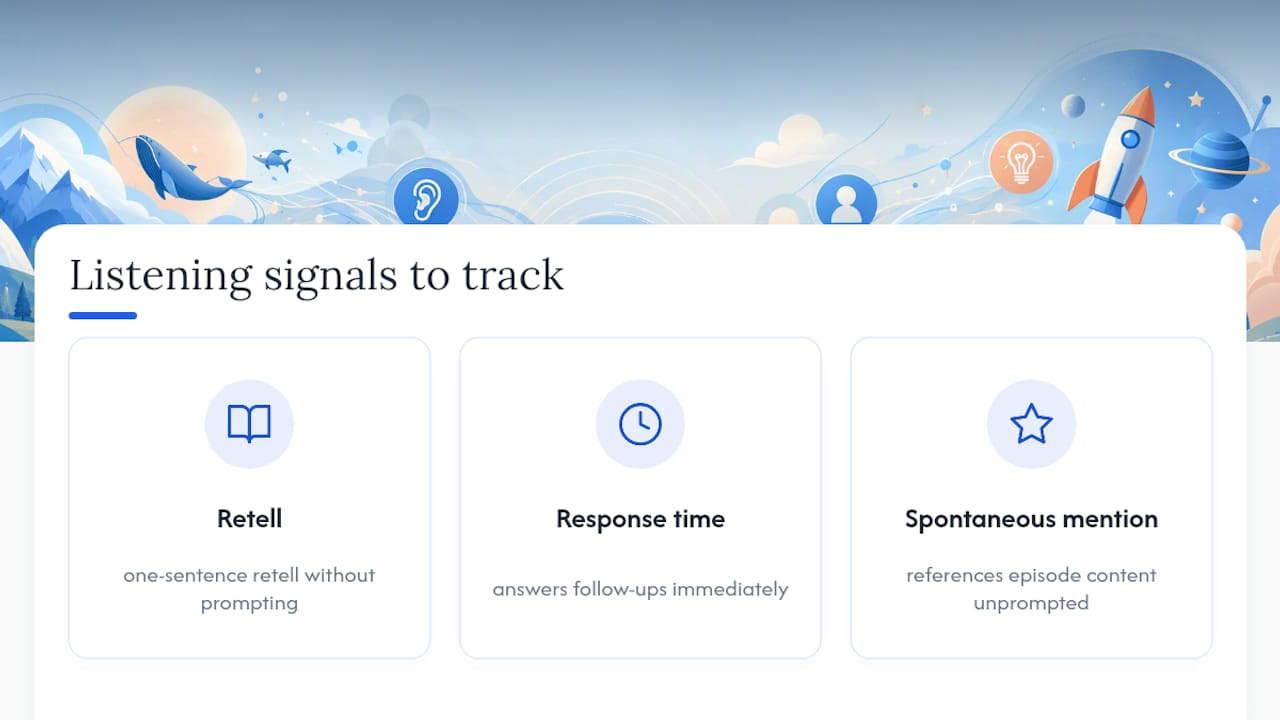
You don't need a formal assessment to know if this is working. Watch three simple signals over a few weeks. First, retell accuracy: can your child summarize an episode in one sentence without heavy prompting? If the retells get more detailed and less garbled over time, comprehension is climbing. Second, question response time: kids who are truly listening answer follow-up questions almost immediately, while distracted listening produces long pauses or guesses. Third, unprompted engagement: notice if your child starts referencing podcast content on their own, mentioning a fact from Wow in the World at dinner, for instance, without being asked.
Keep it informal. A simple notebook with a date, episode title, and one line about how the retell went is enough to spot a trend. If you're working with a small group or classroom, a shared checklist with the same three signals per child works just as well and takes under a minute per student.
Progress in listening skills is rarely linear. Expect good weeks and flat weeks, especially around schedule changes or when you introduce a harder show. The trend over a month matters far more than any single session.
When a Child Struggles to Listen or Stay Engaged
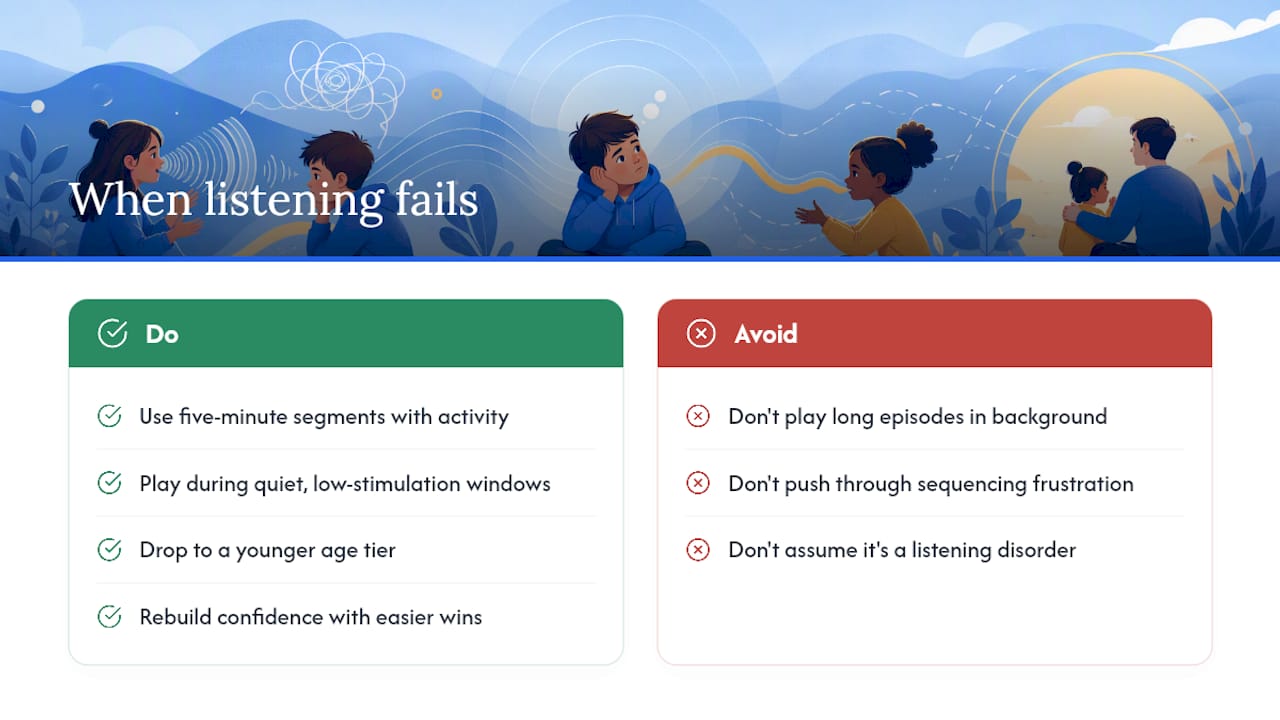
Some kids resist audio-only content at first, and that's usually not a listening problem, it's a habit problem. If your child seems restless or checked out, drop the episode length before you drop the format entirely. A five-minute segment with a clear activity attached beats a 20-minute episode played hopefully in the background.
Distraction during transitions, like car rides with siblings talking, is another common culprit. Try dedicating a quiet, low-stimulation window instead, even just ten minutes before bed, so the episode has a fair shot at holding attention.
If a child truly struggles with sequencing or retelling even after several tries, scale back to shorter, simpler shows rather than pushing through frustration. A 4-year-old wrestling with a show built for 7-year-olds isn't a stubborn listener, they're facing a genuine mismatch. Drop down an age tier, rebuild confidence with easier wins, then climb back up gradually.
Persistent attention difficulties that show up across every format, not just audio, are worth mentioning to a pediatrician or teacher, since podcasts are a tool for building listening skills, not a diagnostic one.
Fitting Podcasts Into Real Family Schedules
The households that stick with this longest don't treat podcasts as an extra task. They swap them into time that's already happening. Car rides, breakfast prep, and the last ten minutes before bed are the three windows that work best because they're low-distraction and already part of the routine.
Treat podcast time as a category separate from screen time rather than folding it into the same daily limit. Since there's no screen involved, many families use audio during exactly the moments they'd otherwise reach for a tablet, which solves two problems at once: less passive screen use and more active listening practice.
Consistency beats intensity. Ten minutes of focused co-listening five days a week builds far more skill than one long weekend binge. Pick one or two fixed slots, like the drive to school and the wind down before bed, and let those become the default rather than negotiating fresh every day.
What Changes Fast and What Takes Time
Parents usually notice the easy win first: kids sit still for audio faster than expected, often within the first week, especially once a show clicks. What takes longer is the retell. Getting a genuinely accurate one-sentence summary out of a 5-year-old can take several weeks of practice, and that's normal, not a sign something's wrong.
If you only do one thing this week, do this: pick a single episode, ask one prediction question before you press play, and ask for one sentence about what happened after. That's the entire method in under ten minutes. Everything else in this guide is a variation on that same loop.
For families wanting age-specific starting points, the picks for 4-year-olds and preschoolers are the fastest way to skip the trial and error.
— JG
A Different Kind of Listening Practice: Personalized Superhero Episodes
Every show in this guide is built for a general audience, which is exactly why the activities matter so much: you're doing the work of making generic content feel personal. G45-hero-cast takes a different route to that same goal. Each week, it delivers a personalized superhero episode built around your own child, using their name, interests, and traits as the actual plot, and drops it into a private podcast feed by Sunday.
That personalization does something the pre-listen prediction game is trying to manufacture artificially: it makes the stakes feel real before the episode even starts, because the hero is your kid. Subscription plans can provide a built-in weekly listening routine without having to hunt for a new show every few days, and options for siblings and gifts can help extend the habit across the whole family rather than one child at a time. If you want a ready-made version of the co-listening routine this article describes, take a look at Superhero Sounds and see what a sample episode sounds like for your child's age and interests.
Sources
- PMC article on audio learning and listening strategies
- PBS Parents — Podcasts
- Kids Listen — directory and advocacy for kids’ podcasts
- Common Sense Media — Best podcasts for kids