Yes, podcasts can genuinely help children develop language, listening skills, and imagination — but the research is clear that how you use them matters as much as which shows you choose.
Co-listening (sitting with your child and engaging with the episode together) consistently produces better outcomes than handing over a device and walking away. EDC researchers found that interactive prompts, relatable characters, and serial narratives were the design features that kept children engaged and sparked follow-on conversations and play. Age-appropriate episode length matters too: a 25-minute episode is a reasonable fit for a 10-year-old and a mismatch for a 5-year-old.
Quick dos and don'ts for first-time podcast use with kids:
- Do listen together, especially for children under 7
- Do pick shows with episode lengths matched to your child's age (more on this below)
- Do pause once or twice to ask a question or react to something funny
- Don't treat podcasts as a background babysitter — passive listening captures a fraction of the benefit
- Don't skip previewing an episode; ads and unvetted content exist even in kids' categories
- Don't assume one show fits all ages in the family — a 6-year-old and a 10-year-old need very different formats
Key Takeaways
Podcasts benefit children most when adults listen alongside them and treat episodes as conversation starters rather than background noise.
| Point | Details |
|---|---|
| Co-listening is the key variable | Listening together and asking one or two questions per episode produces far better outcomes than unsupervised listening. |
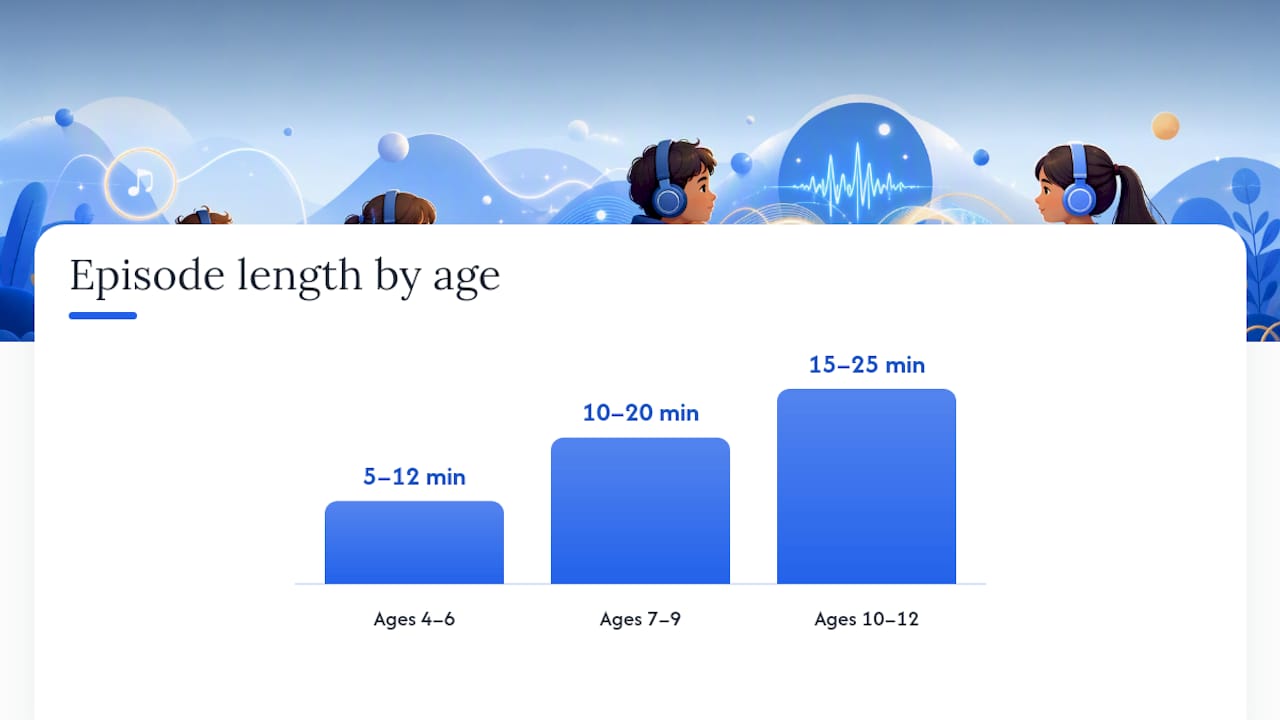
| Match episode length to age | Ages 4–6 need 5–12 minutes; ages 7–9 work well with 10–20 minutes; ages 10–12 can handle 15–25 minutes. |
| Design features drive engagement | Interactive prompts, relatable characters, and serial narratives are the specific features that sustain children's attention and spark follow-on play. |
| Audio builds skills screens don't | Vocabulary, listening comprehension, and imagination all benefit from audio-only formats that require children to construct mental images. |
| G45-hero-cast personalizes the experience | Weekly superhero episodes built around your child's name and traits deliver the highest-engagement design principles in a subscription format for ages 4–9. |
Table of Contents
- What are the real benefits of podcasts for kids?
- What does the research actually say?
- How do benefits change by age group?
- How can parents make podcast listening actually work?
- How do you pick a good children's podcast?
- Which podcasts are worth trying first?
- What are the real limits and safety concerns?
- Why do personalized and character-driven podcasts engage kids so deeply?
- Why audio storytelling for kids deserves more credit than it gets
- G45-hero-cast turns every episode into your child's personal adventure
- Sources
What are the real benefits of podcasts for kids?
Brown University Health summarizes the core case well: podcast listening can build vocabulary, language skills, attention, and imagination. Those four domains map neatly onto what developmental researchers track in early and middle childhood, and each one connects to a specific feature of how good kids' podcasts are designed.
Language and vocabulary
Repeated exposure to spoken narrative is one of the most reliable ways children absorb new words. Unlike conversation, a well-produced podcast uses richer vocabulary in context, meaning a child hears a word like "expedition" or "hypothesis" alongside the story situation that defines it. That context-embedded learning sticks better than flashcard drills. Shows with a consistent host voice and recurring characters give children a stable linguistic environment they return to week after week, which compounds the exposure effect.
Listening skills and attention
Audio-only formats demand something screens rarely ask of children: sustained, sequential attention without visual support. A child following a podcast episode has to hold the thread of a story in working memory, track character names, and predict what comes next — all without a picture to anchor them. That is a real cognitive workout, and research on podcast-based listening activities has found measurable improvements in listening comprehension when audio is used intentionally in instructional settings.
Imagination and creativity
Because podcasts lack visuals, children fill the gap themselves. DW Akademie's guide to children's audio frames this as a cognitive exercise: kids build mental images and construct story worlds, which supports imagination and what researchers call "stealth learning" — facts absorbed through entertainment rather than instruction. After a good episode, many children spontaneously act out scenes, draw characters, or invent their own continuations.
STEM curiosity
Shows built around inquiry — posing a question, exploring possible answers, and landing on a satisfying explanation — model scientific thinking in a format children find genuinely entertaining. The best STEM-oriented kids' podcasts use child co-hosts, sound effects, and humor to make the process of wondering feel exciting rather than academic.
Social-emotional learning
Storytelling has always been how humans transmit social norms and emotional vocabulary. Character-driven podcasts that put protagonists in morally complex situations — where a character has to decide whether to tell the truth, share something precious, or stand up for a friend — give children a low-stakes space to process those scenarios before they encounter them in real life. PTA guidance on children's podcast use highlights this as one of the underappreciated benefits: podcasts can introduce empathy and problem-solving models through story rather than lecture.

What does the research actually say?
The strongest evidence comes from a mixed-methods study conducted by the Education Development Center with 110 caregivers and children ages 4–8 over a six-week period. The EDC "Listen to This!" report found that families integrated podcasts into daily routines with relative ease, and that specific design features — interactive prompts, relatable characters, and serial story structures — were the factors that sustained children's interest and generated the most co-listening, conversation, and follow-on play. Parents in the study reported high engagement, and many noted that episodes sparked activities that extended well beyond the listening session itself.
A 2026 peer-reviewed mixed-methods study reinforced those findings. Tuning in Together examined joint media engagement in U.S. families, particularly in low-income households, and found that co-listening created natural openings for conversation and playful activities that can enhance learning. The study highlighted the same design features the EDC identified: interactive prompts and serial narratives were the elements that made shared listening feel like a shared experience rather than parallel passive consumption.
Co-listening sparks creative play and family conversations, and parents view podcasts as a screen-free supplement that can introduce new vocabulary and concepts. — EdSurge, reporting on the EDC research
EDC researcher Megan Hupert has emphasized that parents should stay involved in podcast selection and talk with children about episodes, because that involvement is what boosts both media literacy and parent-child bonding.
What the research does not yet tell us: most studies in this space are recent, use relatively small samples, and focus on short observation windows. Long-term outcome data — whether early podcast listening predicts measurable gains in reading or vocabulary at age 10, for instance — is still limited. The signal is coherent and encouraging, but parents should treat it as promising evidence rather than settled science.
How do benefits change by age group?
Age shapes everything: what a child can follow, how long they can sustain attention, and what kind of engagement is realistic for a parent to facilitate.
| Age group | Episode length | Listening setup | Key benefits | Parent role |
|---|---|---|---|---|
| 4–6 years | 5–12 minutes | Speaker, co-listening | Vocabulary, rhythm, imaginative play | Listen together; pause for simple questions |
| 7–9 years | 10–20 minutes | Speaker or shared headphones | Comprehension, STEM curiosity, narrative tracking | Encourage predictions; debrief after |
| 10–12 years | 15–25 minutes | Headphones OK for independent listening | Critical thinking, nonfiction depth, media literacy | Weekly family debrief; discuss claims |
Ages 4–6: Children at this stage benefit most from repetition, rhythm, and simple interactive prompts ("What do you think happens next?"). Short episodes prevent attention from fraying before the story resolves. Co-listening is less optional than essential here — a 5-year-old processing an audio story without an adult nearby to anchor meaning gets far less from the experience. For the youngest listeners, look for shows with a warm, consistent host voice and episodes under 12 minutes.
Ages 7–9: Kids in this range can follow more complex plots and retain facts across episodes. They start to enjoy being "right" about predictions, so pausing mid-episode to ask "What do you think is causing that?" pays dividends. Shows for 5–7 year olds that feature character-driven formats work especially well at the younger end of this range. By age 9, many children can handle a 20-minute episode independently, though a brief conversation afterward keeps the learning active.
Ages 10–12: This group can engage with chaptered serials, interview formats, and nonfiction explanations that require holding multiple ideas in mind. Independent listening is fine, but a weekly family debrief — even five minutes over dinner — keeps critical thinking sharp and gives parents a window into what their child is absorbing. Curated picks for 8–10 year olds are a good starting point for this transition.
Special needs and learning differences: Audio formats can be particularly supportive for children with dyslexia or reading challenges, since listening bypasses the decoding barrier and lets comprehension and vocabulary develop independently. Children with ADHD may do better with shorter episodes and a physical activity paired with listening (drawing, building with blocks) to channel attention productively.
Bilingual and multilingual learners: Podcasts in a heritage language offer consistent, engaging exposure that is hard to replicate otherwise. Even 15 minutes of listening to a well-produced show in a second language several times a week builds phonological familiarity and vocabulary in ways that feel like entertainment rather than study.
How can parents make podcast listening actually work?
The gap between "my kid listened to a podcast" and "my kid got something meaningful from it" comes down to a few repeatable practices.
Co-listening routines that fit real life:
- Car rides are the single most natural podcast window for most families — the shared space and the absence of screens make it easy to listen together and react in real time
- Bedtime works well for calm, story-driven shows; keep it to one episode and treat it as wind-down, not stimulation
- Morning routines (breakfast, getting dressed) suit short, upbeat episodes that don't require sustained focus
Conversation prompts you can use before, during, or after an episode:
- Before: "The title of this one is [X] — what do you think it's going to be about?"
- During (pause once): "Why do you think [character] did that?"
- After: "What was the most surprising thing you heard?"
- After: "If you could ask the host one question, what would it be?"
- After: "Did anything in that episode remind you of something that happened to you?"
Activity ideas to extend learning:
- Drawing a scene or character from the episode (works especially well for ages 4–9)
- Acting out a moment from the story with stuffed animals or siblings
- A simple DIY experiment if the episode covered a science topic (many STEM shows suggest one)
- A library trip to find a book on the same subject the episode explored
Pro Tip: Turn a 10-minute episode into a 20-minute learning activity by keeping a small basket of crayons and paper near your listening spot. Tell your child they're going to draw one thing from the episode while they listen. The drawing gives their hands something to do, deepens memory encoding, and gives you an instant conversation starter afterward — no prep required.
How podcasts help family time has more practical frameworks for building these habits into your week without adding pressure to an already full schedule.
How do you pick a good children's podcast?
Not all kids' podcasts are created equal, and the category label "for kids" on a platform does not guarantee age-appropriate content, production quality, or honest advertising practices.
Selection checklist:
- Host tone: warm, curious, and respectful of children's intelligence — not condescending or hyperactive
- Age fit: episode length and vocabulary should match your child's actual age, not a broad "ages 2–12" label
- Interactivity: does the show invite the child to think, predict, or respond? Passive narration is fine, but interactive prompts add engagement
- Ad load: preview the first two minutes and the midpoint; heavy sponsorship content aimed at children is a red flag
- Production quality: clear audio, consistent volume, and a stable format help children follow along without frustration
- Source credibility (nonfiction): does the show cite experts, researchers, or credible institutions? Or does it present claims without any sourcing?
Red flags to watch for:
- Sponsorship segments that blur into content (a host "recommending" a product as part of the story)
- Vague age targeting that lumps toddlers and tweens together
- Nonfiction episodes that state contested claims as settled fact
Platform notes: Most major podcast apps allow you to preview episodes before playing them for your child. Use that feature. Spotify Kids and Apple Podcasts both offer curated children's categories, but neither is a substitute for a parent previewing an episode. For younger children, a Bluetooth speaker in a shared room is preferable to headphones — it keeps the listening experience social and lets you monitor content without hovering.
Pro Tip: Involve your child in picking the next show. Give them two or three options you've already vetted, let them choose, and explain briefly why you picked those options. That one-minute conversation is a media literacy lesson in itself.
Which podcasts are worth trying first?
These five shows represent different benefits and age ranges — a useful starting set for parents building a listening library.
-
Wow in the World (ages 5–12, STEM curiosity): NPR's flagship kids' science show uses two enthusiastic co-hosts, humor, and sound design to make scientific discoveries feel like adventures. Episodes run roughly 20–30 minutes and consistently prompt follow-up questions from children. Strong fit for the 7–12 range.
-
Brains On! (ages 6–12, STEM and critical thinking): Minnesota Public Radio's award-winning show answers questions submitted by kids, which makes the inquiry model feel genuinely child-driven. Episodes are well-sourced and model scientific reasoning without being dry. Brown University Health lists it among recommended shows for building vocabulary and curiosity.
-
Ear Snacks (ages 3–7, music and language): Andrew and Polly's musical podcast is one of the best options for the youngest listeners. Short episodes built around songs, wordplay, and gentle humor make it accessible for preschoolers and early elementary kids. The musical format supports phonological awareness in a way straight narrative cannot.
-
The Unexplainable Disappearance of Mars Patel (ages 8–12, serial mystery and imagination): A fully produced audio drama with a cast of child actors, this show is the closest thing to a children's audiobook series in podcast form. It rewards sustained attention and models complex narrative structure. Excellent for older kids who are ready for chaptered storytelling.
-
Grammar Girl (ages 10 and up, language and writing): Short, focused episodes on grammar, usage, and word history. Not a traditional "kids' show," but older children who enjoy language — especially those writing more in school — find it genuinely useful and surprisingly entertaining.
A note on discovery: Best Podcasts for Preschoolers is a good next stop if your child is on the younger end of this range and you want a deeper curated list.
What are the real limits and safety concerns?
Podcasts are a tool, not a solution. A few honest caveats are worth keeping in mind.
Safety checklist:
- Preview every new show before your child hears it — platform curation is imperfect
- For children under 7, use a speaker rather than headphones to keep listening social and audible to you
- Check for embedded ads, especially sponsorship reads that sound like part of the show
- Keep volume at or below 60% of device maximum for regular listening; the World Health Organization recommends keeping personal audio device volume under 85 decibels for children
- Avoid creating child accounts on podcast platforms that collect personal data; use a parent account with parental controls enabled
Limitations worth naming:
Podcasts are primarily passive listening. They complement active play, reading, and hands-on learning — they do not replace any of those things. A child who listens to a science podcast but never does a science experiment is getting the vocabulary without the embodied understanding. Children's media consumption trends put audio in context alongside screen time and reading, which is a useful frame for parents thinking about balance.
Privacy is a real concern. Most major podcast platforms are not designed with children's data privacy as a primary consideration. Use a parent's account, avoid platforms that require a child's age or name to access content, and review privacy settings periodically.
Pro Tip: Set a simple volume rule your child can apply themselves: "If you can't hear me talking to you from across the room, it's too loud." That gives kids a self-monitoring habit without requiring a decibel meter.
Why do personalized and character-driven podcasts engage kids so deeply?
The answer sits at the intersection of developmental psychology and audio design. When a child feels a genuine connection to a character — or, more powerfully, when they are the character — the motivational pull to keep listening is qualitatively different from passive entertainment.
PLOS ONE research on podcast listening found that podcast engagement is strongly linked to parasocial relationships with hosts and characters: listeners develop a sense of knowing and being known by the voices they hear regularly. For children, who are still building their sense of identity and social belonging, that parasocial bond can be a genuine motivator for repeat listening and deeper engagement with content.
The EDC study reinforced this from a design angle: relatable characters and interactive prompts were the specific features that sustained attention and generated the most follow-on play. It was not production budget or celebrity hosts — it was the feeling that the show was for them specifically.
Personalization in children's audio creates a sense of ownership over the story. When a child hears their own name, their own traits, their own world reflected back in a narrative, the engagement is not just stronger — it is fundamentally different in kind.
Personalized audio takes that principle to its logical conclusion. A show where a child's name, interests, and personality are woven into the story removes the distance between listener and protagonist entirely. That is not a gimmick — it maps directly to what the research identifies as the most powerful engagement mechanism in children's audio.
For parents building a listening habit with younger children (ages 4–9 especially), character-driven formats with a consistent hero the child identifies with tend to produce the most durable listening routines. The personalized superhero podcast format is one concrete application of these design principles.
Why audio storytelling for kids deserves more credit than it gets
Most conversations about children's media focus on screens: how much, what kind, when to limit. Audio barely registers in those debates, which is a real oversight.
The research on co-listening is not just about vocabulary gains or listening comprehension scores. It is about what happens in the car when a parent and a 7-year-old are both leaning into a story together, laughing at the same moment, and then arguing about what the character should have done. That is a different kind of family experience than parallel screen time, and it is one that audio formats are uniquely positioned to create.
What I find most underappreciated in the current conversation is the portability of audio. A podcast works during a commute, during dinner prep, during a walk. It does not require a screen, a charger, or a quiet room. For families where quality time is squeezed into transitions and routines rather than dedicated blocks, that portability is not a minor convenience — it is the whole value proposition.
The caveat I'd add: the research consistently shows that the adult in the room is the variable that matters most. The best-designed show in the world produces modest gains when a child listens alone. The same show, with a parent who pauses it once to ask a question and talks about it for two minutes afterward, produces something meaningfully different. That is not a burden — it is an opportunity.
G45-hero-cast turns every episode into your child's personal adventure
Most kids' podcasts are built for a general audience. G45-hero-cast does something different: each weekly episode is built around your child — their name, their personality, their interests — so they are not just listening to a story. They are the hero of it.
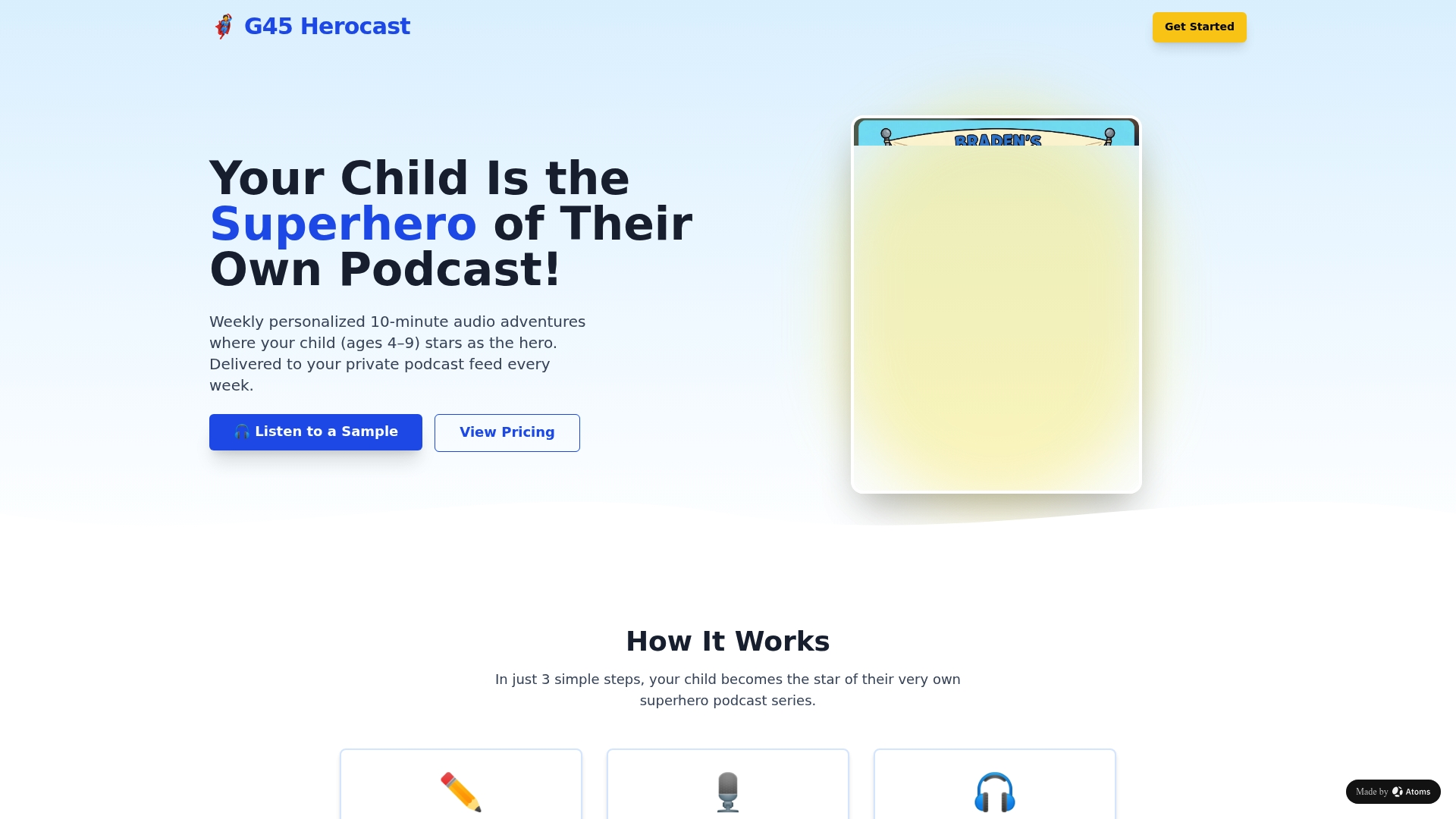
Every Sunday, a new personalized superhero episode lands in a private podcast feed delivered to your email. Episodes are designed for children ages 4–9, with length and content tuned to that developmental window. Siblings can each have their own story, and the subscription is available as a monthly or annual plan. Gift options make it a strong choice for grandparents looking for something that lasts beyond a birthday.
The format maps directly to what the research identifies as the highest-engagement design features: a relatable protagonist (your child), serial narrative structure, and consistent weekly delivery that builds anticipation. G45-hero-cast and see what it looks like when a podcast is made specifically for them.
Sources
- Listen to This! (EDC report)
- Tuning in together: Exploring joint media engagement in the United States through children’s podcasts
- Podcasts for the under 12s: benefits, challenges and tips
- The Benefits of Podcasts for Children | Brown University Health