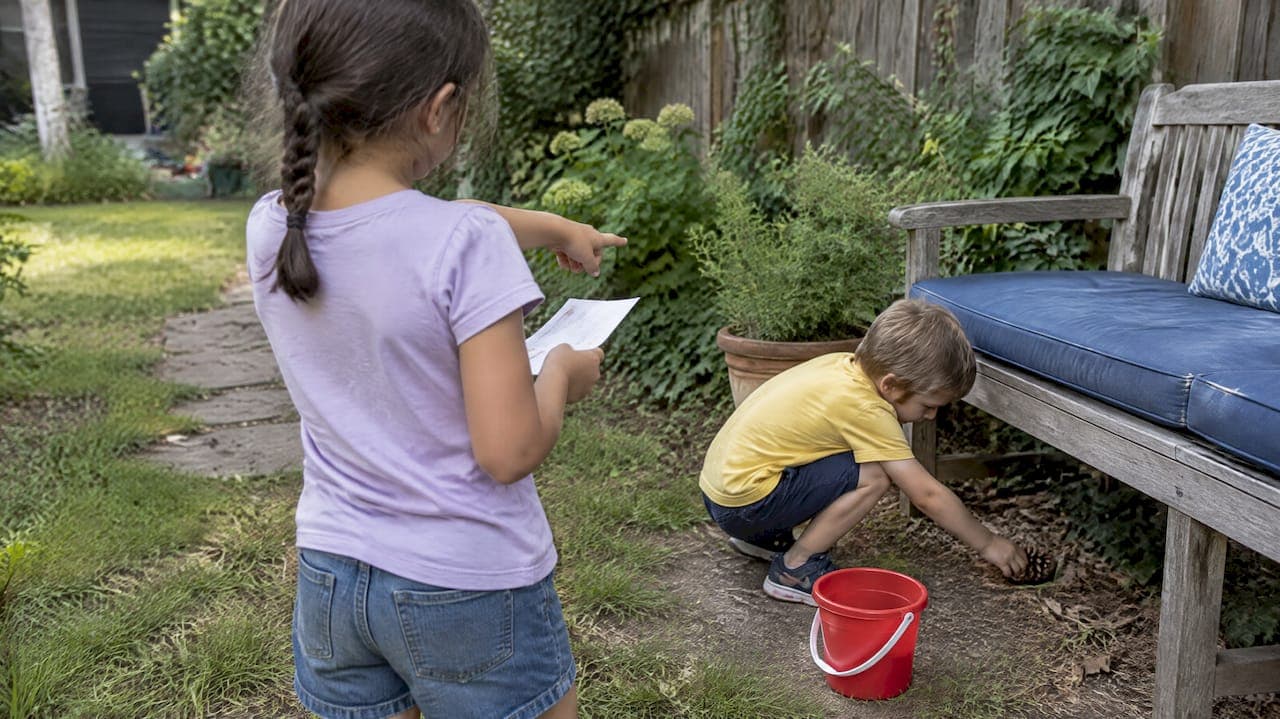
The simplest way to get siblings with a big age gap playing together is to give them one shared goal and different age-appropriate jobs. A scavenger hunt, a cooking project, a collaborative mural, or a shared audio story all work the same way: one mission, split roles. This approach holds up across almost any age gap and takes almost no setup.
TL;DR:
- Activities like scavenger hunts and collaborative art can be easily adapted for large age gaps by assigning roles based on skill level.
- Short rituals such as mural painting or story listening, kept under 40 minutes and rotated among siblings, strengthen bonds more reliably than big events.
- Using concrete rules, timers, and praise for cooperation effectively reduces rivalry centered around turn-taking and fairness issues.
- Shared storytelling and audio activities create equal footing regardless of physical skill or reading ability, promoting cooperation through focus and imagination.
- Simple, pre-assembled activities with roles split by safety or complexity require minimal setup and foster ongoing sibling engagement.
Table of Contents
- 1. Top activity categories that flex across ages
- 2. How to adapt any activity so both kids feel useful
- 3. Build small rituals instead of planning big events
- 4. Managing conflict and turn-taking without constant refereeing
- 5. Seven ready-to-run activities with roles already split
- 6. What child development organizations say about this approach
- 7. What audio storytelling taught me about leveling the playing field
- 8. A short story can double as a shared activity
- FAQ
- Sources
1. Top activity categories that flex across ages
A handful of activity types bend easily to fit a four-year-old and a nine-year-old at the same time, because the task itself can be divided by skill rather than age. Indoor options like fort-building, block towers, or a collaborative art piece let one child plan or build while the other decorates or fetches supplies. Outdoor activities such as scavenger hunts, water play, or mini-sports scale the same way: one sibling reads clues or keeps score while the other runs, searches, or performs the physical task.
Hands-on shared projects, especially cooking and gardening, naturally divide by safety level. The older child handles a knife or the stove while the younger one rinses produce, measures, or sets the table, a split ZERO TO THREE specifically points to as a reliable way to get siblings of different ages cooperating. Sensory and craft stations work in a similar way: one child mixes colors or textures while the other applies them, and both can swap roles halfway through.

Storytelling and audio-based play deserve a separate mention because they remove physical skill from the equation almost entirely. When siblings listen to the same short story, a four-year-old and a nine-year-old are equally capable of following along, laughing at the same moment, or deciding what happens next. That shared focus doesn't require matching coordination, reading level, or attention span, which makes it one of the lowest-friction activities on this list. Families looking for more ideas along these lines can find additional imagination-building activities that scale well across ages.
A few go-to options worth keeping on hand:
- A shared mural or collage where one sibling sketches and the other fills in color.
- A kitchen task split by safety level, like fruit salad prep or building personal pizzas.
- A scavenger hunt with one clue-reader and one searcher.
- A short audio story the whole group listens to together, then acts out.
2. How to adapt any activity so both kids feel useful
Almost any activity can be reshaped for a big age gap once you treat the adaptation as a repeatable process rather than a one-off fix.
- Start with one shared objective, then assign age-appropriate jobs: the older child might read instructions or handle the trickier step, while the younger one handles a simpler, concrete task.
- Offer the older sibling a choice of "extension" roles, like judging, scoring, or inventing a bonus rule, so the activity still challenges them.
- Expect and allow parallel play rather than forcing true collaboration every time. Giving each child their own set of materials next to the other's, rather than one shared set, often prevents friction before it starts, since parallel play is a normal and productive stage, not a failure to cooperate.
- Use a visible timer for turn-taking and a short written agreement (even a hand-drawn chart) for whose job is whose, so nobody has to rely on memory mid-activity.
Pro Tip: Alternate who gets to choose the activity and who gets to lead it each time you repeat a ritual, so both siblings regularly get a turn at having the final say.
Healthychildren also recommends simply changing the game itself to match each child's interests rather than expecting one game to please both. A teamwork-based board game, a building challenge, or a hidden-picture search tends to generate less rivalry than a game built around beating each other.
3. Build small rituals instead of planning big events
Short, repeatable rituals build sibling connection more reliably than occasional elaborate outings, largely because consistency matters more than any single activity being perfectly engaging. A 20-minute weekly habit that actually happens beats a once-a-season outing that requires hours of planning.
A few rituals worth testing:
- A running family mural that both kids add to for a few minutes each week.
- A weekly cooperative game night with one simple rule: play as a team, not against each other.
- Shared snack prep before dinner, with roles split by safety level.
- A short listening session, such as a story or personalized audio episode, during a snack or wind-down window.
Keep the window tight, somewhere between 20 and 40 minutes, and rotate who leads each time. Keep materials ready ahead of time so the ritual doesn't stall out on setup, since friction at the start is often what kills a habit before it becomes one.
4. Managing conflict and turn-taking without constant refereeing
Most sibling conflict at this stage comes down to turns, fairness, and attention, not deep personality clashes, so the fixes are mostly mechanical. Set a small number of clear, age-appropriate rules before play starts rather than mid-argument, and let both kids help choose how long a turn lasts.
- Use a visible timer for shared toys or activities, and let the kids negotiate the interval themselves when possible.
- Praise cooperative behavior out loud when you see it (sometimes called "tootling"), since positive reinforcement tends to produce more of the same behavior.
- Set a concrete, predictable solution for recurring flashpoints, like an alternating schedule for who goes first.
- Watch for a pattern of repeated aggression or intimidation rather than ordinary squabbling, and step in directly when that happens.
Praise and predictable rules reduce rivalry over time, according to the Child Mind Institute, which recommends concrete tools like timers and written agreements alongside one-on-one time with each child to ease competition for attention.
Ordinary sibling friction is different from sustained aggression or intimidation, and the second category calls for a different, more direct response rather than the usual turn-taking tools.
5. Seven ready-to-run activities with roles already split
Each of these can be set up in minutes with supplies most households already have.
- Scavenger hunt (20 to 30 minutes): the older sibling writes or reads clues, the younger one searches. Swap halfway through so both get each job.
- Family mural or collage (30 to 45 minutes): assign a sketcher, a decorator, and a photographer if a third person is around. A printable clue sheet can also turn this into a scavenger-style hunt for materials, an idea borrowed from party invitation design that works just as well at home.
- Kitchen project, like fruit salad or build-your-own pizza (20 to 40 minutes): split tasks by safety level, knife work for the older child, rinsing and arranging for the younger one.
- Fort-building (20 to 60 minutes): one designer, one builder, one decorator. Rotate roles if you rebuild it later in the week.
- Cooperative game, or kids versus grown-ups (30 to 60 minutes): use teamwork rules and consider dropping score-keeping entirely to lower the stakes.
- Water play or sensory station (15 to 30 minutes): set supervised zones with age-appropriate tasks, pouring and scooping for younger kids, measuring or mixing for older ones.
- Audio or story activity (15 to 25 minutes): listen to a short story together, then act out or draw a scene from it. This works especially well as a low-key wind-down, and pairs naturally with ideas for screen-free sleepovers built around personalized audio.
6. What child development organizations say about this approach
ZERO TO THREE points to shared missions and role-based play as reliable bond-builders, and notes that adults can often step back once play is running smoothly. HealthyChildren.org recommends matching games to each child's interests and accepting parallel play rather than forcing identical participation. The Child Mind Institute adds that concrete rules and praise for cooperative behavior measurably ease rivalry over time.

7. What audio storytelling taught me about leveling the playing field
Shared listening puts a four-year-old and a nine-year-old on equal footing in a way that a lot of physical play can't. Pausing a short story to act out a scene or sketch a character turns passive listening into a quick round of cooperative play, no matching skill level required.
— JG
8. A short story can double as a shared activity
A ten-minute personalized episode gives siblings a shared starting point, no screens, no setup. Try it during snack time, then let the characters become the prompt for a quick craft or game. Explore plans built for exactly this kind of family ritual.

FAQ
What is the most ideal age gap between siblings?
There is no single ideal gap: family routines, temperament, and each child's developmental stage matter more than the number of years between them, according to Pampers. A wider gap often means less direct competition and more one-on-one attention for each child.
What are some fun things to do with my older sister?
Shared cooking projects, collaborative art, scavenger hunts, and listening to a short story together all work well across a wide age range. Pick something with one shared goal and split the jobs so each of you has a clear role.
Is 17 and 23 a bad age gap?
No, a six-year gap between an older teen and a young adult is not inherently a problem; what matters more is how the family builds connection despite different life stages. Fairness between siblings at any gap means adjusting expectations by age, not treating both the same way.
Is 21 and 28 a bad age gap?
A seven-year gap between adult siblings is not considered problematic on its own. At this stage, shared activities tend to shift from structured play to shared interests, routines, or traditions built around each person's current life.
Sources
- Raising Siblings Who Stick Together | ZERO TO THREE
- Healthychildren
- How to help siblings get along | Child Mind Institute