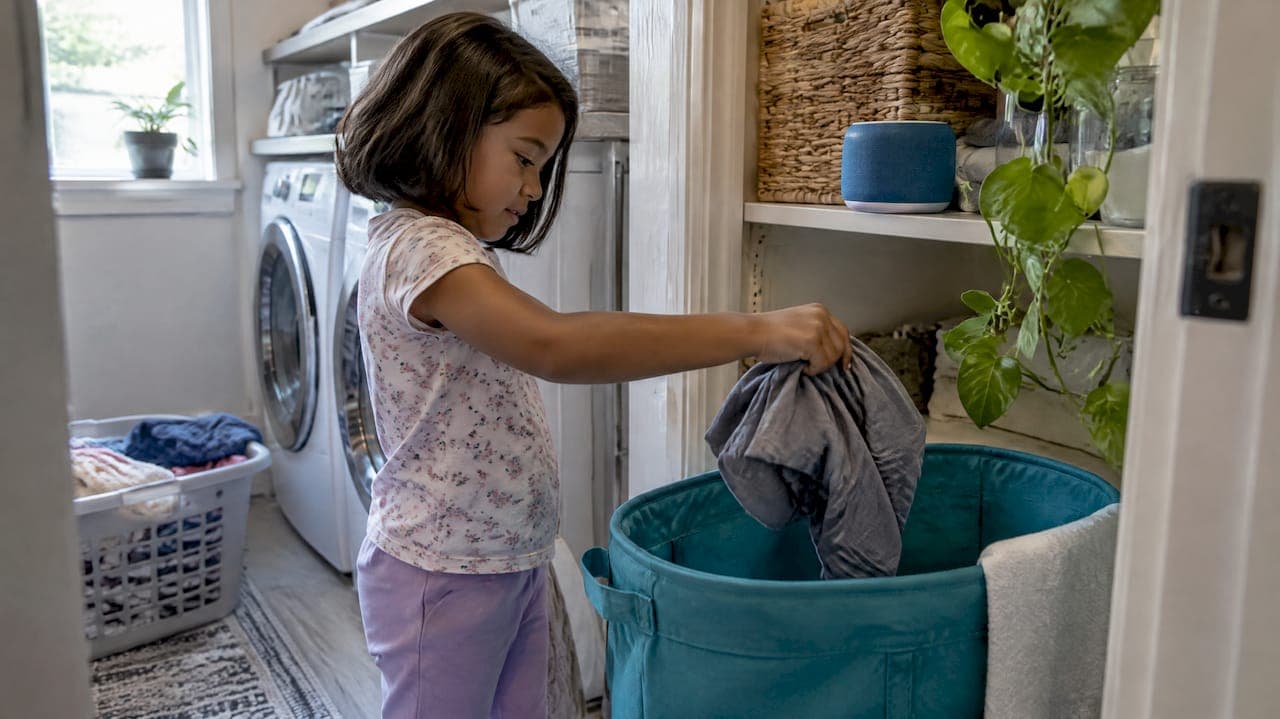
Most chores podcasts are made for parents, not for children. They coach you on how to get a six-year-old to unload the dishwasher without a fight. Very few are made for a child to listen to. This guide covers both: the episodes worth your commute, the chores that suit ages 4 to 9, and how to use audio your child actually enjoys to make helping around the house feel like part of the family story.
TL;DR
- Nearly every well-known chores podcast is aimed at parents. Use those episodes to set your approach, then bring the ideas home in a form a child enjoys.
- Ages 4 to 5 can handle jobs like clearing the table and feeding pets. By ages 8 to 9, loading the dishwasher and simple cooking are realistic, according to a school district parenting guide.
- The advice that repeats across experts: do the task together first, keep the tone light, tie chores to a routine, and skip bribes as the main tool.
- Listening together creates conversation afterward, which is where the chore talk lands best.
- A personalized story where your child is the hero is one screen-free way to make the idea of contributing feel exciting.
Table of Contents
- Two kinds of chores podcasts, and why it matters
- Chores podcast episodes worth your time as a parent
- Which chores fit ages 4 to 9
- How to introduce chores so they stick
- Why listening together helps the message land
- When your child pushes back
- Our perspective: make the hero the helper
- A weekly story your child stars in
- FAQ
- Sources
Two kinds of chores podcasts, and why it matters
Search for chores podcasts and you will find two very different things.
The first kind is a podcast for adults. A host, often a parenting coach or a home organizing expert, talks about how to assign jobs, handle refusal and build habits. These are useful, but a seven-year-old will not sit through forty minutes about "family culture."
The second kind is audio a child enjoys: a story, a game, an adventure. It rarely says "go clean your room" outright, and it does not have to. Children absorb values through stories, and a story in which the listener is the one who notices a problem and steps in to help carries more weight than a lecture.
The smart approach uses both. Let the adult episodes shape what you ask for and how you ask. Let the child-facing audio build the feeling that contributing is something heroes do.

Chores podcast episodes worth your time as a parent
The episodes below come from different parenting philosophies, so you can pick the voice that fits your house. Each is aimed at parents of young children.
| Show and episode | Published | What it covers |
|---|---|---|
| Parenting to Impress, Episode 59 | July 21, 2024 | Starting young, making tasks like bed-making part of daily life, recognizing effort without over-rewarding |
| The Balanced Parent, Episode 48 | March 2, 2021 | Ten approaches, including gratitude, making chores fun, building routines and collaborating |
| Reimagine Peaceful Parenting, Episode 23 | November 10, 2021 | Assigning jobs, handling refusal, avoiding power struggles |
| Fresh Start Family Show, Episode 224 | May 8, 2024 | Helping kids notice household work, visual reminders, a small set of daily responsibilities |
| 3 in 30 Podcast, Episode 373 | July 29, 2024 | Adding chores to existing routines, matching expectations to age, keeping it playful |
| The Decluttered Mom Podcast, Ep016 | n/a | Age-appropriate chores and household responsibilities |
| NPR Life Kit, "Raising Kids Who Help With Chores" | April 1, 2021 | Age-appropriate inclusion instead of bribes or a chore chart |
If you want the short version
The NPR Life Kit episode is the most compact. It argues that children can be encouraged to pitch in through inclusion that fits their age rather than through bribes or a chore chart, and it is built around practical guidance for nurturing cooperation.
If you want a gentler philosophy
The Balanced Parent episode leans on intrinsic motivation: family culture, collaboration and gratitude, so that children value contributing rather than complying only to earn a reward or avoid a punishment. Reimagine Peaceful Parenting takes a similar tone and focuses on empowerment instead of power struggles.
If you want a system
The 3 in 30 Podcast recommends accountability systems alongside a playful tone. Fresh Start Family Show suggests a "notice-and-do" approach and visual reminders. Both suit families who like some structure on the fridge door.
A note on household duties versus paid jobs
One distinction worth borrowing comes from Nancy Ray's episode on how her family does chores: she separates household responsibilities, done because you are part of the family, from bigger jobs a child can earn money for. Whether you adopt that split is up to you, but deciding it before the first argument saves a lot of negotiation.
Which chores fit ages 4 to 9
Age ranges are a roadmap, not a rulebook. Dr. Jo Youngblood of Children's Mercy frames chores as a flexible roadmap and says safety and supervision come first for any task. A child who is strong with a broom at five may still need you beside them at the stove at nine.
Ages 4 to 5
A parenting education page from Fayette County Public Schools lists emptying wastebaskets, bringing in the mail, pulling weeds, watering flowers with a small can, unloading dishwasher utensils, washing plastic dishes and fixing a bowl of cereal for this age. The Decluttered Mom adds that children ages 4 to 5 can help set or clear the table, use a lightweight vacuum, wipe countertops and put stray papers into a family command center.

Ages 6 to 7
At this stage children can usually take on a job from start to finish, like feeding a pet every morning or making their bed. The same school resource describes a progression toward more complex contributions as children grow, so use ages 4 to 5 as your floor and add one new task at a time.
Ages 8 to 9
The Fayette County guide places loading the dishwasher, vacuuming and cooking simple meals in this range. These are real contributions, not make-work, and children tend to feel it. For a printable reference, Michigan State University Extension points parents to an age-appropriate chore chart from the University of Arkansas System.
How to introduce chores so they stick
Across the episodes and expert pages, the same handful of ideas keep coming back.
- Do it together first. The Simplicity Parenting Podcast recommends working alongside the child, keeping tasks lighthearted and repeating the same task at the same time each week.
- Calibrate the difficulty. Kim John Payne uses Vygotsky's Zone of Proximal Development as a guide: hard enough that the child learns, not so hard that frustration takes over.
- Break it into small steps. Johns Hopkins Medicine suggests making chores part of the daily routine, splitting them into small steps and slowly fading your support as the child masters the skill.
- Keep the list short. The Simple Home Podcast suggests a rhythm of daily and weekly tasks over long, exhaustive lists, to build consistency.
- Let it be slow. Brain Based Parenting notes that letting kids help, even when it slows the task down, builds work ethic and a sense of belonging. The urge to do it yourself because it is faster is the habit to resist.
- Praise effort, then step back. The National Association for Child Development advises letting children work independently and praising their effort.
A sample week for a six-year-old
Here is how that might look in practice. Two daily jobs: make the bed and put dirty clothes in the hamper. One job tied to dinner: set the table. One weekly job: water the plants on Saturday morning. That is four tasks, all with a clear start and finish, and all connected to something already happening in the day.
Notice what is missing: a long chart, a reward ladder, a threat. You can add those later if your family needs them. Most do not need them at the start.
Why listening together helps the message land
Hearing a chores episode once will not change a household. Talking about it afterward might. PBS KIDS for Parents reports that nearly 75 percent of surveyed families said children discuss podcasts afterward, and that children commonly quote, reenact or ask questions about what they heard. The article also describes how children as young as four in the author's family absorbed material even when they seemed distracted.
That suggests a simple routine. Play a story at bedtime or on a car ride. Afterward, ask one question: "What did the hero do to help?" You are not delivering a lesson. You are opening a door, and the child walks through it on their own terms. If you want help choosing what to play, our guide to choosing a kids podcast by age walks through the criteria, and our overview of podcast benefits for kids explains what children tend to gain from audio.
When your child pushes back
Resistance is normal. A few tested responses:
- Use structure, coaching and praise instead of punishment. That is the advice from pediatric psychologists highlighted on The Parent-ish Podcast, where Dr. Youngblood recommends clear expectations and routines to avoid power struggles.
- Give short directions. NACD suggests two- to three-step directions for young children and, if you choose, simple incentive systems such as stickers.
- Change the story around the job. Diana Rene says parents can reframe chores to feel positive and even exciting. A "mission" lands better than a "task" with most six-year-olds.
- Make the work visible. If your child does not see the dishes, they will not volunteer for them. The "notice-and-do" idea from Fresh Start Family Show is built on this.
If refusal turns into regular, intense meltdowns across many areas of life, not just chores, bring it up with your child's pediatrician rather than trying to solve it with a better chart.
Our perspective: make the hero the helper
We make personalized superhero podcasts for children ages 4 to 9, and we think about chores differently from most. Chores feel like chores when they are a list handed down from above. They feel like something else when your child sees themselves as the person who notices, steps in and makes the day work for everyone.
That is the strength of a story in which your child is the star. Each of our episodes is written and produced around the real details of a child's life and interests, not just a name dropped into a generic script. When a child hears an adventure that sounds like their world, they lean in. A child who is leaning in is a child who is easier to talk with afterward, about anything, including the laundry.
We do not pretend a podcast replaces the real work. A story will not load the dishwasher. What it can do is create a shared moment, screen-free, where the family is together and excited about the same thing. From that moment the conversation about helping becomes easier to start. Do the chore alongside your child, praise the effort, and let the story give the effort a bigger meaning.
— JG
A weekly story your child stars in
If you want audio that your child hears as their own, our weekly personalized superhero episodes arrive every Sunday in a private podcast feed sent to the email you provide. The Bedtime Standard plan is $99 per month. The Grandparent Gift plan is $999 per year, a way for grandparents to give a child something to look forward to every week. See both on the Bedtime Standard and Grandparent Gift page.
If you are still weighing options, our comparison of podcasts versus TV for kids and our guide on apps versus private podcast feeds lay out the tradeoffs.
FAQ
Are there chores podcasts made for kids to listen to directly?
Very few. Most chores podcasts are made for parents and talk about strategy. For children, the better route is story-based audio where a character helps out, which the child hears as entertainment rather than instruction. Pair it with a quick conversation afterward.
What age should kids start doing chores?
You can start young. The Parenting to Impress episode on household chores recommends starting early and making simple tasks like bed-making part of daily life. At ages 4 to 5, a child can clear the table or feed a pet with you nearby, and safety and supervision stay the priority.
Should I pay my child for chores?
That is a family decision, and experts split on it. NPR Life Kit argues for inclusion over bribes. Nancy Ray keeps everyday household responsibilities unpaid and reserves payment for larger jobs. Whichever you choose, decide before the first argument and stay consistent.
How do I get my child to do chores without a fight?
Do the task together first, keep your directions to a few short steps, tie the job to an existing routine and praise effort instead of perfection. Dr. Youngblood recommends structure, coaching and praise over punishment. If power struggles continue, simplify the list to one or two jobs and rebuild from there.
Sources
- Teaching Kids Responsibility Through Household Chores, Parenting to Impress
- Episode 48: How to Get Kids to Help with Chores, The Balanced Parent
- Episode 23: Raising Helpful Kids: Navigating Chores, Reimagine Peaceful Parenting
- Ep. 224, Fresh Start Family Show
- Teach Kids to Work without being a Drill Sergeant, 3 in 30 Podcast
- Ep016 Age Appropriate Chores, The Decluttered Mom Podcast
- Raising Kids Who Help With Chores, NPR Life Kit
- 209 How We Do Chores, Nancy Ray
- Chores and Responsibilities, Fayette County Public Schools
- Practical age-appropriate chores for kids, Children's Mercy
- The benefits of kids doing chores, MSU Extension
- Five Ways To Help Children Do Chores and Home Care, Simplicity Parenting Podcast
- How to Get Your Kids to Do Chores, Johns Hopkins Medicine
- Chores for Kids, The Simple Home Podcast
- Kids Learn Work Ethic When We Let Them Help, Brain Based Parenting
- Self-Help and Chore Skills, National Association for Child Development
- Listening to Podcasts Together Helps Children Learn, PBS KIDS for Parents
- When Should Kids Start Doing Chores? The Parent-ish Podcast