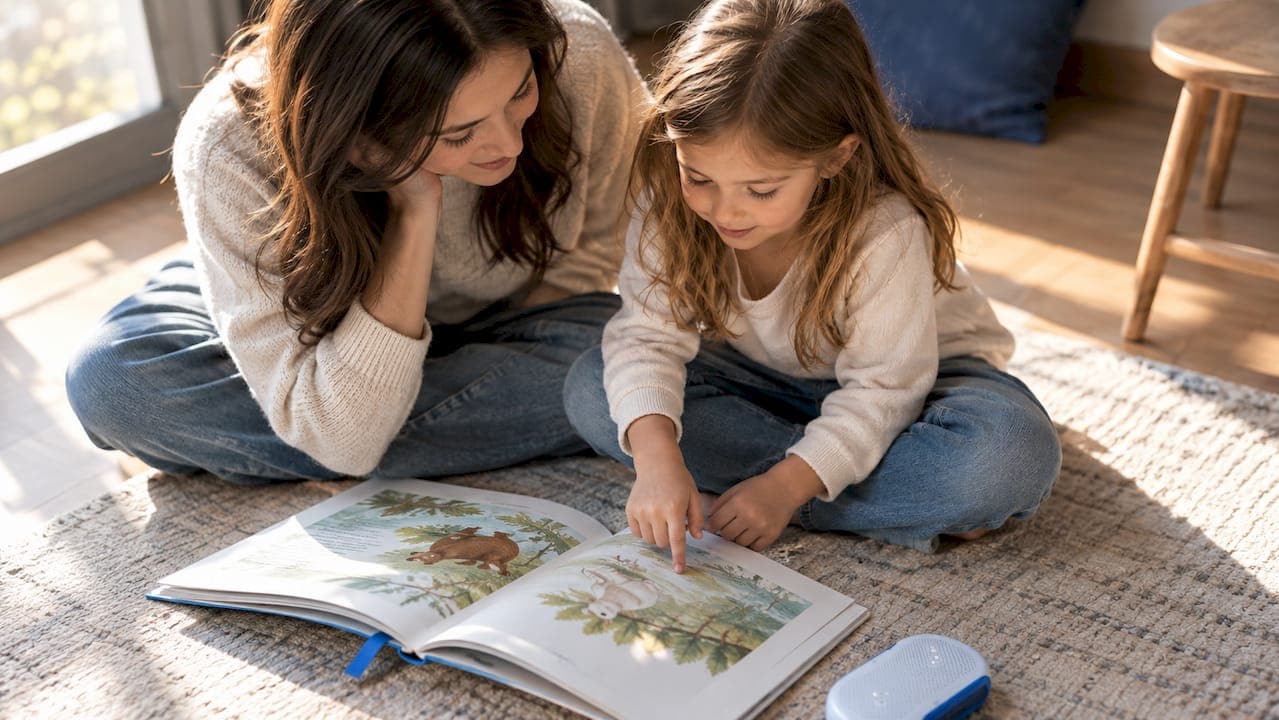
Weekly personalized superhero podcasts win for families who want an ongoing ritual and screen-free excitement every week; a personalized name book wins for a one-time keepsake gift, especially for younger kids who still love flipping pages with an adult. The real difference comes down to personalization depth and how much caregiver involvement each format asks for, and both work best when an adult sits in on the story instead of leaving the child alone with it. The pros and cons below break down exactly which fits your family's routine.
TL;DR:
- Personalized podcasts promote ongoing engagement by delivering a new episode each week, building a relationship with the format over time.
- A name book provides an immediate, tactile keepsake that supports print skills and is best used with adult-led reading sessions.
- Deep personalization, such as integrating interests and traits, enhances retention and social-agency, making both formats more effective.
- A weekly subscription needs caregiver involvement during listening to maximize literacy and social-emotional benefits.
- Episode length preferences vary by age, with shorter episodes generally better for younger children and longer stories suitable for older kids.
Table of Contents
- Personalized Podcasts vs. Name Books: Pros and Cons at a Glance
- What Does the Research Say About Personalized Storytelling?
- How Do You Choose Between the Two for a 4 to 9 Year Old?
- How Do You Get the Most Out of Either Gift?
- Why We Built a Weekly Superhero Podcast Instead of a One-Off Story
- How Our Weekly Subscription Works as a Gift
- Sources
- FAQ
Personalized Podcasts vs. Name Books: Pros and Cons at a Glance
Both formats use a child's name and details to pull them into a story, but they deliver that magic on completely different schedules. A subscription like a weekly personalized superhero podcast keeps building on itself; a name book delivers its full impact the moment it's opened, then holds steady as a keepsake.
Personalized podcasts:
- Weekly novelty means the child gets a new adventure to look forward to, not a single static experience.
- Fully screen-free once downloaded, so it works for car rides, bedtime, or quiet play without a tablet in sight.
- Easy to replay old episodes, which builds familiarity with recurring characters and inside jokes.
- Requires a subscription commitment and a way to play episodes, whether that's a phone, smart speaker, or tablet.
- Can turn into passive background noise if no adult listens along and asks questions.
Personalized name books:
- A tactile object the child can hold, reread, and eventually shelve as a keepsake.
- Naturally supports print skills like left-to-right tracking and page-turning.
- Excellent for dialogic reading sessions where an adult pauses to ask questions.
- Novelty tends to fade faster unless paired with drawing, acting out scenes, or other follow-up activities.
- The learning payoff depends heavily on how much time an adult spends reading it aloud together.
What Does the Research Say About Personalized Storytelling?
Personalizing a story by swapping in a child's real name isn't just a marketing gimmick. A 2025 study of 96 elementary students found that personalizing narrative text improved transfer performance and social-agency ratings compared to generic versions of the same story. Kids didn't just enjoy the personalized version more. They retained more of the actual lesson and felt more ownership over the outcome.
The personalization effect, by the numbers: In that same study, students reading a version where they were the named protagonist scored significantly higher on both comprehension transfer and how much personal agency they felt in the story, compared to peers reading an identical plot with a generic character name.
Audio adds its own layer to this. Because there are no illustrations to lean on, audio-only storytelling forces the brain to build its own mental images, strengthening the same auditory-visual integration skills tied to listening comprehension. That's a different cognitive workout than a picture book provides, not a lesser one.
None of this replaces the adult in the room. The American Academy of Pediatrics has been consistent on this point: shared reading and caregiver interaction drive the strongest literacy and social-emotional gains, and digital or audio formats only add real value when a caregiver engages alongside the child rather than handing over a device and walking away. A separate fMRI study backs this up from the neuroscience side, finding that parental storytelling produces stronger connectivity in children's attention and executive-function networks than narration from a stranger.
The caveat worth remembering: personalization is a hook, not a guarantee. If the underlying story is thin, a name-swap only goes so far, and heavy self-focus without narrative substance can actually dilute the lesson a story is trying to teach.

How Do You Choose Between the Two for a 4 to 9 Year Old?
Matching the format to the actual kid in front of you matters more than any feature comparison. Here's how to work through the decision in order.
- Gauge attention span first. A 4 or 5-year-old often does better with shorter bursts of story, while a 7 to 9 year old can usually sit through a longer arc, whether that's a chapter book or a 15 to 20 minute episode.
- Decide what kind of gift moment you want. A one-off keepsake for a birthday or holiday favors a book you can wrap and watch them unwrap. An ongoing "something to look forward to every week" favors a subscription.
- Map out the budget and billing structure. A subscription bills monthly or annually and keeps producing new content; a printed book is a single upfront cost but has a production and shipping lead time before it arrives.
- Ask about the depth of personalization. Some products just drop a name into a template sentence. Others build the child's interests, age, and traits into the actual plot, which is a meaningfully different experience.
- Check accessibility and cancellation terms before buying. Ask whether transcripts are available, how episodes are delivered, and how easy it is to pause or cancel a subscription if the child's interests shift.
Pro Tip: Before committing to a full year of any subscription, ask if a sample episode or story preview exists. Hearing five minutes of actual production quality tells you more than any product description.
How Do You Get the Most Out of Either Gift?
The format matters less than what happens after the "play" button or the front cover opens. Both podcasts and books turn into genuine learning tools when an adult treats them as a conversation starter instead of background entertainment.
For podcast listening, sit in on the episode when you can and pause to ask open-ended questions using CROWD-style prompts, things like "What do you think happens next?" rather than yes-or-no questions. Encourage your child to retell the episode afterward or act out their favorite scene. Research on family podcast habits found that recurring characters and interactive prompts do the heavy lifting for sustained engagement, and episode length preferences shift by age, so shorter episodes tend to hold younger listeners better.

For books, use the same dialogic technique: pause on a page, ask what your child notices, and let them predict the next line. Reuse the book later as a prompt for drawing or imaginative play.
Pro Tip: Alternate a weekly podcast episode with a read-aloud night using a personalized book. The rotation keeps both formats fresh and gives you two different kinds of one-on-one time. If your child loves acting out scenes, pairing an episode with a superhero costume can turn story time into full-blown pretend play.
Why We Built a Weekly Superhero Podcast Instead of a One-Off Story
We built this as a weekly ritual on purpose, not a single novelty. A child who becomes the hero of one story enjoys it once. A child who becomes the hero of a new adventure every Sunday builds a relationship with the format itself, and that's the kind of repeat excitement a single printed book can't replicate on its own.
We ask families to listen together when they can, because that's where the real payoff shows up. Every episode lands on a private podcast feed with enough runtime for a bedtime routine, and we've built in conversation starters so caregivers have an easy way in. Gifting one is straightforward, and we're upfront that the format works best as a shared experience, not solo screen time replaced by solo audio time.
— JG
How Our Weekly Subscription Works as a Gift
If a name book gives you a single keepsake moment, a G45-hero-cast subscription gives your family a new one every week, without any extra prep on your end. Each Sunday, a fresh personalized superhero episode lands on your child's private podcast feed, built around their actual name, age, interests, and personality traits rather than a generic script with a name dropped in.
We offer two giftable plans: the Bedtime Standard at $99 per month for ongoing weekly episodes, and the Grandparent Gift at an annual subscription price for grandparents who want to give a full year of adventures in one purchase. Both are fully screen-free and built for shared listening, so the excitement of "what happens this week" becomes a standing family habit, not a one-time surprise. If you want to see how the personalization actually plays out episode to episode, our guide to what real story personalization looks like walks through it, and you can gift a subscription directly from our site whenever you're ready.
Sources
- Personalizing narrative text improves elementary students’ transfer and social agency (2025)
- Audio storytelling and cognitive effects study (2024)
- Beyond literacy: shared reading starting at birth offers lifelong benefits (HealthyChildren/AAP, 2024)
- Listen to This! Podcast study report (2025)
FAQ
Is a Personalized Podcast Better Than a Name Book?
Neither format is universally better. Podcasts win for ongoing weekly engagement and screen-free listening, while name books win for a tactile, one-time keepsake, and research on personalized narratives shows both formats benefit from real personalization depth rather than a simple name swap.
What Age Is Best for Personalized Superhero Podcasts?
G45-hero-cast designs episodes for children ages 4 to 9, adjusting story complexity and pacing as kids get older. Younger listeners generally do better with shorter episodes, while 7 to 9 year olds can follow longer, more detailed adventures.
Does G45-hero-cast Require a Subscription?
Yes, G45-hero-cast runs on monthly or annual plans, including the Bedtime Standard at $99 per month and the Grandparent Gift at an annual subscription price for a full year of gifting in one purchase.
Can a Personalized Podcast Replace Reading Time?
It shouldn't fully replace it. The American Academy of Pediatrics emphasizes caregiver interaction as the main driver of literacy gains, so a weekly podcast works best alongside shared reading, not instead of it.
How Long Should Episodes Be for a 4 to 9 Year Old?
Episode length preferences shift with age, and family podcast research found shorter runtimes hold younger listeners better while older kids tolerate longer arcs. Most bedtime-friendly episodes fall in a range that fits comfortably into an evening routine without dragging on.