
Yes. A weekly personalized superhero podcast gives your child screen-free listening practice, a starring role in their own adventure, and a reason to look forward to Sunday all summer. The subscription delivers one new episode a week to a private podcast feed, built around your child as the hero. If you want a low-effort way to start, a gift or a monthly plan is the simplest first move.
TL;DR:
- Personalized episodes featuring your child's name and interests can significantly increase engagement without requiring extensive customization.
- Listening to audio stories promotes language development, longer listening stamina, and creates natural opportunities for parent-child discussions.
- Shorter, age-appropriate episode lengths and a consistent weekly routine help maintain your child's interest and build a lasting listening habit.
- Signing up is simple, requiring only basic information and interests, with delivery via a private podcast feed that does not need an app or screen time.
- A weekly superhero podcast is most suitable for children aged 4 to 9, with plans offering flexible options for siblings or gifting, and a risk-free trial period.
Table of Contents
- What Research Says About Audio Stories, Attention, and Personalization
- How to Build a Summer Podcast Routine That Actually Sticks
- How to Choose a Personalized Podcast Subscription for Your Family
- How G45-hero-cast Approaches Weekly Superhero Episodes
- Getting Started: What Signing Up Looks Like
- Sources
- FAQ
What Research Says About Audio Stories, Attention, and Personalization
Listening to a story is not a passive activity for a child's brain. It forces sustained attention on spoken language and asks the listener to build mental pictures without any visual shortcut, a skill The Conversation argues transfers directly to following oral instructions at school.
The evidence for language gains is not just theoretical. A randomized intervention with 138 third and fourth graders found that listening to tailored audio stories produced measurable gains in semantic and grammatical skills after a structured listening period. That is a controlled result, not a marketing claim.
Personalization matters too, but maybe not the way you'd guess. A study of 222 children found that minimal personalization, just a name and a basic detail, significantly raised affective engagement with a story. Piling on extra customization past that point produced diminishing returns. A weekly episode that folds in your child's name and a favorite thing or two is likely doing most of the emotional work already.
Where audio has real limits: a study comparing live storytelling to audio recordings found kindergartners and second-graders scored higher on comprehension with live delivery than with recorded audio, though the gap disappeared for older kids. That's the case for a parent asking a quick question after an episode rather than treating listening time as fully hands-off.
What this adds up to for summer:
- Vocabulary exposure that's harder to get from screen time
- Longer listening stamina built gradually, week over week
- More natural openings for parent-child conversation
- A reading bridge for kids who aren't independent readers yet, something Reading Rockets highlights as a core audiobook benefit
A key finding: in the F1000Research trial, just adding a child's name to a fable was enough to move the needle on engagement, meaning you don't need hyper-elaborate customization to see a real effect.
How to Build a Summer Podcast Routine That Actually Sticks
You don't need a curriculum. You need a rhythm your kid recognizes and looks forward to.
- Pick one "big listen" day each week. Most families land on the day the new episode drops, treating it like a small event rather than background noise.
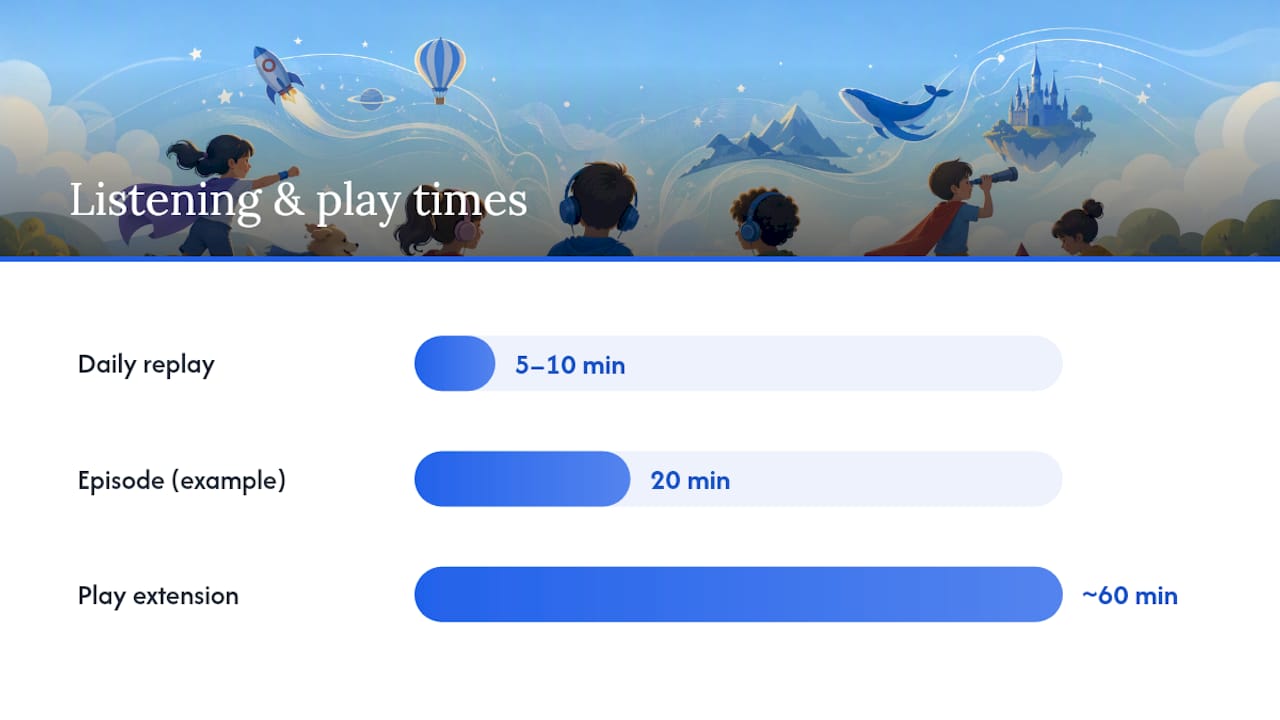
- Add short daily replays. A five to ten minute re-listen at breakfast or before nap time reinforces the story without asking for a new one every day.
- Match episode length to age. Shorter attention spans need shorter sessions:
These ranges come from parenting and education resources built around typical attention spans at each stage, not a hard rule, so let your child's actual focus guide the pace.
- Ask one question after the episode ends. "What would you have done if you were the hero?" or "What do you think happens next?" does more for comprehension than five minutes of extra listening. Our guide on building active listening habits has a few more prompts that work well for this age range.
- Let the story spill into play. Acting out a scene or drawing the hero's costume turns a 20-minute episode into an hour of screen-free imagination, an idea covered in more depth in our imagination play guide.
For road trips and beach days, download episodes ahead of time since cell service is never guaranteed at a campsite or a lakeshore, and pack one set of headphones per kid so nobody's fighting over volume.
Pro Tip: Save the newest episode for a car ride or a rainy afternoon instead of playing it the second it lands. The anticipation is half the fun, and it stretches one 20-minute story into a whole day of "is it time yet?"
How to Choose a Personalized Podcast Subscription for Your Family
A few honest questions before you commit will save you a refund request later.
- How deep does the personalization go? Name-only customization is a low bar. Look for a service that works in your child's actual interests, not just a name drop into a template script.
- How does delivery work? A private podcast feed that updates weekly is simpler for most families than an app requiring logins or screen time to access episodes.
- What's the pace and length? Confirm episodes run in a range that fits your child's age, not a one-size-fits-all runtime.
- Are there sibling or gift options? If you've got more than one kid, ask whether each child gets their own personalized hero or shares one feed.
- What's the cancellation and trial policy? A month-to-month option is a low-risk way to test the format before committing to a year.
- Can you hear a sample episode first? A sample tells you more about tone and pacing than any product description.
Weekly superhero stories tend to fit ages 4 to 9 particularly well because that's the stretch where kids are old enough to follow a plot but still deep in the "I want to be the hero" phase. It's also why grandparents gift these subscriptions so often. A weekly episode is a standing reminder that grandma or grandpa thought of them, long after a toy would have been forgotten in a closet. For more on matching content to a specific age, our age-appropriate podcast guide breaks down what tends to land at each stage.
How G45-hero-cast Approaches Weekly Superhero Episodes
Every G45-hero-cast episode starts with your child's real name, age, and a handful of personal details worked into an original story, not a name inserted into a recycled script. That approach lines up with what the personalization research actually shows: a name and a couple of true details go a long way toward pulling a child into the story.
The subscription runs on two plans: Bedtime Standard, built for a calming weekly wind-down ritual, and Grandparent Gift, designed for grandparents who want to be part of a grandchild's week without a screen involved. Both deliver episodes to a private podcast feed every Sunday.
For families building a broader listening habit, our posts on podcast benefits for kids and best podcasts for preschoolers cover the wider landscape of audio content worth knowing about, even beyond personalized stories.
— JG
Getting Started: What Signing Up Looks Like
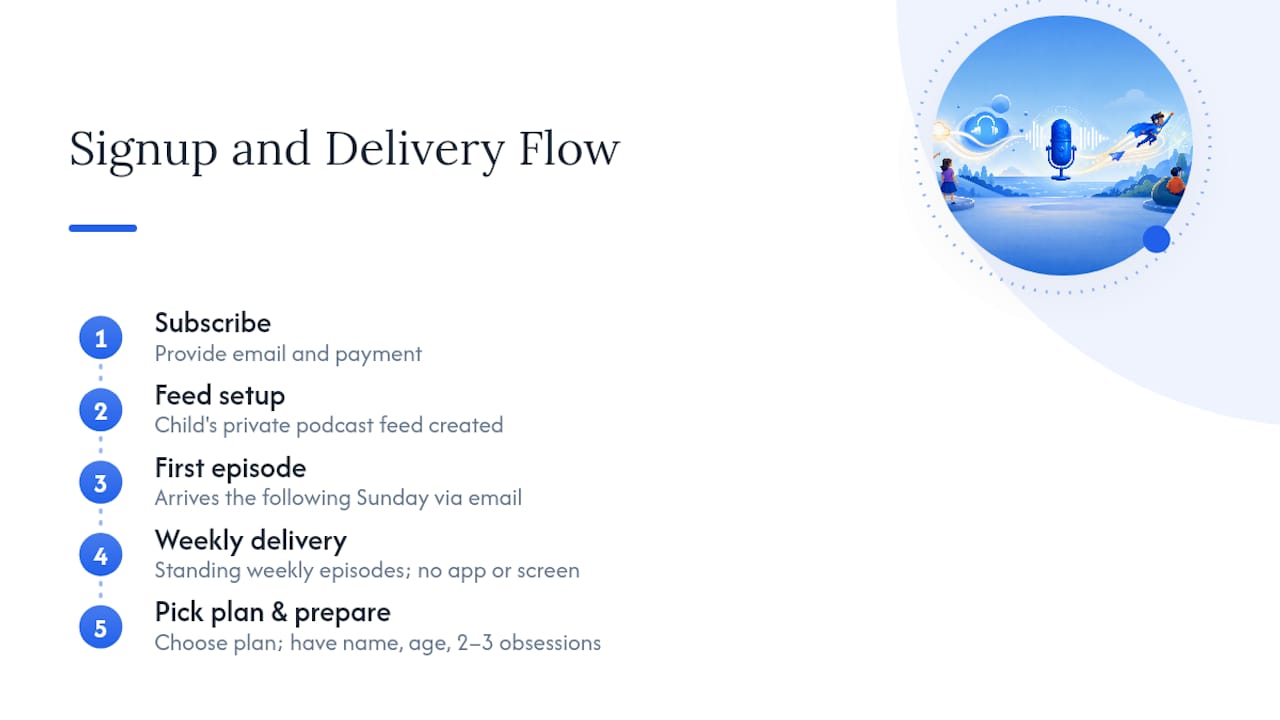
Once you subscribe, your child's private podcast feed gets set up and the first personalized episode lands the following Sunday, right in the email you provided at signup. From there it's a standing weekly delivery, no app required and no screen involved on the listening end.
Grandparents shopping for a gift that isn't another toy tend to choose the Grandparent Gift plan priced at an annual rate, which covers a full year of weekly episodes. Parents testing the format for the first time often start with Bedtime Standard at a monthly rate, then move to an annual plan once the Sunday ritual sticks.
Before you sign up, have three things ready: your child's name, their age, and two or three things they're currently obsessed with, whether that's dinosaurs, soccer, or an invented superpower they talk about constantly. That's genuinely all the raw material an episode needs. If you're weighing this against other screen-free formats, our podcasts versus story apps guide walks through the tradeoffs. Ready to make your child the hero of their own Sunday story? Start a subscription at G45-hero-cast and pick the plan that fits your family.
Sources
For parents who want to dig into the research behind audio learning, start with the DOI study on audio stories and language gains, the F1000Research personalization study, and Reading Rockets on audiobook benefits. Libraries running summer reading programs often pair well with weekly audio listening too.
- Audio Stories as Incidental Language Teachers (DOI study)
- Effects of live vs audio-recorded narrative delivery on children's comprehension (ASHA article)
- Effect of Personalization in Children's Fables (F1000Research)
- Benefits of audiobooks for all readers (Reading Rockets)
FAQ
How long should a listening session be for a 4-year-old?
Around 10 to 15 minutes is a good starting point for a 4-year-old, based on typical attention spans at that age, with older kids able to handle 20 to 30 minute episodes comfortably.
Is my child's personal information safe with a personalized podcast service?
Ask any provider directly how child details are stored and used before signing up, and favor services that limit personalization data strictly to what's needed to write the episode.
Can siblings each get their own personalized episodes?
Many personalized podcast services offer sibling options so each child can star in their own weekly story rather than sharing one feed.
Do audio stories actually help with reading skills?
Audio stories build vocabulary and listening comprehension that support reading readiness, though a comprehension study found live storytelling still edges out recordings for the youngest listeners.
What's the difference between the monthly and annual plans?
The monthly and annual plans are available for ongoing weekly episodes; current prices are on the pricing page.