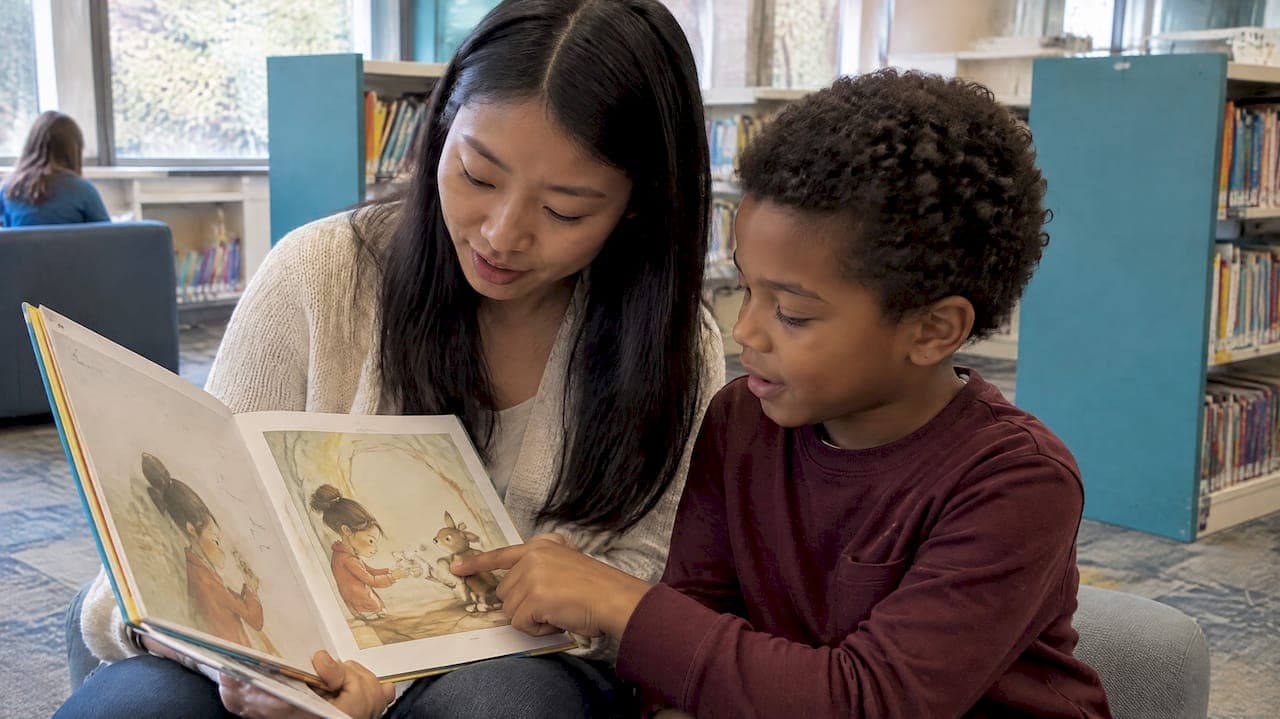
A character trait is a lasting quality of a character, such as kind, brave or stubborn. You learn it from what the character says, does and thinks, not from hair color or a passing mood. For children ages 4 to 9, the easiest way to work with traits is to name one, point to the moment in the story that proves it, and then connect it to the child's own day. This guide shows you how, with examples and sentence starters you can use at bedtime tonight.
TL;DR
- A trait is a lasting quality shown through a character's actions, words and thoughts. A feeling is passing, and appearance is not a trait at all.
- Kids most often meet traits like kindness, courage, honesty, responsibility, curiosity and perseverance.
- Use one simple frame with young kids: "[Character] is [trait] when [action]."
- Stories work best when an adult links the character's lesson to the child's real life.
- Stories that star your own child make the trait conversation personal, which is how our weekly superhero podcasts are built.
Table of Contents
- What a character trait is, and what it is not
- Why traits are worth talking about
- Traits kids ages 4 to 9 meet most often
- How a child figures out a trait: the detective method
- A sentence frame for ages 4 to 6
- Feelings first, then traits
- Characters can have more than one trait, and can change
- From the story to your child's real day
- Make it a bedtime habit
- Bring the hero to life with your child's name
- FAQ
- Sources
What a character trait is, and what it is not
Teachers describe character traits as descriptive adjectives that name a character's specific qualities. Readers usually infer them from what characters do, feel and think rather than relying only on the author saying so. A story that tells you "Maya was generous" is giving you a trait. A story that shows Maya handing her last cracker to a friend lets your child discover it.
Three things get mixed up with traits, and sorting them out is the first skill to teach.
Appearance. A librarian's guide separates external traits, such as eye color, height and hair color, from internal traits that are inferred from what a character says, does, feels or thinks. Red hair tells you nothing about a hero's character. What she does with the red cape does.
Feelings. Happy, sad, angry and surprised are feelings. One kindergarten lesson separates feelings from traits and teaches children to read facial expressions and body language as evidence of how a character feels right now.
Habits of behavior. A trait is what a character does again and again. One teacher's trick is to ask whether the character acts that way often or only once. A boy who snaps once when he is tired is feeling grumpy. A boy who snaps at everyone in every chapter may be written as impatient.
The same split shows up outside books. Immersive storytelling of any kind depends on the audience believing a character stays consistent from scene to scene, which is part of what makes narrative immersion work. A character who is brave in chapter one and acts for no reason like a coward in chapter two breaks the spell.

Why traits are worth talking about
Picking out traits is not a school exercise for its own sake. Naming a trait helps a reader understand why a character does what she does, and so understand the story better. It also gives a young child words for qualities that matter at home.
Parents are already thinking about this. In a national survey of parents with children ages 6 to 17, the qualities they most hoped their kids would develop were self-confidence, responsibility, honesty, respectfulness and kindness. Stories are one of the gentlest ways to practice those ideas, because the stakes belong to someone else.
Researchers at UC Berkeley's Greater Good in Action note that stories give children a relatively safe place to think about moral choices and their consequences. They also caution that young children may not carry a lesson over to real life on their own, so an adult needs to help make the connection. That is your job at the end of the story, and it takes about a minute.
Traits kids ages 4 to 9 meet most often
You do not need a long vocabulary list. A few core traits cover most of what children hear.
A content analysis of Caldecott Medal picture books from 2002 to 2012 found caring or compassion, helpfulness, acceptance, respect, ambition, citizenship, trustworthiness, encouragement and responsibility recurring across winners. Common Sense Media's character-strengths framework adds communication, compassion, courage, curiosity, empathy, gratitude, humility, integrity, perseverance and self-control, and explains that stories can model or explore each one.
Fairy tales lean on a different pair. Harvard's Maria Tatar describes how they commonly model intelligence or resourcefulness and courage, while also stressing compassion and collaboration as ways to face danger.
Here is a practical starter set for ages 4 to 9, with the kind of action that shows each one.
| Trait | What it looks like in a story | A question to ask |
|---|---|---|
| Kind | Shares, comforts, helps without being asked | "Who did she help? How do you know she cared?" |
| Brave | Does the scary thing while afraid | "What was he scared of? What did he do anyway?" |
| Honest | Tells the truth when a lie would be easier | "What happened when she told the truth?" |
| Responsible | Finishes a job others rely on | "Who needed him to follow through?" |
| Curious | Asks, explores, tests an idea | "What did she want to find out?" |
| Persistent | Tries again after failing | "How many times did he try? What changed?" |
| Loyal | Sticks with a friend when it costs something | "What did she give up for her friend?" |
There are negative traits too, and they make a story interesting. Teaching resources list traits such as dishonest, jealous, greedy, impatient and selfish next to the positive ones. Kids often find a flawed character the most fun to discuss, because they can say what the character should have done instead.
How a child figures out a trait: the detective method
The skill underneath all of this is inference: combine a clue from the story with what you already know, then state a conclusion. One character-detective lesson frames it as a repeatable routine of clue, background knowledge and inference, and warns children not to claim a trait without pointing to proof.
Turn that into three questions you can ask aloud:
- What did the character do or say? (The clue.)
- What do you know about people who act like that? (Your own knowledge.)
- So what word describes her? (The trait.)
Clues come in several forms. Useful evidence includes a character's appearance, actions and speech, interactions with others, plot events, and details in the text and illustrations. A national consortium handout lists the same family of clues: appearance, actions, words, feelings and thoughts.
Notice that appearance can be a clue, just not a trait. A character who always has muddy knees might be adventurous. The knees are the clue and "adventurous" is the trait.
A tiny example shows how concrete this can be. In one early-reader activity, Mrs. Wishy-Washy is kind when she pulls the animals out of the mud. The action is the proof, and the proof is what makes the word stick.
With audio only
When there are no pictures, the clues live in words, tone and sound effects. That is a feature. A child listening to a story has to build the character in their head, and has to listen closely to what the hero says and does. Ask them afterward, "What did you hear that told you she was brave?"
A sentence frame for ages 4 to 6
Younger children do best with a fill-in-the-blank. A reading publisher recommends the frame "Character is trait when action" to tie a trait to a concrete event. Here it is in use:
- "Leo is brave when he walks into the dark cave."
- "Nana Rose is kind when she saves the biggest slice for the new neighbor."
- "Captain Spark is responsible when she checks that everyone has a flashlight."
The same publisher suggests starting with people the child already knows. Brainstorm traits for familiar people or pets first, then use the same words for story characters. "Our dog Biscuit is loyal when he waits at the window for you." Once the word exists in the child's head, it transfers easily.
As children grow, expectations grow with them. A U.S. teacher guide describes a progression from identifying characters with prompting in kindergarten, to using key details and illustrations more independently in first grade, and to explaining responses to major events in second grade. So if your five-year-old needs nudges, that is normal. Your seven-year-old can be asked "why" and expected to answer with evidence.
Feelings first, then traits
Before a child can name a trait, they usually need to name a feeling. PBS KIDS for Parents suggests pausing during storytime to spot emotional clues in words and pictures, name the character's feeling, compare it with the child's own experience and talk about what could help. That builds empathy and compassion at the same time.
Then bridge to traits. One teacher notes that when a character repeats the same emotional response, it often points to a trait. A hero who gets worried before every mission may be cautious. A hero who gets a spark of excitement whenever someone is stuck may be a natural helper. The leap is: "She felt worried once. She worries every time. What kind of person is she?"
For more on building this skill, see our guide to teaching empathy with stories and audio.
Characters can have more than one trait, and can change
Good characters are not one word. Two ideas are worth introducing by age 7.
Traits can pull in two directions. Bravery may help a character save someone, but it may also lead her into danger. Curiosity finds the treasure and also opens the forbidden door. Asking "How did that trait help? How did it cause trouble?" gives children a more honest picture of people.
Characters can change. A children's librarian uses Nobody Hugs a Cactus to show that the main character's feelings and attitude shift during the story, and has children compare drawings from the beginning and end to make the change visible. You can do the same by ear: "How was Hank at the start? How is he at the end? What happened in between?"
When the change comes from a challenge the hero faces, it models growth. We cover that in resilience stories for kids.
From the story to your child's real day
The step that matters most is the last one. Harvard's Making Caring Common describes stories as windows into other lives, mirrors for recognizing ourselves, and "sliding doors" that help children apply insights to everyday situations. The same group notes that children's stories can broaden their circle of concern, meaning the people they care about and want to treat kindly.
Keep the bridge short. Three prompts work for most ages:
- "When did you do something like that today?"
- "What would you do if you were in her place?"
- "Who needs a little of that trait this week?"
Do not turn it into a quiz or a lecture. Kids tune out a moral delivered like a sermon. One question, one real answer, and then lights out.
What do children want in a hero? Among kids ages 6 to 17, the most wanted characters are those they want to be like because they are smart, brave or strong, those who face and overcome challenges, and those who are similar to them. That last point is the reason personalization matters.
Our perspective: the hero should be your child
We build our podcasts around a simple belief. A trait only becomes real to a child when they see it in someone they recognize. A generic hero can be brave on page three, and a child will nod politely. When the hero has your child's name, favorite animal and the stubborn streak you know too well, the trait lands.
That is why each of our episodes is individually written and produced to weave in a child's real details and interests, rather than dropping a name into a stock script. The kindness in the story is your daughter's kindness. The courage is your son's courage, shown in the situations his world is made of.
It also changes the conversation afterward. Instead of "Do you think the knight was brave?", you can ask "Remember when you walked up to the door at the end? What made you do that?" Children answer questions about themselves much more eagerly. And because our episodes arrive as audio in a private feed, the whole thing stays screen-free, with nothing between you and the talk after.
JG
Make it a bedtime habit
You do not need a program. A routine of five minutes beats a lesson plan you never use.
- Listen or read. Keep to one short story. Length matters less than you think, and our piece on story length by age explains why a short one can be plenty.
- Pick one trait. Name it, don't list five. "Tonight's word is patient."
- Ask for the proof. "What did she do that was patient?"
- Link it to home. One real example from today.
- Repeat the next night with a new word. Over weeks, the vocabulary builds quietly.
If you want superhero stories that carry a specific value, our guides on kindness superhero stories and on making educational superhero stories teach give you scripts and prompts. If your child is sensitive to loud action, try gentle superheroes for sensitive kids.
For grandparents
Grandparents have a particular advantage: they know the family's stories. Ask a grandchild, "What is something kind your grandpa did when he was your age?" Then tell it, and ask which trait it shows. Long-distance grandparents can do the same on a call, using any story the child just heard.
Bring the hero to life with your child's name
If you would like the child at the center of the story, that is what we do. Each Sunday we deliver a personalized superhero episode to a private podcast feed at the email you provide. Your child is the hero, and the adventure is built around their name, age, interests and personality.
Our Bedtime Standard plan is $99 per month. The Grandparent Gift plan is $999 per year, made for grandparents who want to give a grandchild a full year of weekly adventures. You can see both on our home page.

Siblings and gift options are available too, so each child can star in their own story. Pick the trait you most want to see your child grow into, and tell us when you sign up.
FAQ
What is the difference between a character trait and a feeling?
A feeling is temporary, like happy, angry or surprised, and shows up in faces and body language. A trait is a lasting quality shown by repeated behavior, like kind or stubborn. A quick test is to ask whether the character acts this way often or only once.
At what age can children identify character traits?
Many kindergarteners can name a character and a trait with prompting, and by first and second grade children use details and events more independently. Ages 4 to 5 do well with a sentence frame and one trait at a time. Ages 7 to 9 can give evidence and explain why.
How do I teach traits without it feeling like homework?
Keep it to one question at the end of the story and ask about the child's own experience rather than quizzing on the plot. Stories give kids a safe space to think about choices, but adults need to connect the lesson to real life. A minute at bedtime is enough.
Can a character have both good and bad traits?
Yes, and it makes stories richer. Bravery can help a character rescue someone and also lead into danger. Ask your child how the same trait helped and how it caused trouble.
Sources
- Barrington Area Library: The Ins and Outs of Character Traits
- ReadWriteThink: Action is Character: Identifying Character Traits
- Identifying Characters and Their Traits, kindergarten lesson
- Teacher Trap: Ways to Teach Character Traits and Changes
- CodeBusters: What Is Narrative Immersion
- Scholastic Kids & Family Reading Report
- Greater Good in Action: Honesty Stories for Kids
- Character Traits in Caldecott Award-Winning Literature
- Common Sense Media: Character Is
- Harvard Gazette: The tale of Snow White
- Twinkl: What are Character Traits?
- Character Detectives
- ReadWriteThink: Using Picture Books to Teach Characterization
- National PASS Center: Elements of Fiction Character Traits
- Hameray: Activities to Build Character Connections with K-1 Readers
- Teacher guide: Lesson 2, Describing Characters
- PBS KIDS for Parents: Practicing Empathy During Storytime
- Making Caring Common: How to Use Stories to Help Kids Develop Empathy
- Making Caring Common: An empathy-building book list for kids