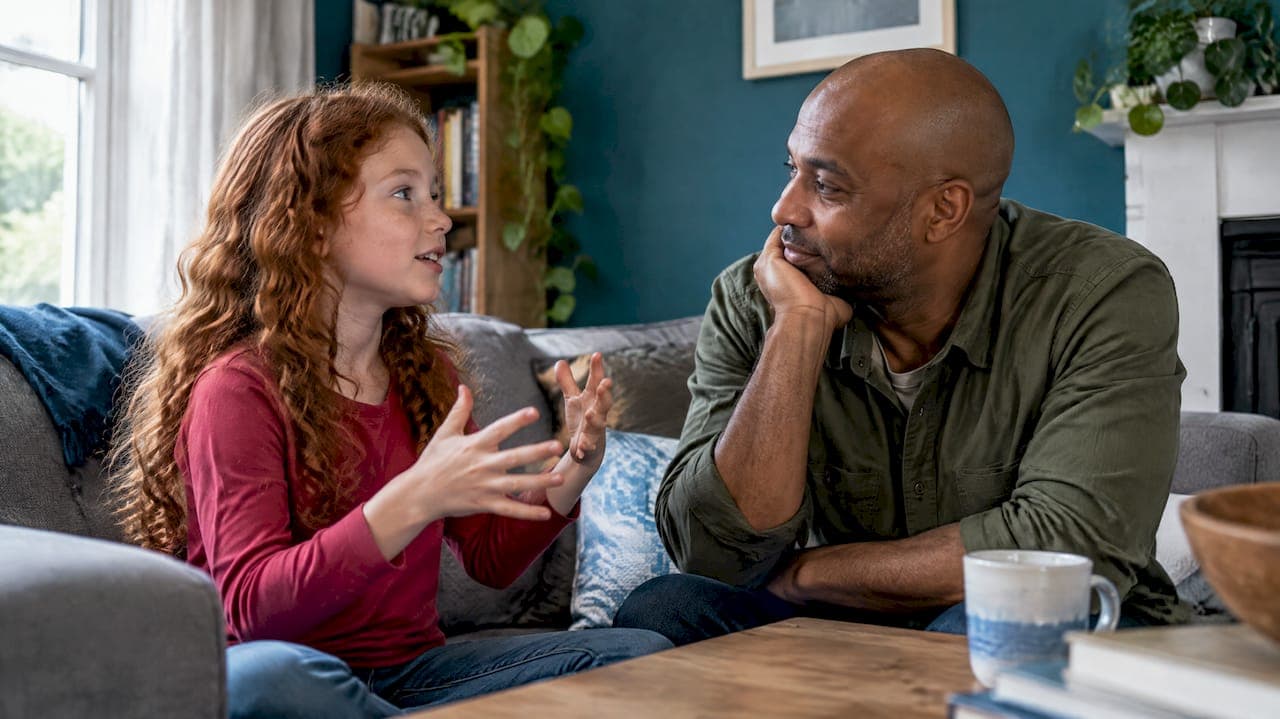
Stories do more for a child than fill the ten minutes before lights out. Research from U.S. education agencies and pediatric groups ties storytelling and shared reading to stronger vocabulary, better listening and comprehension, more empathy, and closer bonds between children and the adults who tell the stories. This guide walks through each benefit, what the evidence supports, and how to get more of it at home, whether you are a parent or a grandparent.
TL;DR
- Stories build language: vocabulary, sentence structure and the ability to retell events in order, which carries over to reading comprehension.
- Stories build feelings skills: children try out emotions and other people's viewpoints safely, which supports empathy and confidence.
- Stories build relationships: the American Academy of Pediatrics links reading together with stronger caregiver-child bonds.
- The biggest gains come from interactive storytelling, where the child answers, predicts and retells, not from passive listening alone.
- You do not need a book in hand. Told stories, family stories and audio stories all count.
Table of Contents
- Why stories work so well for ages 4 to 9
- Benefit 1: Language and vocabulary
- Benefit 2: Listening, narrative skill and reading comprehension
- Benefit 3: Imagination and creative thinking
- Benefit 4: Empathy and emotional understanding
- Benefit 5: Confidence and a sense of belonging
- Benefit 6: Closeness and calmer bedtimes
- Perspective: why we make the child the hero
- How to get more from every story
- Reading, telling or listening: which is best?
- What the research does not promise
- A weekly story made for your child
- FAQ
- Sources
Why stories work so well for ages 4 to 9
Children in this age range are doing three big jobs at once: learning to talk in longer, more organized sentences, learning to read, and learning how other people think and feel. A story touches all three. It packs unfamiliar words into a context a child can follow, it has a beginning, middle and end, and it puts a character in a situation the child can imagine from the inside.
BBC Teach summarizes the reasons we read to children as supporting literacy and vocabulary, widening the child's world, and building empathy through other perspectives. That short list is a good frame for everything below.
Benefit 1: Language and vocabulary
This is the best-documented benefit. The U.S. Institute of Education Sciences' What Works Clearinghouse notes that shared book reading can build language, vocabulary, print knowledge, phonological awareness and knowledge of the social and natural world. Children are most engaged when they take part by retelling, making connections and answering questions.
A few findings worth knowing, with their limits:
- A 2019 U.S. study found that the amount of parent-child book reading in early childhood predicted later vocabulary, reading comprehension and motivation to read, even after accounting for family income and the child's early language skill. It did not predict decoding or math.
- In a national sample of 1,772 children, daily shared reading at age 1 was associated with a higher vocabulary score at age 3. That is evidence about toddlers, not a promise for every 4 to 9 year old.
- The What Works Clearinghouse reports that dialogic reading, where adults listen and question while children become the storytellers, has positive effects on oral language. It found no discernible effect on phonological processing.
The honest takeaway: stories are a strong tool for spoken language and vocabulary, and a helpful but not magic tool for the mechanics of reading. Children still need direct reading instruction.
Benefit 2: Listening, narrative skill and reading comprehension
A child who can follow and retell a story is practicing the same skills that reading comprehension later demands: tracking characters, holding events in order, and understanding cause and effect.
The IES-funded SKILL study taught children oral narration and story structure. Researchers reported that improvements in oral narration carried over to written narration and helped reading comprehension. The principal investigator observed that schools focus heavily on decoding while oral narration is a foundational skill that is rarely taught.
You can borrow that idea at home. A University of Florida parent tip sheet says that asking a child to retell a story supports comprehension, knowledge of characters, setting, problem and solution, oral language and sequencing. Try it the next morning: "What was the problem in last night's story? How did it get solved?"
Listening without pictures matters too. PBS Parents reports that storytelling without physical pictures often leads to higher attentiveness and deeper narrative comprehension, because children must visualize the story themselves. Audio stories use exactly this muscle. If you want to go deeper, our guide to how audio plays power imagination and creativity covers it, and speech therapy listening stories for kids 4 to 9 shows how to turn bedtime into listening practice.
Benefit 3: Imagination and creative thinking
When a story does not hand over every image, the child fills the gaps: what the dragon's cave looks like, how the hero's voice sounds, what happens next. That act of building scenes is the core of imaginative play, and it feeds make-believe, drawing and story invention afterward.
Superhero stories are a natural fit at this age, because children already act them out. If your child loves capes and missions, pretend play ideas built around kind superhero missions turn a story into an afternoon of play with no screens.
Sharing a story through another medium can extend it too. Drawing the characters or building a scene together works the same way as playing a storytelling board game inspired by Disney animation: everyone takes a turn adding to the tale, which keeps the child active instead of passive.

Benefit 4: Empathy and emotional understanding
A story lets a child feel what it is like to be someone else, with none of the real-world risk. BBC Teach notes that stories help children work out how to solve real-life situations, and fiction helps them understand other people and show empathy. The same article points to neurobiological research suggesting that storytelling engages brain areas linked to empathy, emotion and cognitive control as children simulate the experiences in a narrative.
A 2018 meta-analysis in Pediatrics found that parent-child book reading interventions positively affect the psychosocial functioning of both children and parents. In plain terms, shared stories seem to help the grown-up as well as the child.
In practice, empathy grows when you pause and ask: "How do you think she felt when that happened? What would you have done?" Our four-step guide to teaching empathy with stories and audio gives parents and teachers a simple routine.
Benefit 5: Confidence and a sense of belonging
Children who are the storytellers, or the heroes, tend to speak up more. Tuning a story to a child's own life gives them a place in the narrative. PBS Parents suggests that parents and grandparents can share family or heritage stories, or make the child a character in the story, to bond with them.
Family stories carry another benefit. Parenting SA, a South Australian government resource, says stories about family history help children develop a sense of belonging and understand their place in the world. The advice is not specific to the U.S., but the idea works in any family: tell the story of the day you were born, or the time Grandpa got lost on a fishing trip.
For children who are shy or anxious, a story where the hero feels nervous and then tries anyway gives them words and a model for their own feelings. If your child struggles with attention or winding down, see our notes on audio stories at bedtime for kids with ADHD.

Benefit 6: Closeness and calmer bedtimes
The American Academy of Pediatrics says that reading together strengthens caregiver-child relationships, supports early brain development and attachment, and lays groundwork for school readiness. Storytelling shares that closeness, with or without a book.
Bedtime is where most families use it. Parenting SA notes that special stories at bedtime help children enjoy being close to you and relax, ready for sleep. A predictable story slot gives a child something to look forward to and a signal that the day is ending.
If nightly books have gone stale, read alternatives to bedtime stories for kids ages 4 to 9 for other wind-down routines.
Perspective: why we make the child the hero
We build our service on one observation: children lean in when the story is about them. A generic tale with a name swapped in does not do that. A child who hears their own pet, their favorite game, their fear of the dark and their little sister woven into an adventure is listening differently. They are predicting, comparing and caring about how it ends, which is the active engagement the research above rewards.
We also see audio as a gift to busy families. There is no screen to manage, and a story can play in the car, at the kitchen table or on the bed with a parent or grandparent beside the child. The best use is not to hand a child a speaker and leave. Listen together once, then ask what the hero did and why. That small conversation is where much of the learning sits.
Stories should be short enough for a young attention span, too. Our note on story length by age explains why 500 words can be enough.
— JG
How to get more from every story
The IES guidance describes the strongest storytime as interactive rather than passive: plan the discussion, ask for multi-word answers and justifications, revisit books with different purposes, and connect the story to what children already know. Here is that in everyday terms.
- Predict. Pause midway: "What do you think happens next?"
- Ask why. "Why did she do that?" pushes past one-word answers.
- Connect. "Has something like that ever happened to you?"
- Retell. The next day, ask your child to tell it back, in order.
- Repeat. Children love the same story again, and each replay can have a new focus: the characters, the problem, the words.
- Invite a turn. Let your child tell you a story, even a silly one. Use their ideas.
The AAP's Bright Futures guidance for families points the same way: read, sing and play rhyming games daily, use books to talk together, ask questions about stories, and ask your child to tell part of a story. That guidance is written for a 3-year-old visit, and it scales up easily.
Reading, telling or listening: which is best?
They do different jobs, and a mix is ideal.
| Format | Strongest for | Watch out for |
|---|---|---|
| Reading picture books aloud | Print awareness, vocabulary, page-turning habits | Child may only look at pictures |
| Telling stories from memory or imagination | Eye contact, family stories, visualization, flexibility | Needs a parent with energy at day's end |
| Audio stories and podcasts | Listening focus, imagination, screen-free wind-down | Best when an adult talks about it afterward |
| Story apps with screens | Interactive visuals | Adds screen time at the worst moment for sleep |
If you are weighing the last two, our buyer's guide to podcasts versus story apps breaks down the tradeoffs, and the top audio adventures for ages 4 to 9 list is a good place to start browsing. Audio can also support independent play for ages 4 to 9 when you need a quiet hour.
What the research does not promise
It is worth being straight about limits. The What Works Clearinghouse's review of shared book reading found mixed effects on comprehension and language development for preschool children, and no discernible effects on alphabetics or general reading achievement. Many studies focus on toddlers and preschoolers, or on children from specific groups. Stories are a strong, low-cost support for language and connection. They do not replace reading instruction, and they will not guarantee a result for any one child.
A weekly story made for your child
If you would like the benefits above without having to invent a new tale every night, this is what we do. Each week we write and produce a superhero audio adventure for children ages 4 to 9, with your child as the hero, shaped around their name, age, interests and traits. It arrives every Sunday in a private podcast feed at the email you give us. It is fully screen-free, and siblings and gift options are available.
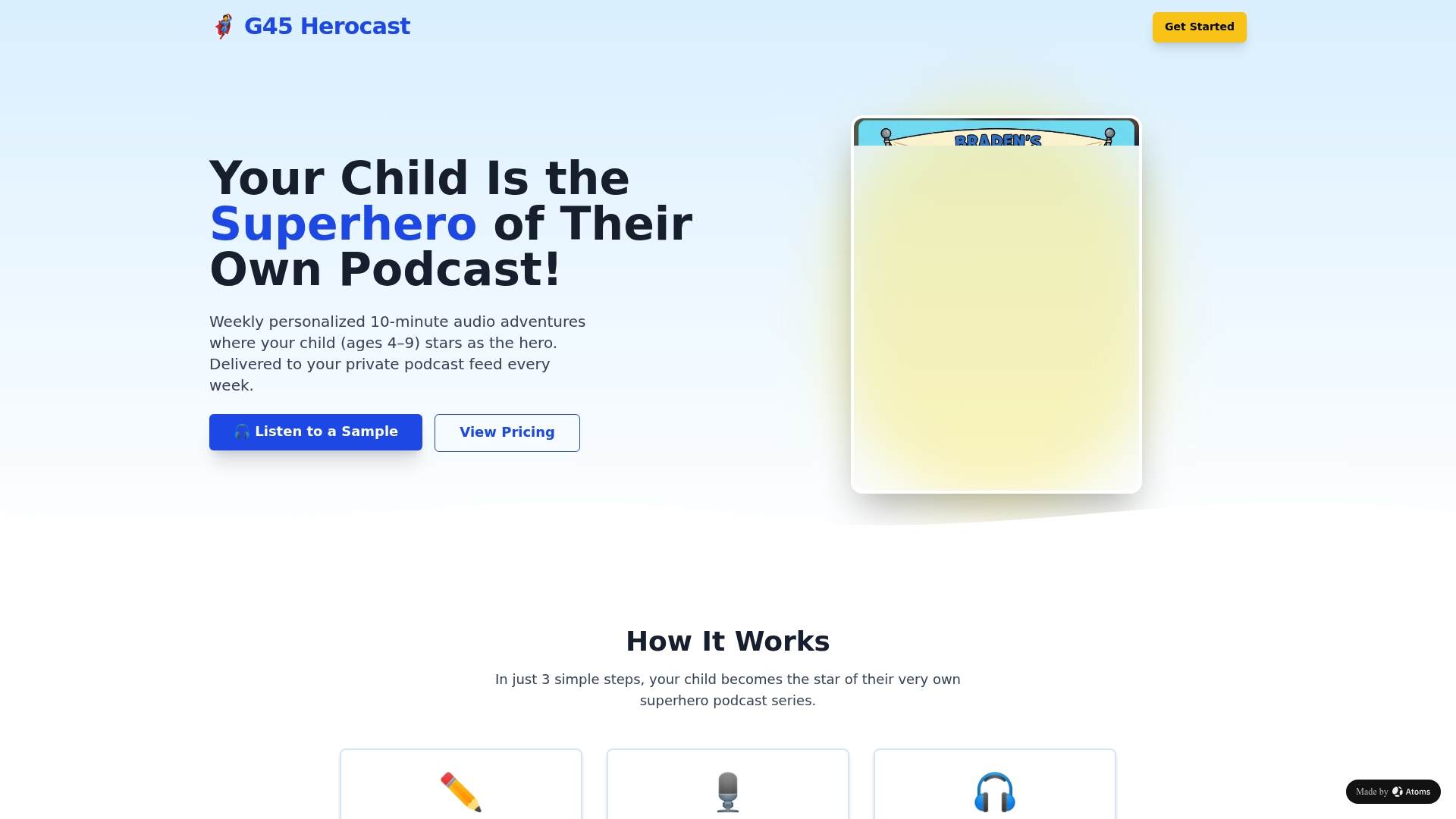
The Bedtime Standard plan is $99 per month. The Grandparent Gift plan is $999 per year, a way for grandparents to show up in a grandchild's week even from far away. You can see both on our home page.
FAQ
What are the benefits of storytime for children?
Storytime supports vocabulary, listening, narrative skill and imagination, and it builds empathy and closeness with the adult sharing it. The AAP says reading together strengthens caregiver-child relationships and helps lay groundwork for school readiness. Benefits are largest when the child gets to talk, predict and retell.
What are the 5 C's of storytelling?
There is no single official list. The "5 C's" appear in different forms in business and design writing, and none of them is a child development standard. For kids, a useful checklist is characters, a problem, the setting, the choices the hero makes, and how it ends. Those are the same parts you can ask your child to retell.
Why do we read stories to children?
We read stories to support literacy and vocabulary, widen children's worlds beyond their own surroundings, and help them understand other people. Stories also give children a calm, shared moment with a parent or grandparent, which is its own benefit.
Does storytelling work if my child is already reading?
Yes. Oral narration and listening comprehension keep developing through the early school years, and the SKILL study found that stronger oral storytelling carried over to written storytelling and reading comprehension. Listening to stories above their own reading level also exposes children to richer words and plots.
Are audio stories as good as books?
They do different things. Audio stories build listening, visualization and attention without a screen, while picture books add print awareness and illustration. Talking with your child about either one is what makes the biggest difference.
Sources
- Why is storytelling important to children? (BBC Teach)
- What Works Clearinghouse Educators Practice Guide, Recommendation 7 summary (IES)
- Parents' early book reading to children (PMC, 2019)
- Shared Reading at Age 1 Year and Later Vocabulary (PMC)
- WWC Dialogic Reading (IES)
- WWC Shared Book Reading (IES)
- SKILL randomized controlled trial (IES)
- Tip Sheet: Ask Your Child to Retell the Story (University of Florida)
- How Telling Stories Helps Kids Learn (PBS Parents)
- Psychosocial Effects of Parent-Child Book Reading (Pediatrics, PubMed)
- Why stories are important (Parenting SA)
- Early Literacy and Math (American Academy of Pediatrics)
- Bright Futures Information for Parents: 3 Year Visit (AAP)