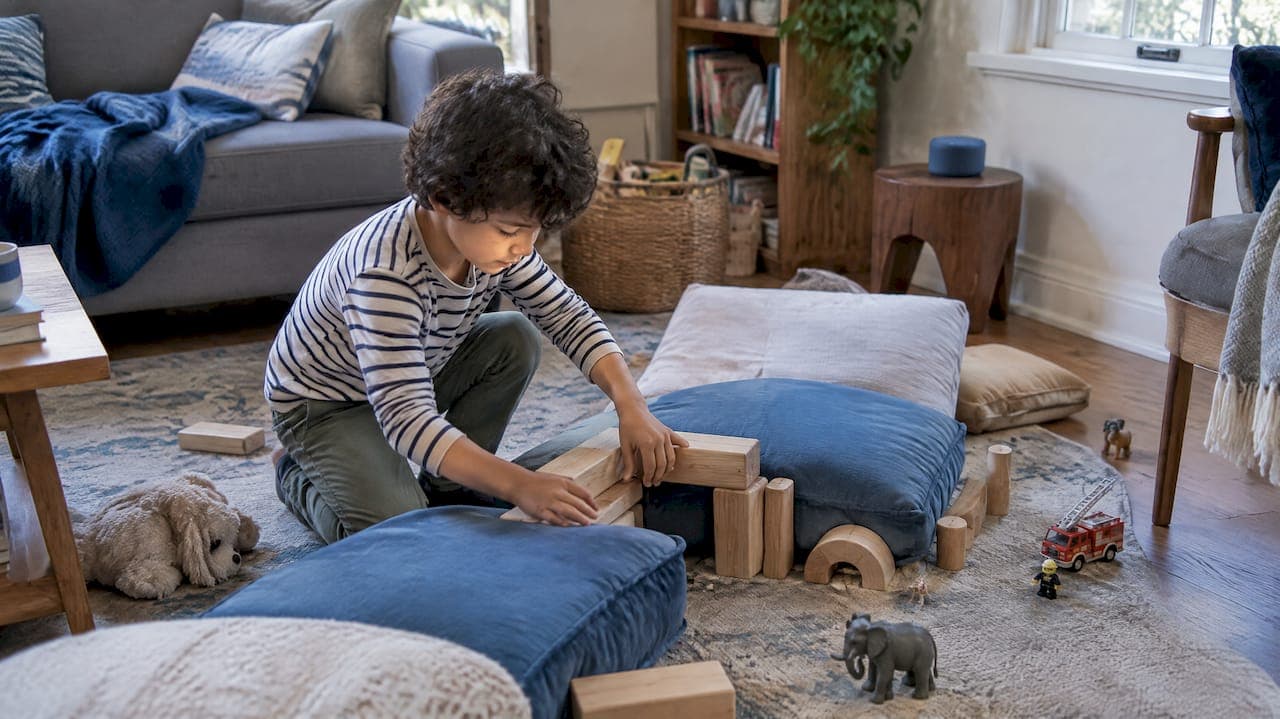
Audio can make independent play easier for a child ages 4 to 9. A story that gives your child a mission, played from a speaker while toys, costumes or blocks are within reach, turns "I'm bored" into 20 or 30 minutes of self-directed pretend play. It works best when you set the scene, listen together first, and keep the volume low. This guide covers how to do each of those things.
TL;DR
- Audio-only stories are a screen-free prompt for play. The child still does the imagining, moving and deciding.
- Listen together the first time or two, then step back. The American Academy of Pediatrics (AAP) encourages co-listening before independent use.
- Set out open-ended props (costumes, blocks, pillows) before you press play.
- Keep volume at half or less and take a break every hour. Speakers are easier on ears than earbuds.
- Stories that star your child, with their real interests, give the strongest reason to act the story out.
Table of Contents
- What independent play with audio actually is
- Why audio works better than a screen for this
- How to set it up: a five-step routine
- Match the audio to the age
- Why personal stories hold attention longer
- Perspective: what we see in how kids use these stories
- Keep the volume safe
- When independent play with audio does not work
- A starter plan for the first two weeks
- Try it with a story built around your child
- FAQ
- Sources
What independent play with audio actually is
Independent play means your child plays on their own, without you directing it, while you are nearby. Audio adds a voice and a storyline, not a screen. The child listens, then moves, builds, pretends and talks back to the story.
That last part matters. NAEYC describes play as essential for all children from birth through age 8, and says it supports self-regulation, language and social skills. Play also runs on a spectrum, from free play to guided play to structured games. Audio-prompted play sits in the middle: the story supplies a thread, and your child supplies everything else.
It is not the same as putting on background noise and walking away. Some parents on forums describe playing long ambient videos while a toddler wanders around. That can buy you a quiet moment. A story with a clear goal gives an older child something to do with their hands and body, which is the part that builds imagination.
Why audio works better than a screen for this
A screen asks a child to sit and watch. Audio leaves eyes and hands free, so a child can run a rescue mission across the living room while the narrator describes it.
There is research behind the difference, with limits. One EEG study of preschoolers found that screen-based story listening was linked to a different brain-connectivity pattern and lower narrative comprehension than dialogic reading, the back-and-forth way an adult reads with a child. That study compared screens with adult-led reading, so it does not prove audio is magic. It does show that how a story is delivered changes how a child takes it in.
On language, a 2026 randomized trial of text-supplemented audiobooks found they supported vocabulary learning in children averaging about 9.5 years old. Earlier work, a meta-analysis of multimedia stories, found that well-designed stories can help young children understand narratives and learn words even without an adult beside them. So a good audio story can do some of the language work of a read-aloud. It does not replace one.
If you want to compare formats before you pick, our guides on podcasts versus TV and podcasts versus story apps go through the trade-offs.

How to set it up: a five-step routine
Most failed attempts come from skipping the setup. Try this order.
- Listen together first. Sit with your child for the first episode or two. The AAP's advice on co-viewing is about discovery, not policing: you learn what your child enjoys, and they learn that you are interested. Once you share that, stepping away feels less like being left.
- Choose a play zone. A corner of the living room or a bedroom floor with a clear space. Stay within earshot, in the kitchen or at a desk.
- Lay out open-ended props. NAEYC's guidance on planned learning environments is that children play best when the space holds flexible materials they can use their own way. Think cape and mask, a cardboard box, building blocks, stuffed animals, scarves. A superhero costume is a good example, because putting it on tells a child it is time to become the character.
- Say what happens next. "When the story ends, I'll come see what you did." A clear end point helps younger kids let go of you.
- Debrief briefly. Ask one question: "What was the hardest part of the mission?" This turns solo play into a shared story and makes your child more likely to invite you in next time.
Match the audio to the age
| Age | What tends to work | What you can expect |
|---|---|---|
| 4 to 5 | Short episodes with clear actions ("fly to the roof," "sneak past the dragon") | 10 to 15 minutes of play, often near you |
| 6 to 7 | Stories with a problem to solve and room to pause | 15 to 25 minutes, more props and role-play |
| 8 to 9 | Longer, more layered plots, mysteries, missions with choices | 20 to 40 minutes, may invent a sequel afterward |
These are rough patterns from how families commonly use stories, not clinical benchmarks. Every child differs, and tiredness, hunger and mood matter more than the number on the birthday cake.
For ideas on what to put on, see our lists of age-appropriate podcasts and audio adventures for ages 4 to 9.
Why personal stories hold attention longer
Generic stories entertain. Stories about your own child pull them in. When the hero has your child's name, favorite animal, best friend and fear of the dark, the story stops being something to watch and becomes something to do.
This is where independent play and audio fit together best. Researchers writing in Frontiers-style reviews of dramatic play have noted that children spend more time in adult-directed media and less in rich pretend play. A prompt that hands the child a role and a mission pushes in the other direction: act it out, plan it, talk to your characters. The audio is the spark, not the substitute.
Perspective: what we see in how kids use these stories
We make weekly superhero podcasts where each child is the hero, so we think about this question every week. Our view is simple: the best audio does not fill a child's head. It leaves gaps.
A name dropped into a generic script is easy to make and easy to forget. We write each episode around the child's real details and interests, so there is a reason for them to stand up and do something. A story that says "you've been chosen to protect the treehouse" invites a child to go and guard a pillow fort. Nothing on a screen can do that for them.
We also build the weekly rhythm on purpose. A new episode arrives every Sunday in a private podcast feed, so the week starts with something to look forward to. It also gives parents a predictable window: listen together on Sunday, then let the next episodes become independent play time during the week.
And we say this plainly to parents: audio is a tool, not a babysitter. The goal is more family time, not less. The best sign we can hear about is a child who comes out of their room, still in a cape, and wants to tell you what happened.
— JG
Keep the volume safe
Independent play means you are not right next to your child, so set volume limits before you walk away.
- Half volume or less, with breaks. The AAP's general rule is to keep devices at half volume or less and take listening breaks every hour, especially with earbuds or headphones.
- Use the arm's-length test. If a child wearing headphones cannot hear you speak from an arm's length away, it is too loud. If you can hear sound leaking out, it is too loud.
- Do not trust the label alone. The AAP notes that some headphones marketed as kid-safe can still exceed 75 decibels, so listen to the device yourself.
- Prefer a speaker for play. Kids who move around do not want a cord, and a small speaker at room volume avoids the issue. We go deeper in headphones versus speakers for kids.
The AAP has also warned that personal listening devices are among the most common sources of noise exposure for children, and that heavy exposure can lead to hearing loss or tinnitus. If your child complains of ringing or muffled hearing, talk to your pediatrician.
When independent play with audio does not work
A few common snags, and what to try.
Your child keeps coming to find you. Shorten the stretch. Start with one 10-minute episode in the same room, then move your chair a bit farther each day. Independent play is a skill that builds up.
They just lie on the couch. That is listening, not play, and it is fine at bedtime or on a rainy afternoon. For active play, add props and say the goal out loud before the story starts: "Let's see what the hero needs to carry today."
Siblings fight over it. Give each child their own story, or have them play different roles in the same one. Our service has options for siblings, so each child can be the hero of their own episode.
It turns into a nightly negotiation. Put audio in a fixed slot, like after school or before dinner. A predictable slot beats a daily bargain. You can also see how this fits into screen-free bedtime routines.

The broader picture is in our guide to making screen-free play last with imagination podcasts. A school-break idea from the AAP is also worth borrowing: it lists audio as one calming option alongside reading, coloring and sensory play for kids who need to settle.
A starter plan for the first two weeks
- Days 1 to 3: Listen together, in the play space. Ask what your child liked.
- Days 4 to 7: Start the story, stay for the first few minutes, then go to the next room.
- Week 2: Play on your child's own. End each session with one question about the mission.
If an episode falls flat, move on. A story built on what your child cares about will always beat one that is just popular.
Try it with a story built around your child
If you want a ready-made prompt for this kind of play, Superhero Sounds creates a weekly superhero podcast for children ages 4 to 9, delivered every Sunday to a private podcast feed. Each episode is written around your child's name, interests and traits. The Bedtime Standard plan is $99 per month, and the Grandparent Gift plan is $999 per year for grandparents who want to give a child something to look forward to every week. You can see both on our home page.
FAQ
How long should a child play independently with audio?
Start with 10 to 15 minutes for ages 4 and 5, and 20 to 30 minutes for ages 6 to 9. Let the story's length set the limit instead of forcing a timer. Build up slowly over a few weeks.
Is audio better than a screen for independent play?
For active, imaginative play, audio usually leaves a child freer, because their eyes and hands are not tied to a device. One EEG study linked screen-based story listening with lower narrative comprehension than reading with an adult. Audio is not a cure-all, but it is a reasonable screen-free choice.
Should I listen with my child first?
Yes. The AAP suggests co-listening at the start to learn what your child enjoys and to build trust. After a few episodes together, most children are ready to play on their own.
Are headphones safe for kids during audio play?
They can be, with limits. Keep volume at half or less, take a break every hour, and make sure your child can hear you from an arm's length away. For active play, a speaker at a low volume is often simpler.
Sources
- NAEYC: Principles of Child Development and Learning
- HealthyChildren.org: Why co-viewing is important
- PMC: Hyperconnectivity during screen-based stories listening (EEG study)
- PMC: Remote text-supplemented audiobook intervention and vocabulary learning
- PMC: Can the computer replace the adult for storybook reading?
- HealthyChildren.org: Tips to preserve your child's hearing
- HealthyChildren.org: AAP sounds alarm on excessive noise risks
- HealthyChildren.org: School breaks, swap screens for play