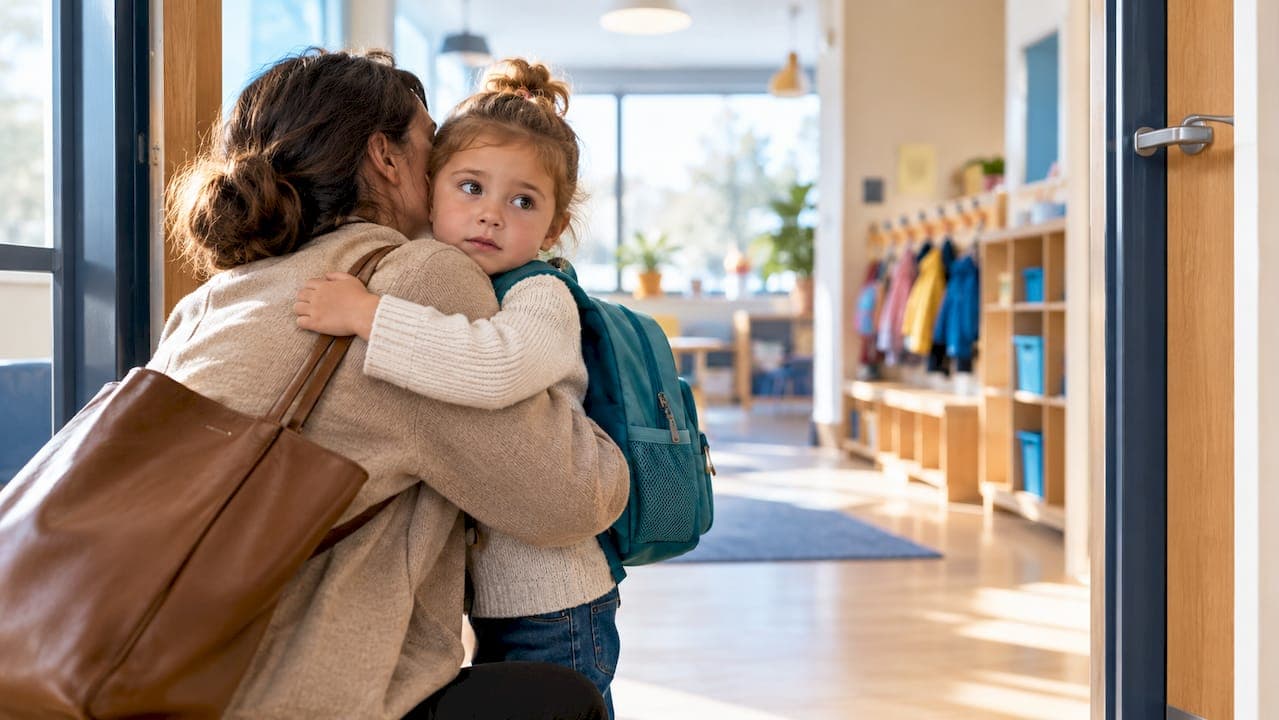
Kindergarten transition anxiety is normal for most children, and it's usually temporary. Start with a simple goodbye ritual, one short practice separation before the first day, and a story that puts words to what your child is feeling. Most kids settle within a few weeks. If crying and clinginess stretch past a month with no improvement, or your child starts refusing school outright, that's the signal to loop in the teacher and pediatrician.
TL;DR:
- Most children settle into kindergarten within a few weeks, but those with sensory sensitivities or recent disruptions may take longer.
- A predictable goodbye ritual, practiced separation, and stories about feelings are among the most effective strategies to ease anxiety.
- Red flags such as school refusal, panic attacks, or declining sleep and eating habits lasting over several months require consultation with teachers and pediatricians.
- Short-term, consistent routines and small baby steps, like visiting the school and practicing separations, can significantly reduce anxiety levels.
- Personalized stories and screen-free rehearsals, such as audio adventures, provide additional confidence boosts for worried children.
Table of Contents
- Six Real Kindergarten Transition Anxiety Stories
- Signs of Kindergarten Anxiety and How Long Adjustment Really Takes
- Step-by-Step Strategies to Ease the Kindergarten Transition
- Books and Stories That Help With Kindergarten Anxiety
- When Kindergarten Anxiety Needs More Than a Ritual
- What I've Learned Watching Families Navigate This
- A Screen-Free Way to Rehearse the Big Day
- Where These Insights Come From
- Sources
- FAQ
Six Real Kindergarten Transition Anxiety Stories
Every parent who has stood in a kindergarten hallway peeling a small hand off their leg knows this feeling. The stories below aren't identical, and that's the point. Anxiety shows up differently depending on the kid, the family, and even the week.
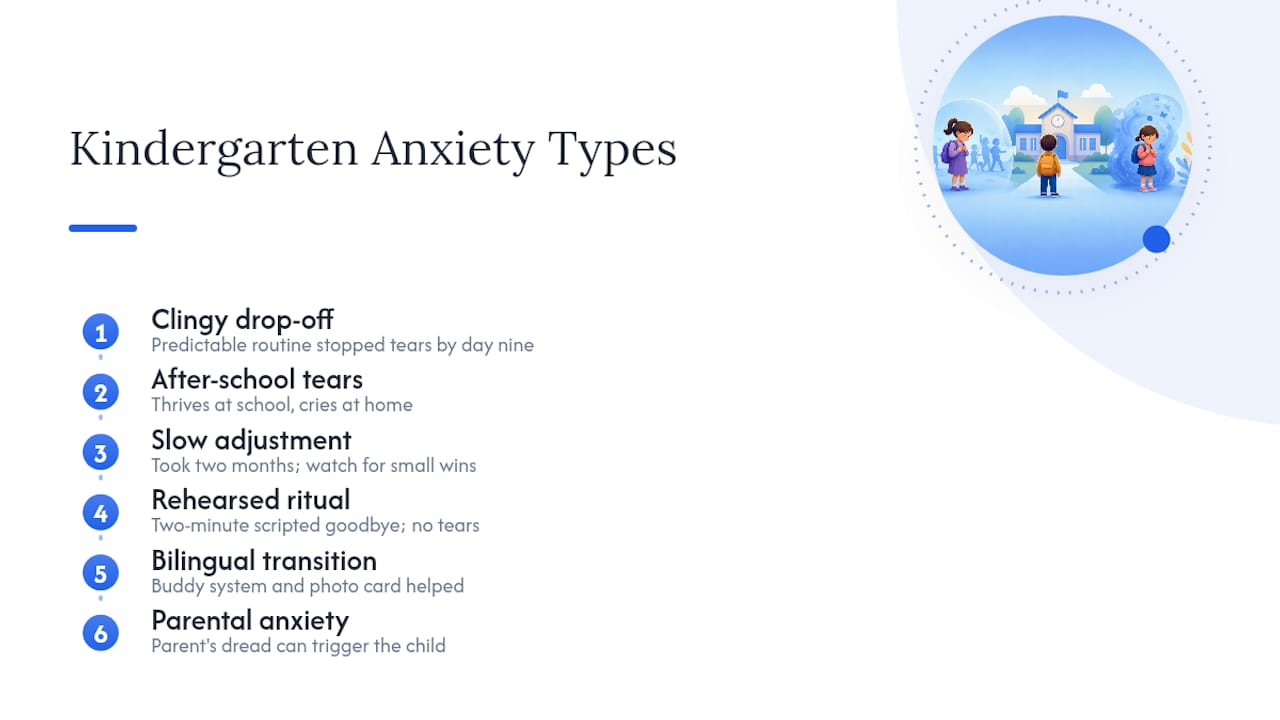
The clingy drop-off. Maria's son Diego wrapped himself around her leg every single morning for two weeks straight, sobbing loud enough that other parents turned to look. She tried talking him through it, then bribing him, then rushing the goodbye. Nothing worked until she switched to a fixed, boring routine: one hug, one high five, one wave from the door, every single day, no exceptions. Diego stopped crying by day nine. The fix wasn't comfort. It was predictability.
Tears at home, thriving at school. Priya's daughter came home from kindergarten sobbing about how much she hated it, yet her teacher reported a cheerful, engaged kid who raised her hand and played at recess. This gap is common. Kids hold it together during the school day and release the pressure the moment they're back with someone safe. Priya learned to treat the after-school meltdown as a compliment to her, not a red flag about school.
The long, slow adjustment. Not every child snaps into place in a week. James took almost two full months to stop crying at drop-off, and his parents nearly pulled him out twice. What helped was ignoring the calendar and watching for small wins instead: one day without tears, then two, then a whole week. Progress that isn't linear is still progress.
The quick rebound after a ritual. Sofia's parents built a two-minute goodbye script before day one and rehearsed it at home like a play. On the actual first day, she walked in without a single tear. Practice separations rehearsed in advance can shrink the anxiety window dramatically for some kids.
The immigrant family's mixed emotions. For Amara's family, kindergarten meant a new language on top of a new building. Her mother felt pride and panic at once, worried Amara would feel isolated. She asked the school for a buddy system and sent a small photo card in Amara's backpack. Anxiety in bilingual or newly arrived families often carries an extra layer worth naming out loud.
The parent who wasn't ready. Sometimes the anxious one is the adult. Tom cried in his car after drop-off for a week and later admitted his daughter had picked up on his own dread. Kids read parental energy closely, and a parent's calm goodbye does more work than any pep talk.
Signs of Kindergarten Anxiety and How Long Adjustment Really Takes
Anxiety at this age rarely announces itself as "anxiety." It shows up as behavior and body complaints:
- Crying, clinging, or begging to stay home at drop-off
- Stomachaches or headaches with no medical cause, especially on school mornings
- Trouble falling asleep the night before school, or waking up early and anxious
- Appetite changes, either skipping breakfast or overeating for comfort
- Regressions like thumb-sucking, bedwetting, or baby talk that had already stopped
Timelines vary more than most parenting articles admit. Some children stop crying within days. Others take weeks, and a smaller group takes a couple of months, particularly kids with sensory sensitivities, a history of separation difficulties, or families still working through pandemic-era disruptions to routine and socialization. Parent accounts on forums consistently describe this spread, with some kids settling in under a week and others needing the better part of a semester before drop-off feels routine.
Pro Tip: Track functioning, not feelings. A child who's still sad at drop-off but eating lunch, playing at recess, and sleeping fine is adjusting. A child whose eating, sleep, and play are all sliding is the one worth watching closely.
Step-by-Step Strategies to Ease the Kindergarten Transition
- Practice separations before day one. Leave your child with a grandparent or friend for short stretches in the two weeks before school starts, gradually extending the time.
- Visit the school building. Walk the halls, find the classroom, locate the bathroom. Unfamiliar spaces feed anxiety more than unfamiliar people do.
- Preview the actual routine. Talk through what happens hour by hour on a typical day, from backpack to bus to snack time.
- Build a 30 to 60 second goodbye ritual and stick to it. A hug, a phrase, a wave. Keep it identical every single day.
- Never sneak out. Slipping away while your child is distracted feels efficient once and erodes trust for weeks.
- Send a transitional object. A small photo, a bracelet, or a note in the lunchbox gives an anxious child something tangible to hold onto.
- Debrief after school with a simple script, not an interrogation. Ask "What was one good thing and one hard thing today?" instead of "How was school?"
- Celebrate small wins out loud. Dry eyes at drop-off, even once, deserves a mention at dinner.
- Keep the rest of the routine boring and stable. New anxieties don't need a new bedtime or a new after-school activity layered on top.
- Ask the teacher for a small, specific check-in, like a thumbs-up text after the first ten minutes, rather than daily reports that can turn into micromanagement.
A short, consistent goodbye ritual paired with practice separations is one of the most reliable ways to ease your child's kindergarten jitters, and teachers tend to respond best to a brief, specific request rather than an open-ended one.
Pro Tip: Copy this two-line goodbye script and use it verbatim every morning: "I love you, I'll see you at pickup, have a great day." Then walk away without looking back, even if there are tears.
For calming in the moment, teach one simple tool before school starts: five slow breaths counted on fingers, or a small fidget object kept in a pocket. Rehearsing it at home means your child already knows how to use it under pressure.
Books and Stories That Help With Kindergarten Anxiety
Stories give kids language for feelings they can't yet explain, and reading one together lets you role-play the hard part before it happens in real life. A few titles show up again and again on teacher recommendation lists and in parenting guides, largely because narrative and story-based tools help children label emotions and imagine coping strategies:
- The Kissing Hand by Audrey Penn — a raccoon learns a secret way to feel his mother's love all day at school. Best read the week before school starts.
- First Day Jitters by Julie Danneberg — a twist ending reveals the nervous character is actually the teacher, which normalizes adult anxiety too.
- The Night Before Kindergarten by Natasha Wing — a rhyming rundown of first-day nerves and excitement, good for the actual night before.
- Wemberly Worried by Kevin Henkes — a mouse who worries about everything finds a friend on day one.
- Llama Llama Misses Mama by Anna Dewdney — simpler language, good for younger or more literal thinkers.
After reading, ask concrete questions: "What did the character do when she felt scared?" "What's one thing you could try tomorrow?" Some families also use a screen-free personalized audio story at bedtime or right before drop-off to rehearse the morning, since hearing themselves cast as the confident one in a story can make the real version feel more familiar.
When Kindergarten Anxiety Needs More Than a Ritual
Most kindergarten anxiety fades with time and routine. Watch for red flags that go beyond typical jitters: outright school refusal, panic attacks, or a steady decline in eating, sleeping, or social functioning over several months rather than weeks.
Start with the teacher, since they see your child in the actual environment causing the distress. If concerns continue, the pediatrician is the next call, and provider guidance on childhood anxiety recommends this exact order before considering a referral to a child therapist. Early intervention tends to shorten the whole ordeal rather than lengthen it.
What I've Learned Watching Families Navigate This
Handing your child to a stranger in a building full of strangers never stops feeling strange, even when you know it's the right thing. Every parent essay about kindergarten drop-off carries the same bittersweet undertone: pride sitting right next to dread, sometimes in the same breath. One parent's account of her son's first day captures this better than any checklist could. Her son loved it. She still cried in the car.
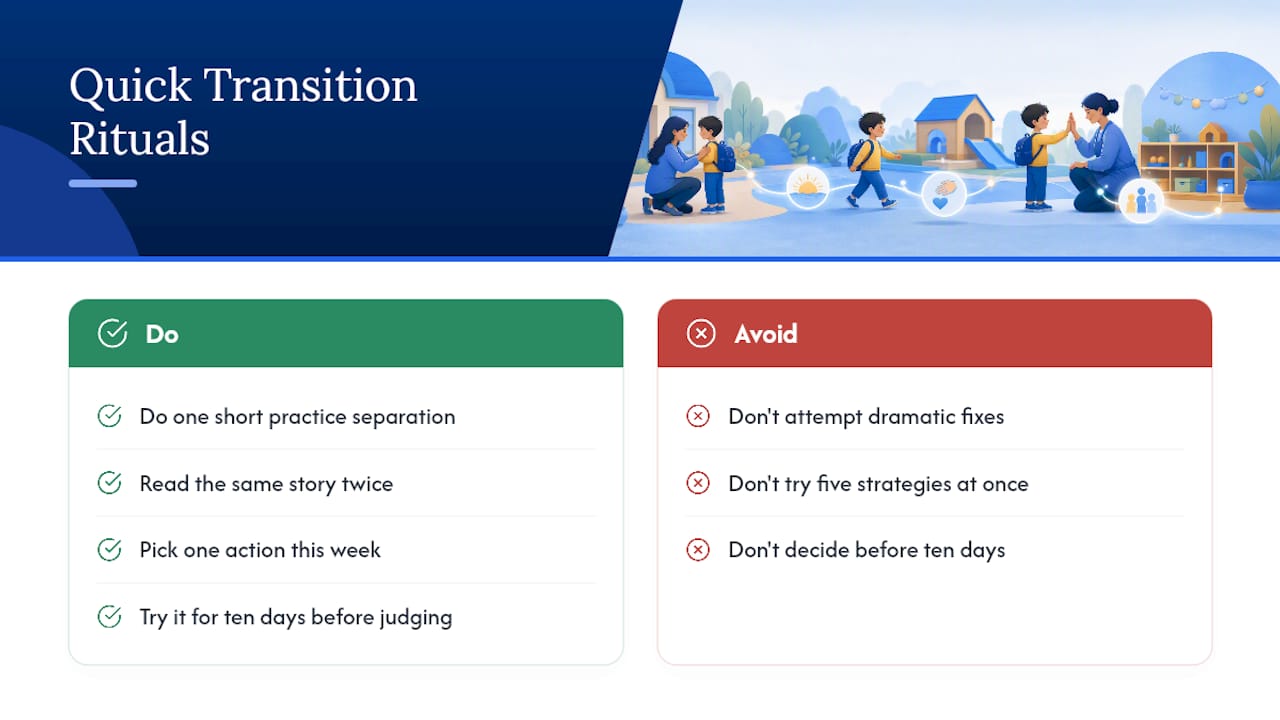
If you take one thing from all six vignettes above, take this: the fix is rarely dramatic. It's a boring, repeated ritual. A short practice separation. A story read twice. Pick one action this week, not five, and let it run for ten days before deciding whether it worked.
— JG
A Screen-Free Way to Rehearse the Big Day
Most of the strategies above rely on repetition, a script, a goodbye ritual, a story read at bedtime. G45-hero-cast builds that repetition into something your child actually looks forward to: a weekly personalized superhero podcast where they are the hero of their own audio adventure, using their real name, interests, and quirks.

Families use it two ways that fit directly into what this article covers. At bedtime, a personalized episode becomes a calming, screen-free wind-down that can double as a gentle preview of tomorrow's routine. Right before drop-off, a quick replay of an episode where their character shows courage can work as a confidence boost that doesn't require a screen in a car full of morning chaos. It pairs naturally with the screen-free morning routines many families already lean on to keep mornings predictable, and with the kind of short parent-child bonding moments that make a goodbye ritual feel less like a chore and more like a shared habit.
Episodes are delivered every Sunday to a private podcast feed, so the ritual is already waiting before the week even starts. The Bedtime Standard plan runs $99 per month, and the Grandparent Gift plan runs $999 per year for families who want a grandparent covering the subscription. Check current episode options and start a subscription at G45-hero-cast.
Where These Insights Come From
- How to Ease Your Child's Kindergarten Jitters — Edutopia's breakdown of goodbye rituals, practice separations, and teacher communication.
- My Son Loved His First Day of Kindergarten — a KPBS parent essay on the mixed emotions of drop-off day.
- Anxiety Disorders in Children — MindShift Psychological Center's overview of red flags and referral steps.
- The Kindergarten Transition — a roundup of story-based tools for easing school anxiety.
This article is general information, not a substitute for advice from a qualified doctor. Consult a qualified healthcare professional about your own circumstances before acting on anything here.
Sources
- How to Ease Your Child’s Kindergarten Jitters
- My son loved his first day of kindergarten. It brings up my own bittersweet memories
- Anxiety Disorders in Children - MindShift Psychological Center
FAQ
What Is the 3-3-3 Rule for Anxiety in Children?
The 3-3-3 rule is a grounding technique where a child names three things they see, three sounds they hear, and three body parts they can move. It's a quick way to pull attention away from panic during a hard drop-off moment, and it works best when practiced calmly at home before you ever need it in the moment.
How Do I Help My Child With Kindergarten Starting Anxiety?
Build a short, consistent goodbye ritual, practice brief separations in the weeks before school starts, and read a transition story together like The Kissing Hand. Most children respond well to predictable routines and teacher collaboration, and consistency matters more than the specific ritual you choose.
What Are Good Stories for Kids With Kindergarten Anxiety?
The Kissing Hand, First Day Jitters, and The Night Before Kindergarten are the most widely recommended titles for easing kindergarten transition anxiety. A personalized audio story where your child is the hero can serve a similar purpose at bedtime or right before drop-off.
What Are Common Symptoms of Anxiety in Kindergarteners?
Common signs include crying or clinging at drop-off, stomachaches or headaches with no medical cause, sleep disruptions, appetite changes, and behavioral regressions like thumb-sucking or bedwetting. Most of these ease within days to a few weeks; if they persist for a couple of months or worsen, talk to the teacher and pediatrician first.