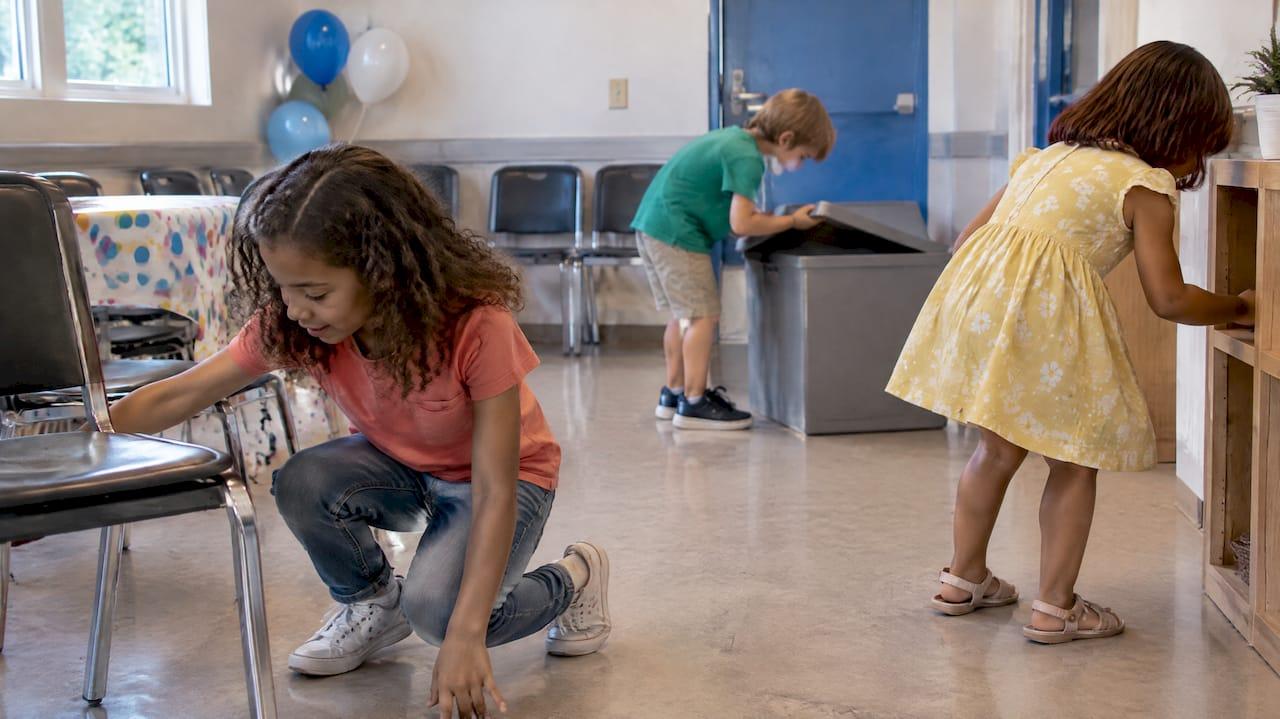
The easiest screen-free birthday is a short, loosely structured party. Plan four to six activities, mix loud and calm ones, keep each game short, and leave room for free play. Classic games, one hands-on craft and a simple treasure hunt will fill a two-hour party for most kids between 4 and 9. This guide gives you the games, the schedule, the indoor and outdoor options, the safety checks and a few ways to make the day feel personal.
TL;DR
- Plan four to six activities for a two-hour party, plus two spares, and alternate active and calm games.
- Keep each game to about 10 to 15 minutes. Under-6s lose interest quickly, so rotate often.
- For kids under 10, favor cooperative games over elimination and competition.
- Keep a rainy-day plan: crafts, charades, a themed scavenger hunt or dance games.
- Finish with something the kids made or heard together, not a bag of plastic extras.
Table of Contents
- Tell parents early that it is screen-free
- Build the party around a simple schedule
- Games that work for ages 4 and 5
- Games that work for ages 6 to 9
- Hands-on stations for a calm middle stretch
- Indoor or outdoor: choose by space and weather
- Make it work for mixed ages and different abilities
- Safety and supervision for active games
- Where audio fits into a screen-free birthday
- Our perspective: the best party memory is the one the child stars in
- A birthday gift that keeps going after the party
- FAQ
- Sources
Tell parents early that it is screen-free
The awkward part of a screen-free party is usually not the kids. It is the announcement. One parenting site suggests mentioning the policy casually in the invitation, with a line such as "We are keeping it screen-free so the kids can play together." It reports that most parents are relieved.
A few practical touches help:
- Put the plan on the invitation: games, a craft and cake, with pickup time.
- Ask about allergies when guests RSVP, so you are not guessing on the day.
- Tell parents they are welcome to stay and help if their child is shy.
- If you take photos, take them yourself and share them afterward.
Build the party around a simple schedule
A schedule is what makes a party without devices feel calm instead of chaotic. For 4-year-olds, PBS KIDS for Parents suggests short games, silly songs, treasure hunts and lots of active play, with the party lasting about two hours. HealthyChildren.org, from the American Academy of Pediatrics, suggests roughly 10 to 15 minutes per game or activity.
For a two-hour party, Party Game Book advises four to six games and two spares. It also notes that kids under 6 tend to drift after about 10 minutes of any one game, and that alternating loud and calm activities keeps everyone engaged.
Here is a schedule you can copy and adjust:
| Time | Activity | Energy |
|---|---|---|
| 0:00 to 0:15 | Arrival activity: coloring table or mask decorating | Calm |
| 0:15 to 0:30 | Welcome game: Simon Says or freeze dance | Active |
| 0:30 to 0:50 | Treasure or scavenger hunt | Active |
| 0:50 to 1:10 | Two or three craft or building stations, kids choose | Calm |
| 1:10 to 1:25 | Big shared game: relay, parachute-style group game or bubble chase | Active |
| 1:25 to 1:50 | Snacks, then cake | Calm |
| 1:50 to 2:00 | Story, song or open play while parents arrive | Calm |
One tip from Festidy's party game finder: put an active game before snacks and a calm one before cake. Kids settle faster, and the cake moment is easier to enjoy.
Games that work for ages 4 and 5
Preschool-age kids do best with simple rules they can learn in one sentence. Mommy Poppins is quoted in one roundup as pointing to Duck, Duck, Goose and Simon Says for this age. Good options include:
- Freeze dance. Play music from a phone or speaker, then pause it. Kids freeze in silly poses. No one is out.
- Simon Says. Physical therapist Dr. Brittany Nardone explains in Today's Parent that it supports motor skills, listening, impulse control and following multi-step directions.
- Bubble chase. Almost no setup, and the youngest guests love it.
- Treasure hunt with picture clues. Hide small items or stickers and use drawings instead of written clues.
- Duck, Duck, Goose. Rules take seconds, and it works in a circle on the lawn or living room floor.
Keep the turns short and skip elimination. A child who is "out" at age 4 is usually a child about to cry.
Games that work for ages 6 to 9
School-age kids can handle more rules, longer clues and a little teamwork. UNICEF's guidance on screen-free activities suggests nature walks, scavenger hunts, I Spy, storytelling and hide-and-seek for 5 to 8-year-olds. All of those can be turned into party games.
Try these:
- Charades. Use animals, jobs or superheroes. Let kids act in pairs if someone is shy.
- Relay races. Pass a beanbag, carry a plastic spoon with a soft ball, or hop to a cone and back.
- Riddle or clue hunt. Older kids read the clues aloud while younger kids hunt.
- Team quizzes. Use the birthday child's favorite topics, from dinosaurs to space.
- Capture the flag. Best for a backyard or park with a few helpers, and it suits the older end of this range.
- Craft stations. Mask-making is one HealthyChildren.org suggests, using paper plates, paper bags, felt, markers and crayons.
Keep competition gentle
Michigan State University Extension's group games guide says competition is generally inappropriate for youth under 10 and recommends noncompetitive games or removing the competitive element. In practice:
- Score the whole room as one team, with a goal such as "beat the timer."
- Give every child a prize or a job at the end of a game.
- Replace elimination with a twist: kids who are "out" become the judges, helpers or music controllers.
Hands-on stations for a calm middle stretch
Stations are the secret weapon of a device-free party. Kids pick one, drift to another, and parents get a breather. Set up two or three tables, each with one task:
- Mask or cape station. Paper plates, markers, felt scraps and stickers. Kids leave with a costume.
- Build station. Blocks, LEGO-style bricks, cardboard tubes and tape. Challenge: build a hideout for a hero.
- Cupcake or cookie decorating. Sprinkles, frosting and fruit. It doubles as a snack and a craft.
- Story corner. Cushions and a few picture books, for kids who need a quieter minute.
The same parenting site mentioned earlier suggests skipping goodie bags and sending children home with something they made. The mask or cupcake does that job. If you do prefer favors, read up on age-based party favor safety before choosing small items for younger guests.
Indoor or outdoor: choose by space and weather
Indoors, games like Simon Says and treasure hunts build gross and fine motor skills, according to Today's Parent. Outdoors, games such as tag, hide-and-seek and capture the flag give kids cardiovascular exercise. Use that as a quick guide:
| Setting | Good picks | Why |
|---|---|---|
| Backyard or park | Relay races, tag, scavenger hunt, water games, capture the flag | Room to run, easy cleanup |
| Living room | Freeze dance, charades, Simon Says, craft stations | Contained, low setup |
| Small apartment | Treasure hunt, charades, one craft table, story circle | Little floor space needed |
| Rainy day | Dance games, charades, themed hunt, cupcake decorating | Burns energy without chaos |
When space is tight
Classpop advises choosing activities that rotate rather than sprawl, setting up one anchor activity, pushing furniture against the walls and using countertops and folding tables to create defined zones.
When the weather turns
Have a backup before you need it. Easy Kids Parties suggests an indoor backup or rescheduling, indoor versions of planned activities, and keeping parents informed. Quick crafts, board games, a themed scavenger hunt, charades or Pictionary all work, and a calm corner helps overwhelmed kids. Classpop adds that rainy-day activities should contain energy without suppressing it, and that rotating every 20 to 30 minutes prevents restlessness.
For more ideas that work in tight quarters or bad weather, see these kids' birthday ideas, rain or shine. We also keep a screen-free rainy day kit that you can adapt for a party.

Make it work for mixed ages and different abilities
Birthday guest lists rarely stay inside one age band. A 9-year-old cousin and a 4-year-old neighbor may be at the same party. Gather & Play advises changing the format, not the players: read prompts aloud, let anyone play as part of a pair, offer a seated version of every game and put different ages on the same team. It also says pairing is the most powerful adaptation, because it lowers speed, knowledge and confidence barriers at once.
More adjustments you can use:
- Picture clues for younger kids, riddles for older ones in the same scavenger hunt.
- Change the rules, not the child. Utah State University Extension suggests adjusting scoring, distances, field size, number of chances or extra turns, and playing seated if needed, keeping a balance between challenge and frustration.
- Play youngest to oldest or children against parents. The Child Mind Institute describes both formats, plus target-throwing rounds with a shared team score.
- Think beyond the game. The National Center on Health, Physical Activity and Disability recommends quiet or sensory spaces, reachable food tables with seated options and accessible board or card games.
If siblings of different ages are in the mix, our guide to role-split activities for age-gap siblings shows how to give each child a part that fits.
Safety and supervision for active games
A few checks before the first guest arrives:
- Clear the play zone of breakables and loose rugs, and use soft equipment. AllFun also recommends keeping pins and small beads away from little kids.
- Agree on a stop signal, such as a bell or a clap pattern, so you can pause any game quickly.
- Check allergies before choosing snacks, prizes and craft materials.
- Skip latex balloons for games with kids under 8. Festidy notes a safety reminder for this age because children can choke on balloons and pieces, citing CPSC guidance.
- Give eliminated kids a job so nobody sits out feeling left behind.
- Watch emotions as well as bodies. Michigan State University Extension recommends emphasizing both physical and emotional safety when explaining team challenges.
Where audio fits into a screen-free birthday
Not every moment of the day needs to be a game. Audio is a calm, screen-free way to bring the kids together: a story circle, a quiet wind-down before parents arrive, or a sleepover ritual at the end of the night. If your child is planning a sleepover, our four-phase screen-free sleepover plan shows how audio can fit in. For younger superhero fans, our superhero pretend play ideas turn capes and masks into kind missions. Our broader list of screen-free activities for kids is useful for the days around the party, too.
Our perspective: the best party memory is the one the child stars in
We write weekly superhero podcasts for children ages 4 to 9, so we think about this question differently from most party guides. The best birthdays are not the ones with the most activities. They are the ones where the child feels like the main character for a while.
That is why we build each episode around the child's real details and interests, not just a name dropped into a generic script. The same principle works at a party: a treasure hunt themed on the birthday child's favorite animal, a cape with their chosen hero name, a story that stars them. Kids light up when the day is clearly about them.
It is also why we like audio as a screen-free tool. A story in the ear leaves the eyes and hands free. Kids can listen together, act it out, build a fort, or just lie on the floor and imagine. Families get shared time, and children get something to look forward to every week.
If you are planning a party, borrow that idea. Pick one thing that is unmistakably theirs, and build the rest of the day around it.
JG
A birthday gift that keeps going after the party
Grandparents and parents often ask for a gift that is not another toy or device. Our weekly personalized superhero podcast is designed for exactly that. Each Sunday, a new adventure arrives in a private podcast feed, written so your child is the hero, with episodes shaped around their name, interests, age and traits.
The Bedtime Standard plan is $99 per month, and the Grandparent Gift plan is $999 per year. There are also options for siblings. You can read more and subscribe on our site.
FAQ
How long should a screen-free birthday party for a 4 to 9 year old last?
About two hours works well for most kids in this range. PBS KIDS for Parents suggests two hours for 4-year-olds, and it is a comfortable length for older kids too. Plan four to six activities, with a couple of spare games in your pocket.
What is the easiest screen-free game with no prep?
Simon Says and freeze dance need nothing but a speaker, and Duck, Duck, Goose needs only a circle. All three have simple rules that preschoolers can follow. They also work for older kids if you add silly commands or harder dance challenges.
What do I do if kids ask for screens at the party?
Tell parents ahead of time that the party is screen-free, and keep the schedule moving. Short activities, a craft station and a clear next step usually keep kids busy. Let the birthday child pick a favorite game so there is something they are excited about.
How do I handle a wide age range?
Pair older kids with younger ones, offer seated versions of games and use picture clues for the youngest guests. Remove scoring where you can, since competition is generally not recommended for children under 10. A choice period with two or three stations lets each child find a comfortable level.
Sources
- Screen-Free Birthday Party Ideas for Kids (Ages 3-10)
- Screen-free activities for children, UNICEF Parenting
- Playful Birthday Party Ideas & Tips for Young Children, HealthyChildren.org
- Age-by-Age Birthday Party Guide, PBS KIDS for Parents
- These Easy Games for Kids are Screen-Free Lifesavers, Today's Parent
- Birthday Party Games for Kids: 50 Indoor + Outdoor Ideas
- Icebreakers, Team Challenges, and Other Group Games, Michigan State University Extension
- Plan, Prepare...PARTY, Utah State University Extension
- Making Games Work for Kids of All Ages and Needs, Child Mind Institute
- Hosting an Accessible & Adaptive Holiday Party, NCHPAD
- Adapting Party Games for Mixed Ages: A Practical Guide
- Contingency Planning at Kids' Parties
- Birthday Party Activities: 77 Fun Ideas for All Ages
- 40 Party Games for Kids, Sorted by Age
- Party game finder: kids games by age and theme