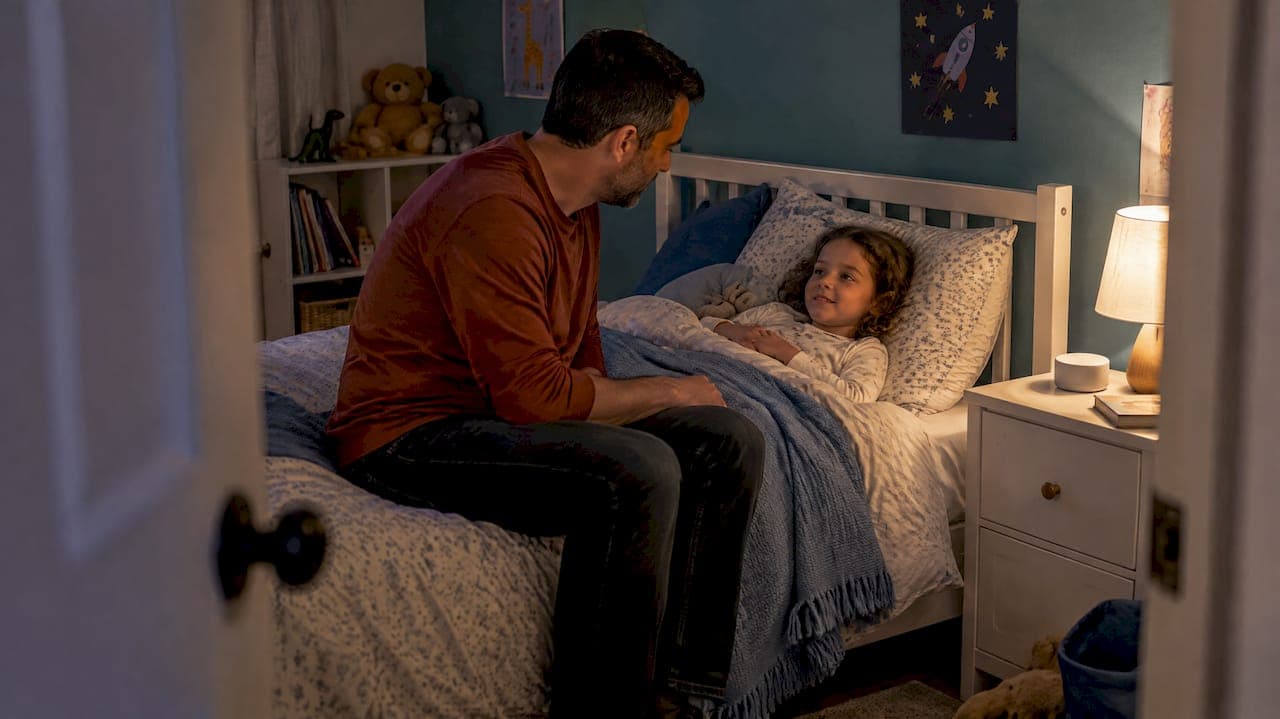
For most children ages 4 to 9, the best answer is not one or the other. Music has the longer research record for helping people fall asleep. Stories fit into the language-based bedtime routines that have been linked to longer sleep in young children. What matters most is that your child enjoys it, that it is calm, and that it happens in the same order every night. Below, we break down what the studies show, how the two compare, and how to set up either one safely.
TL;DR
- Music has the stronger direct research for easing sleep onset and improving sleep quality, including trials with school-age children.
- Story-based routines (reading, singing, storytelling) at age 3 were linked to longer nighttime sleep at age 5 in a large U.S. study.
- Stories give your child something to look forward to and a shared moment with you. Music gives a steady, low-stimulation background.
- Keep either one screen-free, at a low volume, inside a bedtime routine of about 30 minutes.
- Many families use both: a short story, then soft music as the lights go out.
Table of Contents
- What the research says about sleep stories
- What the research says about music
- Sleep stories vs. music, side by side
- How to choose for your child
- Our perspective
- How to use either one safely
- A 30-minute routine that uses both
- Make the story your child's own
- When bedtime is still a struggle
- FAQ
- Sources
What the research says about sleep stories
Let's start with a caveat that applies to this whole topic: most studies look at bedtime routines as a package, not at "a story" in isolation. Still, the signals are encouraging.
In a U.S. longitudinal study of 4,274 children in 20 cities, language-based bedtime routines such as singing, reading and storytelling at age 3 were positively associated with nighttime sleep duration at age 5, after adjusting for child and family characteristics. That is a long view, and it points to the routine as the helpful part.
A more recent and much smaller test looked at audio directly. In a 2022 feasibility study of children ages 3 to 8, using an audio-based story app during the bedtime routine was followed by improved scores on a standard children's sleep habits questionnaire compared with baseline. It was a feasibility study, so it shows promise rather than proof.
There is one more data point, with a clear warning label. In a very small study of 18 children, those who heard a parent-recorded bedtime story slept longer per sleep episode and fell asleep sooner (22 minutes versus 27). The review that collected it rated the evidence as very low certainty. Read it as a hint, not a promise.
Why stories can feel different from music
A story has a beginning, a middle and an end. For a 4 to 9 year old, that arc is a signal that the day is wrapping up. It also gives your child a reason to get into bed on time. Stories and music are most relaxing when children enjoy them and are not overly excited, and reading or singing gives children something to look forward to in the routine.
That last point is where story content matters. A gentle, predictable plot with a calm ending works. A cliffhanger or a scary villain does not. The American Academy of Pediatrics' family site advises avoiding violent or anxiety-inducing content within 2 hours of bedtime. If your child is a worrier, our guide to short bedtime scripts and screen-free audio for anxious kids shows how to keep the tone soft.
What the research says about music
Music has a longer track record in sleep studies, including with children.
In a randomized controlled trial of elementary school children in Taiwan, 45 minutes of background music at naptime and bedtime for three consecutive weeks led to significant improvements in sleep quality, specifically in sleep duration and efficiency. A review of bedtime routines in young children also notes that background music at naptime can reduce the time it takes to fall asleep, with one study showing children dozing off faster on music days than on days without it.
The same review adds that singing or lullabies may lower a child's arousal and promote relaxation, which helps sleep onset. And the Sleep Foundation reports that music may shorten the time to fall asleep and improve sleep quality.
A 2025 academic perspective on sonic sleep aids put the two side by side: music-based relaxation has evidence for better sleep quality, while the evidence for narrated content is still limited. The authors also called for better randomized trials of the whole field. In plain terms, nobody has yet run the large head-to-head test of stories against music in 4 to 9 year olds. So the practical question is not which one wins a study. It is which one your child will settle with, night after night.
Sleep stories vs. music, side by side
| What you care about | Sleep stories | Music |
|---|---|---|
| Direct research with children | Routine-based evidence and early audio-story studies | More trials, including a randomized trial in school-age children |
| Shared time with you | High: you can listen together, then talk about it | Lower: usually plays in the background |
| A built-in "end" signal | Yes, the story finishes | No, unless you set a timer or a track count |
| Fit for a child who needs to unwind mentally | Good when the plot is calm and familiar | Good when the sound is slow and steady |
| Risk of over-stimulation | Exciting plots or scary content | Upbeat or emotionally intense songs |
| Best age fit | 4 to 9, especially kids who love characters | All ages, including kids who find stories too engaging |
How to choose for your child
If your child is a talker or a busy thinker
Children whose minds race at bedtime often do well with a story, because it gives that busy mind one gentle thing to follow. A familiar voice and a predictable shape matter more than clever twists. Many parents find that a short story is enough: our piece on story length by age explains why around 500 words can be plenty for this age group.
If your child gets overstimulated by plots
Some kids lean in too hard to a story and want to know what happens next. For them, slow instrumental music, a lullaby or nature sounds may work better. HealthyChildren.org specifically suggests trying relaxing music or nature sounds in the sleep spot.
If your child resists bedtime itself
A story is a good bargaining chip: "Get into bed, and your episode starts." The anticipation does some of the work for you. If your child has attention challenges, our guide on using audio at bedtime for ADHD goes deeper.
If you are not sure
Try each for a week and keep notes: how long it took your child to settle, how they woke up, and whether bedtime felt calmer. Change one thing at a time. If you want to see the wider field of options, we compare podcasts and story apps and list other ways to do bedtime stories for ages 4 to 9.
Our perspective
We make personalized superhero podcasts for children ages 4 to 9, so you can guess which side we lean toward. But we have never believed it is a contest.
What we see in the way families use audio is this: the child's attention is the thing you are working with. Music is wonderful at lowering the temperature of a room. A story is wonderful at giving a child a reason to be in that room at all, and a feeling that the day ended well. When the hero of the story is your own child, with their name, their favorite things and their own traits woven into the plot, that feeling of "this is mine" is stronger than it is with a generic tale.
That is why each of our episodes is written and produced individually, not made by dropping a name into a stock script. We design our stories to be calm, with a gentle ending, and we deliver them to a private podcast feed every Sunday so there are no screens to light up the bedroom.
Our goal is simple: better family time, and a little excitement each week as your child becomes the superhero of their own audio adventure. Pair it with soft music afterward if your child likes that. The two work well together.
JG
How to use either one safely
Whichever you pick, the setup matters as much as the content.
- Keep it screen-free. The AAP's family resources advise that bedrooms should be screen-free zones. Use a speaker or a dimmed audio player, not a bright tablet. The 2025 sleep-aid perspective also cautioned that app-based use may conflict with screen-related sleep-hygiene guidance.
- Use a speaker, not earbuds. The Sleep Foundation recommends a speaker without bright light at a soothing, non-disruptive volume, and advises caution with headphones, which can damage the ear canal if the volume is too high, build up earwax and raise the risk of ear infections.
- Keep the volume modest. If your child does use a personal listening device at other times, the AAP says they should be able to hear when spoken to and should take breaks.
- Avoid emotionally stimulating tracks. The Sleep Foundation advises against music that stirs strong feelings. The same goes for story plots.
- Use a timer. Letting audio run all night is not necessary. A sleep timer, or a story that ends naturally, keeps the sound from becoming a crutch.
- Leave while they are sleepy, not asleep. The Sleep Foundation advises that parents leave the room while the child is sleepy but not yet asleep, so the child learns to fall asleep independently.
A 30-minute routine that uses both
The Sleep Foundation suggests that bedtime routines should be short, around 30 minutes, so they do not delay sleep or become hard to maintain. MedlinePlus adds that bedtime activities should happen in the same order every night and stick to a set amount of time. Here is one way to put that together:
- Minutes 0 to 10: Bath, pajamas, teeth. Lights lower.
- Minutes 10 to 15: Choose tomorrow's clothes or say one good thing about the day.
- Minutes 15 to 25: Get in bed and play a short story, ideally one your child stars in. Listen together.
- Minutes 25 to 30: Story ends. Say goodnight, then start soft music at low volume, on a timer.
- Lights out. Leave while your child is calm and drowsy.
For the order, a story first and music last works well for most kids, because the music carries them from "listening" to "sleeping." If your child is more wired by stories, flip it: music only.
And how much sleep are you aiming for? The American Academy of Sleep Medicine recommends that children ages 6 to 12 get 9 to 12 hours of sleep per night. Work backward from the wake-up time to set a realistic bedtime. You are also in good company: a 2025 AASM survey found that 85% of parents of school-aged children keep a regular bedtime routine.

Make the story your child's own
If you decide that stories are a good fit, the next step is finding one your child will want to hear again and again. Our Bedtime Standard plan is $99 per month and delivers a weekly customized superhero podcast, starring your child, to a private feed every Sunday. If you are buying for a grandchild, the Grandparent Gift plan is $999 per year. You can see both on our homepage.
Each episode is built around your child's name, interests, age and traits, and it is designed for a calm, screen-free evening. If you are still comparing, our guides to custom bedtime stories for ages 4 to 9 and bedtime podcasts for kids lay out what to look for. For a closer look at how our approach works, read about personalized superhero audio stories.
When bedtime is still a struggle
Neither a story nor a playlist will fix every sleep problem. The American Academy of Child and Adolescent Psychiatry suggests planned bed and wake times, a simple relaxing routine and turning off electronics within an hour of bedtime. If your child is still awake after 15 to 20 minutes, they suggest a quiet activity and a return to bed when sleepy.
If trouble falling asleep goes on despite a consistent routine, talk with your child's pediatrician, a sleep specialist or a trained child mental-health professional. Do this sooner if you notice loud snoring, frequent night waking, nightmares that disrupt the week, or daytime exhaustion.
FAQ
Does sleeping music actually help?
The research suggests it can. A randomized trial in Taiwanese elementary school children found better sleep duration and efficiency after three weeks of bedtime music. Results vary by child, so watch how yours responds. Keep it slow, soft and at a low volume.
Do sleep stories work for kids?
Many families find they do, mainly because they anchor a calm routine. A 2022 feasibility study found that children ages 3 to 8 had improved sleep-habit scores after using an audio story app at bedtime. Larger trials are still needed, so treat stories as one part of the routine.
Is it good to play music while a child sleeps?
Playing it as your child falls asleep is the common approach, with a speaker and a low volume. Overnight playback is not necessary, and a timer is a simple fix. Avoid earbuds, since the Sleep Foundation notes they can damage the ear canal at high volume.
Is an audiobook a good way for a child to fall asleep?
It can be, if the book is calm and the volume is low. A small study found that hospitalized children who heard a parent-recorded bedtime story fell asleep in 22 minutes versus 27, though the review rated the evidence very low certainty. Choose familiar, gentle stories and keep the screen off.
Sources
- A longitudinal study of preschoolers' language-based bedtime routines
- Out Like a Light: feasibility study of an audio-based story app
- Non-pharmacological interventions for sleep promotion in children
- Activities that Help Children Sleep
- Sleep and Health: Why Rest Matters for Your Child
- The effects of background music on quality of sleep in elementary school children
- Benefits of a bedtime routine in young children
- Music and Sleep: Can Music Help You Sleep Better?
- Between sound and sleep: a perspective on Sonic Sleep Aids
- AAP: excessive noise risks to children
- Perfecting Your Child's Bedtime Routine
- Bedtime habits for infants and children: MedlinePlus
- AASM: help students reset their bedtime routine
- AASM: healthy sleep habits for the school year
- AACAP: Sleep Problems