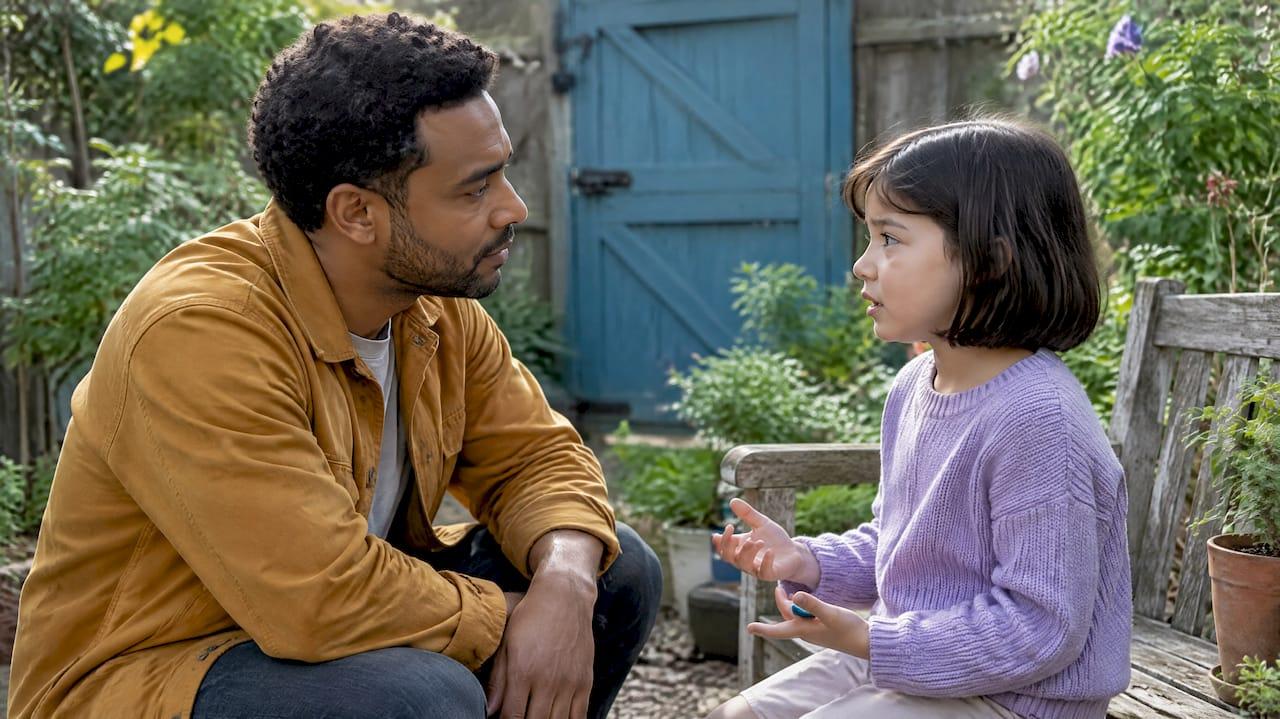
A positive male role model for a child ages 4 to 9 is a man (real or fictional) who shows kindness, honesty, courage and responsibility in ways a child can see, copy and talk about. The best ones are usually close to home: a dad, grandfather, uncle, coach or teacher. Stories, books and shows add more examples. This guide covers the traits that count, where to find good examples, and how to turn stories into everyday conversations.
TL;DR
- Children copy what they see. The most powerful role model is an engaged adult who listens, stays patient, treats people with respect and admits mistakes.
- Parents say kindness, honesty and bravery matter more than flashy heroic traits, according to a 2026 survey of U.S. parents.
- Real figures like Jackie Robinson and Fred Rogers, and fictional ones like Frog and Toad, give kids concrete pictures of good character.
- Stories work best when you talk about them afterward: ask what the character felt and what your child would have done.
- Personalized audio stories can put your own child in the hero's seat, practicing kindness and friendship with no screen.
Table of Contents
- What makes a male role model positive for a young child
- Role models also teach boys how to feel
- Real men kids can learn from
- Fictional heroes who show good character
- Stories about making friends and including others
- How to talk about role models so they stick
- Our perspective
- Bring your child's own hero story home
- A simple weekly routine
- FAQ
- Sources
What makes a male role model positive for a young child
Young children do not judge a role model by fame. They judge by what he does when they are watching. The National Responsible Fatherhood Clearinghouse describes a good male role model as present and engaged, a good listener, patient and gentle, kind and respectful to others, and willing to admit his mistakes. It also says he follows his own rules, so the child sees the same standard applied to adults.
Notice what is missing from that list: muscles, money and winning. Parents seem to agree. In a 2026 Talker Research survey of 2,000 U.S. parents of children ages 4 to 12, bravery (38%), strength (37%), kindness (37%) and honesty (31%) outranked traits like moral righteousness (16%) or being a risk-taker (13%). The same survey found that parents most often define a hero as someone who goes out of their way to help others (58%).
Four traits to look for
When you are choosing which men to point out to your child, or which characters to put in front of them, these four traits cover most of what matters at ages 4 to 9:
- Kindness. He notices when someone is left out or hurting and does something small about it.
- Honesty. He tells the truth, including when he got something wrong.
- Courage. He does the hard or scary thing, and sometimes courage means saying sorry or asking for help.
- Responsibility. He follows through: feeding the pet, showing up, finishing the job.
Responsibility is easy to practice at home. The fatherhood.gov guide gives age-appropriate chore examples: 4- to 5-year-olds can feed the cat and 6- to 7-year-olds can water plants. A child who has a real job, and a man who notices it, is already learning what a dependable person looks like.
Role models also teach boys how to feel
A positive male role model is not only brave and strong. He also shows that feelings are normal and can be shared. The Boys & Girls Clubs of America's Boyhood Initiative says the best way to show a son how to grow into a respectful, healthy, connected person is to model those qualities yourself, including how to share difficult feelings in healthy ways. That gives a boy permission to do the same.
The same guide suggests parents look for role models on and off screen whose behavior is healthy and respectful, and whose interests, jobs and opinions challenge narrow stereotypes. A firefighter who loves to bake, a dad who cries at a sad movie and a coach who praises effort over winning all widen a boy's picture of what a good man can be.
In Talker Research's survey, parents said they are already working on this: teaching their child to express themselves in healthy ways (57%), letting them explore their own interests (55%) and practicing patience in stressful situations (52%). The same poll found 82% of the kids want to be considered a hero someday. That is a strong starting point: children already want to be the kind of person others look up to.

Real men kids can learn from
Real people work well for ages 7 to 9, when children begin to understand that heroes have histories. For younger kids, keep the story short and focus on one trait.
Jackie Robinson
The Jackie Robinson Museum describes him as a natural leader who was kind to others, with integrity, determination, courage and compassion, and says he used his public influence to stand up for what he believed in and help others. For a 6- to 9-year-old, a good question is: "What do you think it took to keep going when people were unfair to him?"
Fred Rogers
Common Sense Media's review of Mister Rogers' Neighborhood says Fred Rogers embodies integrity, friendliness, gratitude, creativity, compassion and empathy. The preschool series, which started in 1968, uses songs, visits with friends and everyday tasks like caring for his goldfish to teach responsibility, overcoming fears and respecting differences. It is a gentle model of a man who is never in a hurry with a child's feelings.
Everyday heroes in a book
Christy Monson's 50 Real Heroes for Boys collects true stories of men who showed integrity, kindness, empathy, courage and respect. It includes Jackie Robinson, Jim Henson, who used humor to uplift millions, and Dav Pilkey, who persevered through dyslexia to become a children's book author. The Pilkey story is a good one for a child who finds reading or school hard.
Fictional heroes who show good character
Fictional men are easier to love at age 4 or 5, and a good story lets a child watch a character make a choice and live with it.
Superheroes
Superman is the obvious place to start. DC lists his powers as super strength, flight, invulnerability and more, along with his everyday identity as Clark Kent, a reporter. The talking point for kids is not the flying. It is that he uses his strength to help. Ask: "Why do you think he is gentle with people who are smaller than he is?"
Marvel describes T'Challa as the king of Wakanda and its ruler and protector, the latest in a legacy line of Black Panther warriors. He is a useful example of a leader whose job is to protect others, which is a different idea of strength from dominating them.
If your child is sensitive and finds loud action stories scary, see our guide to gentle superheroes for sensitive kids.
Gentle book and TV friends
Common Sense Media's list of books with positive role models for boys includes Frog and Toad Are Friends by Arnold Lobel (1970), which spotlights charming, relatable characters and friendship. Its list of TV shows includes Santiago of the Seas, a preschool series that celebrates kindness and teamwork. Neither one needs a cape. A frog who comforts a friend is a perfectly good role model for a 5-year-old.
Stories about making friends and including others
Friendship is where role models do their daily work. A child who has seen a character invite the lonely kid to play is more likely to try it on the playground.
PBS KIDS for Parents says that good friends provide support, and that children learn friendship by practicing being kind, supportive, trustworthy and a good listener. It also suggests pretend play to help children work through exclusion and learn to include others. Act it out with stuffed animals: one animal is left out, and your child decides what happens next.

For older kids, PBS explains that Arthur stories almost always involve friends and offer lessons on resolving differences, handling jealousy and anger, and expressing yourself while being mindful of others. If you want practical ideas beyond stories, these steps to help kids make friends are easy to adapt at home.
Kindness stories where boys help and resolve conflict
When you pick a story, look for these moments rather than a specific title:
- A boy notices someone sad and stops what he is doing.
- A character says sorry first, without being told to.
- Two friends disagree, use their words and both give a little.
- A hero shares the credit or the toys.
We have collected short ideas in five quick kindness superhero stories you can tell at bedtime without any preparation.
How to talk about role models so they stick
A story is only half the lesson. The conversation afterward is where a child connects it to life. PBS KIDS for Parents recommends watching with your child, checking understanding by asking what is happening or what might happen next, then helping the child relate it to their own life with three questions:
- Did that ever happen to you?
- What did you do?
- How did you feel?
The same guide suggests agreeing on "getting along" rules at home: use your words when you are angry, treat each other with respect, listen to each other's ideas, and do not stay angry once the situation is over. Say these rules out loud, and then follow them yourself.
PBS also recommends helping children connect kind behavior with friendship, such as sharing blocks or comforting a friend who is crying. When you see your child do it, name it: "You gave Sam a turn. That was a kind thing to do." The fatherhood.gov guide similarly recommends praising good behavior such as sharing toys and using age-appropriate consequences. It advises against spanking, since it can teach children that hitting is acceptable when angry.
For a deeper approach to this, see our four-step guide to teaching empathy with stories and audio, and our piece on spotting and discussing traits in stories.
For grandfathers and uncles
If you are a grandfather, uncle or family friend, you are exactly the kind of man this article is about. A few small habits count: call regularly, ask about your grandchild's friends by name, tell a story about a time you were scared or got it wrong, and let the child see you say sorry. Distance does not have to get in the way. A shared story, read or listened to on the same day, gives you something to talk about on the phone.
Our perspective
We make personalized superhero audio stories for children ages 4 to 9, and we think about role models every week. Here is what we have learned from building each episode around one child.
A hero is more convincing when the child is the one making the choices. In a generic story, a boy watches Superman be kind. In our episodes, the child hears his own name, his own interests and his own traits, and then hears the hero he is take a kind or brave step. We believe that is a strong way for a child to rehearse the habits we hope he carries into the playground.
Each episode is individually written and produced to weave in the child's real-life details, which goes far beyond inserting a name into a generic script. When a child's hero comforts a friend, shares the credit or tells the truth when it is hard, we hope the child recognizes himself in that choice.
We also believe the best role models are the people in the room. That is why our stories are screen-free and meant to be shared. A dad, a grandfather or a parent can listen along and ask the questions we listed above. The story starts the conversation, and the family finishes it.
JG
Bring your child's own hero story home
If you would like a weekly story where your child is the hero, we create customized superhero podcasts for children ages 4 to 9. Each episode is tailored to the child's name, interests, age and traits, and arrives every Sunday in a private podcast feed sent to your email.

The Bedtime Standard plan is $99 per month. The Grandparent Gift plan is $999 per year, a way for a grandparent to give a grandchild a new adventure every week. Sibling options are available too. See the plans on our home page, or read more about tailored superhero adventures for kids ages 4 to 9. For ideas on other audio, our picks of audio adventures for kids are a good place to start.
A simple weekly routine
You do not need a big program. A routine you will keep up beats a perfect one you drop.
- Pick one trait for the week. Kindness, honesty, courage or responsibility.
- Share one story. A picture book, a short true story about a man you admire, or an audio episode.
- Ask the three questions. Did that ever happen to you? What did you do? How did you feel?
- Give one real job. Feeding a pet or watering a plant fits ages 4 to 7.
- Notice and name it. When you see the trait in your child, say so in one sentence.
For confidence and perseverance, two more guides can help: confidence building stories and resilience stories for kids. If you also have a daughter, our list of superhero stories for girls covers the same ground. And if you want to make stories more instructive, read how to make educational superhero stories teach.
FAQ
What does it mean to be a positive role model?
It means showing, in daily life, the qualities you hope a child will grow into. For young children that means listening, staying patient, treating people kindly and respectfully, and admitting mistakes. Children notice consistency, so what you do when you are tired or frustrated matters most.
Do role models have to be real people?
No. Real people like Jackie Robinson or Fred Rogers offer true stories, while fictional characters like Frog and Toad or a kind superhero let a young child see a choice in action. Mix both, and talk about what the character did and why.
How do I help my son find positive male role models if his dad is not around?
Look at the men already in your child's life: grandfathers, uncles, teachers, coaches and family friends. Add stories and shows that portray kind, respectful men, and encourage regular, simple contact such as calls or shared activities. Youth organizations such as Boys & Girls Clubs can also be a place to start.
What are good traits to talk about with a 4- to 9-year-old?
Start with kindness, honesty, courage and responsibility. Parents in a 2026 national survey ranked bravery, strength, kindness and honesty highest. Pick one trait at a time, and use a short story and a few questions rather than a lecture.
Sources
- 10 Tips for Being a Great Dad, National Responsible Fatherhood Clearinghouse
- Boyhood Stereotypes: Tips for Parents, Boys & Girls Clubs of America
- Student & Family Resources, The Jackie Robinson Museum
- Mister Rogers' Neighborhood, Common Sense Media
- 50 Real Heroes for Boys, Christy Monson
- Superman, DC
- Black Panther (T'Challa), Marvel
- Books with Positive Role Models for Boys, Common Sense Media
- TV Shows with Positive Role Models for Boys, Common Sense Media
- Being a Good Friend and Neighbor, PBS KIDS for Parents
- Getting Along: How Arthur Can Help Your Child Manage Friendships, PBS KIDS for Parents
- Helping Kids Make Friends: Practical Steps for Parents