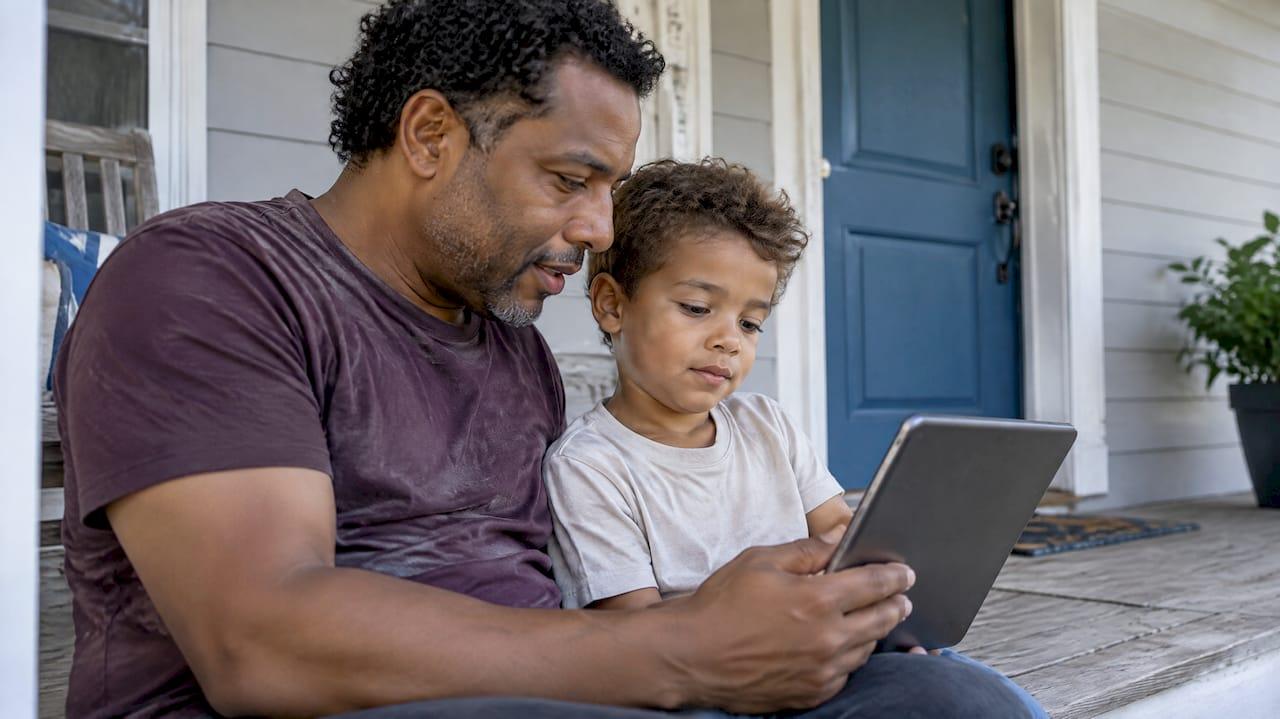
For ages 4 and 5, the American Academy of Pediatrics (AAP) recommends no more than one hour a day of high-quality programming, ideally watched with you. For ages 6 and up, the AAP's 2026 update reportedly drops fixed hour limits. It replaces them with a framework that asks what your child watches, when, and what the screen pushes aside. This guide covers both age bands and how to tell whether your child's screen use is a problem. It ends with routines that work for parents and grandparents.
TL;DR
- Ages 2 to 5: up to 1 hour a day of high-quality programming, co-viewed when you can, per the AAP's 2016 policy statement.
- Ages 6 and older: the 2026 AAP update reportedly replaces hour limits with the 5 C's: Content, Context, Calm, Co-view, Communication.
- Quality and company matter as much as minutes. Co-viewing educational content is different from solo scrolling.
- Protect sleep, play, reading and family time first. Keep screens out of bedrooms and off for the hour before bed.
- Write a simple family media plan and share it with every caregiver, grandparents included.
Table of Contents
- Screen time recommendations by age at a glance
- Ages 4 and 5: one hour, ideally together
- Ages 6 to 9: from minutes to habits
- What counts as screen time?
- The 5 C's, in plain language
- How to tell when screens are crowding out your child's life
- Routines that keep it consistent
- Our perspective
- Choosing what your child listens to and watches
- A screen-free story your child stars in
- FAQ
- Sources
Screen time recommendations by age at a glance
The numbers below cover the ages our families care about most, 4 to 9. They come from the AAP, the main US pediatric source.
| Age | Daily guidance | What to focus on |
|---|---|---|
| 4 to 5 | No more than 1 hour of high-quality programming | Watch together, connect what they see to real life, choose educational and prosocial content |
| 6 to 9 | No fixed hour limit in the 2026 update | The 5 C's, plus at least 1 hour of physical activity and enough sleep |
Two cautions about this table. First, "no fixed limit" does not mean "no limits." It means the limit is built around your child's day instead of a stopwatch. Second, the 2026 update has been covered mostly by parenting sites. Check the AAP's own Screen Time Guidelines page and HealthyChildren.org for current wording. Your pediatrician can tell you what fits your child.
Ages 4 and 5: one hour, ideally together
The AAP's 2016 statement on young children recommends limiting screen use for ages 2 to 5 to one hour a day of high-quality programming. It also recommends that a parent or caregiver co-view, help the child understand what they see, and apply it to the world around them.
That last part is easy to miss. The guidance is not only a cap. It describes how a screen should be used: with you nearby, with a conversation attached, and with content that encourages educational and prosocial behavior.
In practice, for a 4- or 5-year-old:
- Count the hour across all devices. TV, tablet, phone and video games all share it.
- Pick one or two shows you have previewed, rather than letting autoplay choose.
- Ask one question afterward. "What did the character do when she got scared?" turns watching into talking.
- Keep a few anchor times screen-free, such as meals and the lead-up to bed.
We have a longer walkthrough in how to limit screen time for your 5-year-old.
Ages 6 to 9: from minutes to habits
The AAP's 2016 statement for school-aged children did not set a single daily number either. It said that children 6 and older should get at least 1 hour of daily physical activity and 8 to 12 hours of sleep depending on age, and that screens should not crowd these out.
In February 2026 the AAP reportedly went further. According to one summary of the update, it eliminated specific time limits for ages 6 and older while keeping the one-hour limit for ages 2 to 5. In their place is a framework called the 5 C's. The same summary quotes Dr. Libby Milkovich, a developmental and behavioral pediatrician who co-authored the guidance. She says how children use screens matters more than how long, and that two hours of co-viewing educational content with a parent differs fundamentally from two hours of solo scrolling.
For a 7-year-old, that means a Saturday of watching a nature series with you and then building a fort based on it is not the same as an hour alone with an endless feed. The first adds to the day. The second may take over from other things.

What counts as screen time?
The AAP notes that children use screens for school, connecting with family and friends, games, videos, learning hobbies and more. Its guidance says to consider the quality of interactions with digital media, not only the amount of time.
A workable way to sort it:
- Connection: a video call with a grandparent. Most families treat this differently from entertainment.
- Learning and creating: a school assignment, a drawing app, an educational program watched together.
- Passive entertainment: shows, videos and games. This is where the one-hour guidance for ages 2 to 5 applies most.
- Background screens: a TV that no one is watching. The 2026 guidance, as summarized by one family-tech site, recommends "one screen at a time" and turning the TV off when no one is actively watching.
The 5 C's, in plain language
The AAP explains its approach on HealthyChildren.org. Here is how to use each C at home.
Content. Content quality shapes whether kids have a positive or negative relationship with media. The AAP asks parents to help children spot content with too much violence, rude role-modeling, unrealistic beauty standards or commercialism. One 2026 summary describes high-quality content as media that models social-emotional skills, includes age-appropriate learning goals and leaves room for creativity.
Context. Where and when a screen is used counts. A tablet at the dinner table is different from a tablet on a car ride.
Calm. All kids need strategies for handling big feelings and falling asleep. The AAP notes that media can become a child's main go-to. If that happens, it suggests talking with friends, your pediatrician, a therapist or other supports about other ways to settle down.
Co-view. Watching together is one of the most consistent themes. The same 2026 summary says co-viewed content has measurably better developmental outcomes than solo viewing.
Communication. Keep talking about what they see and how to be safe and kind online. The AAP's 2016 school-age statement recommends ongoing conversation about online citizenship and safety, including respect, privacy and being wary of online solicitation. It also suggests building a network of trusted adults, such as aunts, uncles and coaches, whom children can turn to.
How to tell when screens are crowding out your child's life
The AAP asks families to think about what media is displacing. Its list includes family time, sleep, outdoor play and reading. It also says to help kids see that digital media has "hooks" that keep them online longer than intended, as described in the 5 C's guidance.
Watch for these signs:
- Sleep: the AAP notes that children with too much media exposure or devices in their bedrooms fall asleep later and sleep less, and that screen light and stimulating content can disrupt sleep.
- Activity: the same page notes that watching TV more than 1.5 hours daily is a risk factor for obesity in children ages 4 through 9.
- School and focus: multitasking with entertainment media during homework can hurt school performance, according to the same source.
- Mood and calming: your child cannot settle without a screen, or melts down when it ends every time.
- Family life: screens appear at every meal, car ride and quiet moment.
If you see several of these, talk to your pediatrician. Dr. Milkovich also reminds parents that the old advice has become almost impossible to follow and that the pressure should not rest only on parents. The AAP frames the fix as crowding in good things: sleep, outdoor play, reading, sports and family time get their share first.
Routines that keep it consistent
The AAP suggests that families develop, follow and regularly revisit a Family Media Use Plan. The plan covers the type and amount of media and appropriate behavior. It should also be shared with other caregivers so the rules hold at grandma's house and at the sitter's. HealthyChildren.org offers a free Family Media Plan tool.
A starter plan:
- Pick the screen-free zones. The AAP suggests bedrooms and mealtimes, especially the last hour before bed.
- Keep devices out of bedrooms. The AAP advises no TVs, computers or smartphones where children sleep, and no screens for 1 hour before bedtime.
- Add homework to the list. The 2026 guidance, in one summary, names mealtimes, bedrooms, the hour before bed and homework time as phone-free zones.
- Plan the replacement. A screen-free slot needs something in it. See our screen-free family time starter plan and 12 screen-free activities for kids.
- Build a bedtime ritual. Our 7-night ramp for screen-free bedtimes shows one way to start.
- Check parental controls on every device, including tablets and consoles, as the 2026 guidance recommends.
- Revisit the plan every few months as your child grows.
Mornings are the other tricky spot. Our screen-free morning routine plans are built for school days.
Our perspective
We built G45-hero-cast around one idea: a child's wind-down time should feel like an event, not a negotiation. Every Sunday, a new audio adventure arrives in a private podcast feed, and your child is the hero.
Pediatric guidance keeps pointing to the same things: quality over minutes, doing things together, and protecting sleep and family time. Audio fits that picture well. There is no screen to light up the room before bed, and a story can be a shared moment on the couch or in the car.
We write and produce each episode individually, using your child's real details and interests, not just their name dropped into a generic script. That is our own approach, and it is why children ask for the next one.
Grandparents are some of our favorite listeners. A story starring a grandchild, delivered weekly, gives them a way to be present between visits. We also hear that it gives parents a ready answer to "what can we do instead?"
Screen-free does not have to mean boring. It has to mean something your child is excited to come back to.
JG
Choosing what your child listens to and watches
The AAP's co-viewing advice works for audio and music too. Preview before you play, listen together at least some of the time, and ask your child what they think of it. If music is part of your family's routine, this guide on picking songs families love shows one approach to choosing children's entertainment and helping kids understand what they hear.
For a side-by-side look at audio and video, read podcasts vs. TV for kids. To pick a show for your child's age, use our 6-step checklist for choosing a kids podcast. If attention is a concern, see how to reduce screen time for kids with ADHD. For a longer look at what a lower-screen routine can feel like, see our take on reducing kids' screen time.
A screen-free story your child stars in
If you are building the bedtime or car-ride slot from the plan above, our weekly personalized superhero podcasts are made for children ages 4 to 9. Each episode is written around your child's name, interests, age and traits, and arrives every Sunday in a private podcast feed. Options for siblings and gift plans are available.
Bedtime Standard is $99 per month. Grandparent Gift is $999 per year, for grandparents who want to give a grandchild a weekly adventure. See both on the G45-hero-cast plans page.
FAQ
How much screen time should a 5-year-old have?
The AAP's 2016 guidance recommends no more than one hour a day of high-quality programming for ages 2 to 5, with a parent or caregiver watching along. Less is fine. Try to pick content that is educational and encourages kindness.
Is there a daily limit for kids 6 to 9?
The AAP's 2026 update reportedly removes fixed hour limits for ages 6 and older and uses the 5 C's instead, according to this summary. The AAP still wants screens to leave room for at least one hour of physical activity and 8 to 12 hours of sleep, depending on age.
Do educational apps and shows count?
Yes, they are still screen time, but quality matters. The AAP says to look at the quality of interactions with digital media as well as the minutes. Watching together makes educational content more valuable.
When should screens stop before bed?
The AAP advises no screens for 1 hour before bedtime and no TVs, computers or smartphones in children's bedrooms. A story, a bath routine or quiet audio can fill that last hour.
How do I keep grandparents on the same page?
Share your family media plan with them. The AAP recommends communicating guidelines to other caregivers so rules stay consistent. Offering grandparents a screen-free activity, such as a shared story or a game, makes the rules easier to keep.
Sources
- Media and Young Minds, Pediatrics (AAP, 2016)
- Media Use in School-Aged Children and Adolescents (AAP policy statement, 2016)
- Media Use in School-Aged Children and Adolescents (full text)
- Screen Time Guidelines (AAP)
- Kids & Screen Time: How to Use the 5 C's of Media Guidance (HealthyChildren.org)
- Helping Kids Thrive in a Digital World (HealthyChildren.org)
- Constantly Connected: How Media Use Can Affect Your Child (HealthyChildren.org)
- How Much Screen Time Is Too Much? Recommended Limits by Age
- How Much Screen Time Is Okay for Kids in 2026?
- The AAP Screen Time Guidelines 2026: A Parent's Guide