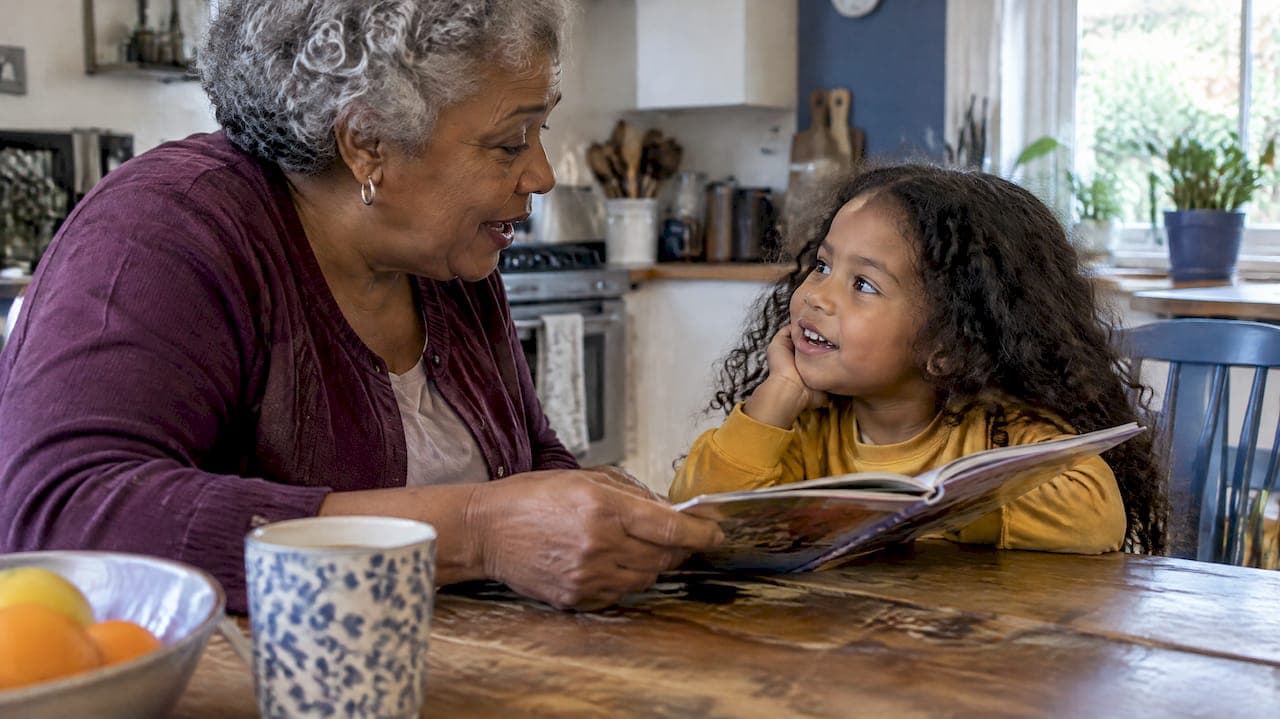
The simplest way to give a child weekly stories is to pick one regular time, choose a story format that suits their age, and keep it small enough that you never skip it. That can be a library picture book every Friday, a family story night, or a new audio adventure that arrives every Sunday. This guide covers what works for ages 4 to 9, where to find free stories, and when a paid weekly story is worth considering.
TL;DR
- Choose one fixed night and one fixed spot. Consistency matters more than length or variety.
- For ages 4 to 9, mix formats: read-aloud picture books, audio stories, and stories the family makes up together.
- Libraries and free digital collections can cover a weekly habit at no cost.
- A personalized weekly story, where the child is the hero, adds excitement and works well as a screen-free gift.
- Short is fine. A story that gets finished beats a long one that gets abandoned.
Table of Contents
- Why a weekly story is worth the effort
- What kinds of weekly stories suit ages 4 to 9
- Four ways to share a weekly story
- How to set up a weekly story routine
- Our perspective: why we make the child the hero
- When a free routine is enough, and when a paid story helps
- Our weekly personalized superhero podcast
- Making the weekly story stick
- FAQ
- Sources
Why a weekly story is worth the effort
Parents and grandparents often ask whether a story once a week really matters when school already covers reading. It does, in a different way. A story shared out loud is a conversation as much as a text.
Reading Rockets, a national literacy project, describes reading aloud as the single most important activity for reading success. The same page explains that stories expose children to vocabulary and language patterns and help them connect what they hear to their own lives. Listening to a story also asks a child to build pictures in their head, which is a skill that supports comprehension later.
There is a family side too. PBS KIDS for Parents notes that sharing stories can help children develop listening and communication skills, imagination, and memory. None of that requires a perfect performance. It requires showing up at the same time each week.
For children who are already reading on their own, listening still pays off. Read-alouds let a child meet words and sentence structures above the level they can decode alone. Reading Rockets makes this point for kindergarten through second grade: read-alouds of complex texts expose children to words, expressions and grammatical constructions they will meet later in written texts. So a seven-year-old who reads fluently still benefits from being read to.
What kinds of weekly stories suit ages 4 to 9
The right story depends less on a child's exact age than on what holds their attention. Still, some patterns help when you are choosing.
Ages 4 to 5: short, rhythmic, repetitive
Young listeners love repetition, refrains, and animals or characters who do silly things. Reading Rockets' list of great read-alouds for kindergarteners includes chants, gentle humor, and stories about everyday feelings, which gives you a good picture of the style. Stories at this age can run just a few minutes.

Ages 6 to 7: more plot, still short
Children in first and second grade can follow a beginning, middle and end with a small problem to solve. Picture books with richer language work well here, as do the first chapters of a longer book that you read one chapter per week. A weekly chapter also builds anticipation, because the child has seven days to wonder what comes next.
Ages 8 to 9: adventure, mystery, humor
Older kids want stakes. Mystery, adventure, and funny stories hold them, and so do stories with characters who face real worries. A child this age may also prefer audio, because it feels more grown-up than a picture book. If your child is nearing the upper end of this range, our guide to podcasts for 8 to 10 year olds shows what to look for.
How to match a story to your child
The U.S. Department of Education's regional lab for the West notes that when choosing storybooks, you should look for engaging events and characters, rich language, and stories that reflect children's lives and experiences. That last point is the easiest to use at home. If your child loves trucks, dinosaurs, soccer, or a new baby sibling, start there.
Reading Rockets also cautions against locking children into assigned levels. Its guidance says that limiting students to set reading levels can restrict their chance to meet complex content and sophisticated language, and recommends access to texts at a range of levels guided by interest and knowledge. For a listening routine, that means you can choose stories a little above what your child could read alone.
Another useful idea comes from Barton and Booth (1990), cited by Reading Rockets: children need to see characters handling the same fears, interests and concerns they experience to build meaningful connections. A story about a nervous first day of school lands differently for a child who is about to have one.
How long should a weekly story be
Longer is not better. Plenty of children this age listen happily to a story of around five to ten minutes. We wrote about this in more detail in why 500 words can be enough for kids. If your child asks for "one more" at the end, that is the sign you picked the right length.
Four ways to share a weekly story
A good routine usually blends a few formats. You do not have to choose only one.
| Format | Best for | Cost | Effort for the adult |
|---|---|---|---|
| Library picture books or chapter books | Ages 4 to 9, building a reading habit | Free with a library card | Medium: choosing and reading aloud |
| Free digital story collections | Rainy days, travel, backup option | Free | Low to medium |
| Family-made stories | Every age, great for car rides and dinner | Free | Medium: needs a bit of imagination |
| Audio stories or podcasts | Bedtime, quiet time, screen-free evenings | Free to paid | Low |
Read-alouds from the library
U.S. libraries are the best starting point. The American Library Association reports that libraries provide free access to books, online resources and family programming, along with guidance for parents and caregivers on early learning. A weekly library trip can itself be the ritual: the child chooses one book, you read it on the same night every week.
Free digital collections
The Association for Library Service to Children keeps a page of free digital media resources for children. It lists collections such as the Internet Archive Children's Library, the Project Gutenberg Children's Bookshelf, and the International Children's Digital Library. These are handy when you want a story right now and the library is closed.
Family story night
A family story night means everyone takes a turn. One person starts a story with a sentence, the next adds another, and the plot gets sillier. Kids also enjoy retelling a favorite story with a twist, such as changing the ending or the setting. For grandparents, stories from their own childhood are a gift no book can match.
To keep it going, end with one question that invites discussion. The Department of Education's guidance recommends text-based questions that invite critical thinking and authentic discussion. At home that can be as simple as asking, "What would you have done?" or "Which part was your favorite?"
Audio stories and podcasts
Audio is the easiest format to repeat every week, because the adult does not have to read. Children close their eyes, imagine, and wind down. ALSC also keeps a podcast advisory listing family-listening shows, including free shows and curated youth podcasts, which is a good place to find what is out there.
If you are unsure whether your child is ready, see our guide on the best age for podcasts. For younger listeners, our picks for preschoolers can help.
How to set up a weekly story routine
A routine only works if it is easy. Here is a simple way to build one.
- Pick the night. Choose one evening that is usually calm. Sunday works for many families because it sets up the school week. Some prefer Friday, when there is no early alarm.
- Pick the spot. A couch, a bed, a blanket fort. The place becomes a cue for the child that story time is starting.
- Set a time limit. Aim for five to fifteen minutes. A short story you always do beats a long one you skip.
- Let the child choose sometimes. Alternate between a story you pick and a story they pick. Ownership keeps older kids interested.
- Add one question. Ask about a feeling, a choice, or a favorite moment. That turns listening into conversation.
- Keep screens out. A phone or tablet invites scrolling. A speaker, a printed book, or an audio-only device keeps attention on the story.
- Protect it. Treat the weekly story like a standing appointment. If you miss a week, restart the next one without guilt.
If evenings feel flat or stressful, our post on making evenings fun with personalized stories has more ideas. If your child gets anxious at lights-out, see these short bedtime scripts and screen-free audio for anxious kids. And if you want other ideas beyond books, try alternatives to bedtime stories.
Our perspective: why we make the child the hero
We build weekly stories for a living, so we are not neutral. Here is what we have learned from it.
The biggest pull for a child is recognition. When the main character has your name, your pet, your favorite snack, and your fear of the dark, the story stops being something you watch and becomes something that happened to you. Barton and Booth's point about children needing to see their own concerns in characters is, to us, the whole idea in one sentence.
We also think "personalized" is often done lazily. Dropping a child's name into a generic script is not personal. Each of our episodes is written and produced individually, using the child's real-life details and interests, so the story fits that child and not a template. A child who loves soccer and is nervous about swim lessons gets a different adventure from a child who loves dinosaurs and is learning to share.

The second thing we care about is screen-free time. Many parents we serve want fewer devices in the evening, not another app. Audio gives a child a rich story with nothing to look at, and it leaves the adult free to sit next to them, which is the point. Our aim is better family time and a small jolt of excitement every week as each child becomes the hero of their own podcast.
We do not think a personalized story replaces library books or a grandparent's tall tales. It sits beside them. Read a picture book on Wednesday, tell a made-up story in the car, and let the Sunday episode be the one your child waits for.
— JG
When a free routine is enough, and when a paid story helps
Free is a perfectly good answer. A library card, a free digital collection, and ten minutes a week will build a strong habit. If that is working for your family, keep going.
A paid weekly story tends to make sense in a few situations:
- Your child is hard to engage. A story starring them is often the thing that gets a reluctant listener to sit down.
- You are short on time. A new episode arriving on a schedule removes the weekly search for something to read.
- You want a screen-free option. Audio keeps the evening device-free.
- A grandparent lives far away. A gift subscription gives them a weekly way to be present in a grandchild's life.
- Siblings want their own story. Each child can have their own episode, so nobody feels left out.
If listening skills are a goal, you can also pair stories with a few habits, which we cover in building active listening with podcasts for ages 4 to 9. For children working on speech and language with a professional, see our notes on listening stories for speech practice. Your child's speech-language pathologist is the right person to say what practice suits your child.
Our weekly personalized superhero podcast
Our weekly superhero podcasts are made for children ages 4 to 9. Each episode is customized to the child's name, interests, age, and personality, and is delivered every Sunday by email to a private podcast feed that only your family can use. You can choose a monthly or annual plan, and we have options for siblings and gifts.
There are two plans:
- Bedtime Standard: $99 per month.
- Grandparent Gift: $999 per year.
You can see both on our site, where you can subscribe and set up your child's hero.
Making the weekly story stick
A few last habits make the difference between a routine that lasts a month and one that lasts a year.
- Anchor it to something that already happens. After bath, after dinner, after brushing teeth. The story rides along on a habit that is already there.
- Let kids repeat favorites. Children ask for the same story again and again, and that repetition is good for them. Do not rush to new material.
- Rotate the format. A book one week, an audio story the next, a family-invented tale on a road trip. Variety keeps the ritual fresh.
- Look for the age sweet spot. The same story can be a toddler-style giggle at four and a deep adventure at nine. Let your child's reaction guide you.
- Match the moment. Some stories fit calm bedtime, others suit car rides or rainy afternoons. Our guide to family podcast listening by age and moment breaks this down.
For grandparents who live far away, the routine can be shared. Pick the same night, then call afterward to ask what the child liked best. That small phone call turns a story into a weekly connection.
FAQ
How often should kids have stories?
Daily is wonderful if your family can manage it, but a once-a-week story is a real and valuable habit. Choose one night, keep it short, and protect it. If you want more, add a quick bedtime read on other nights.
Where can I find free weekly stories for kids?
Start with your local library, which offers free books, online resources, and family programs. The Association for Library Service to Children also lists free digital collections, such as the Internet Archive Children's Library and the Project Gutenberg Children's Bookshelf. Many libraries also share family-friendly podcast recommendations.
Are audio stories as good as reading a book?
They do different jobs. Books give children print, pictures, and a shared page to point at, while audio builds listening and imagination. Most families do best with a mix of both.
What if my child won't sit still for a story?
Shorten it and let the child move, draw, or play quietly while listening. A story with the child as the main character often helps, because they want to hear what happens to them. If listening difficulties seem to go beyond ordinary wiggles, talk with your child's pediatrician or teacher.
Sources
- Reading Aloud to Build Comprehension | Reading Rockets
- Guidance for Educators Using a Balanced Literacy Program | Reading Rockets
- Great Read Alouds for Kindergarteners | Reading Rockets
- Reading and Sharing Stories | PBS KIDS for Parents
- Joyful Reading and Creative Expression with Young Children | IES REL West
- State of America's Libraries Report 2019 | American Library Association
- Digital Media Resources | ALSC